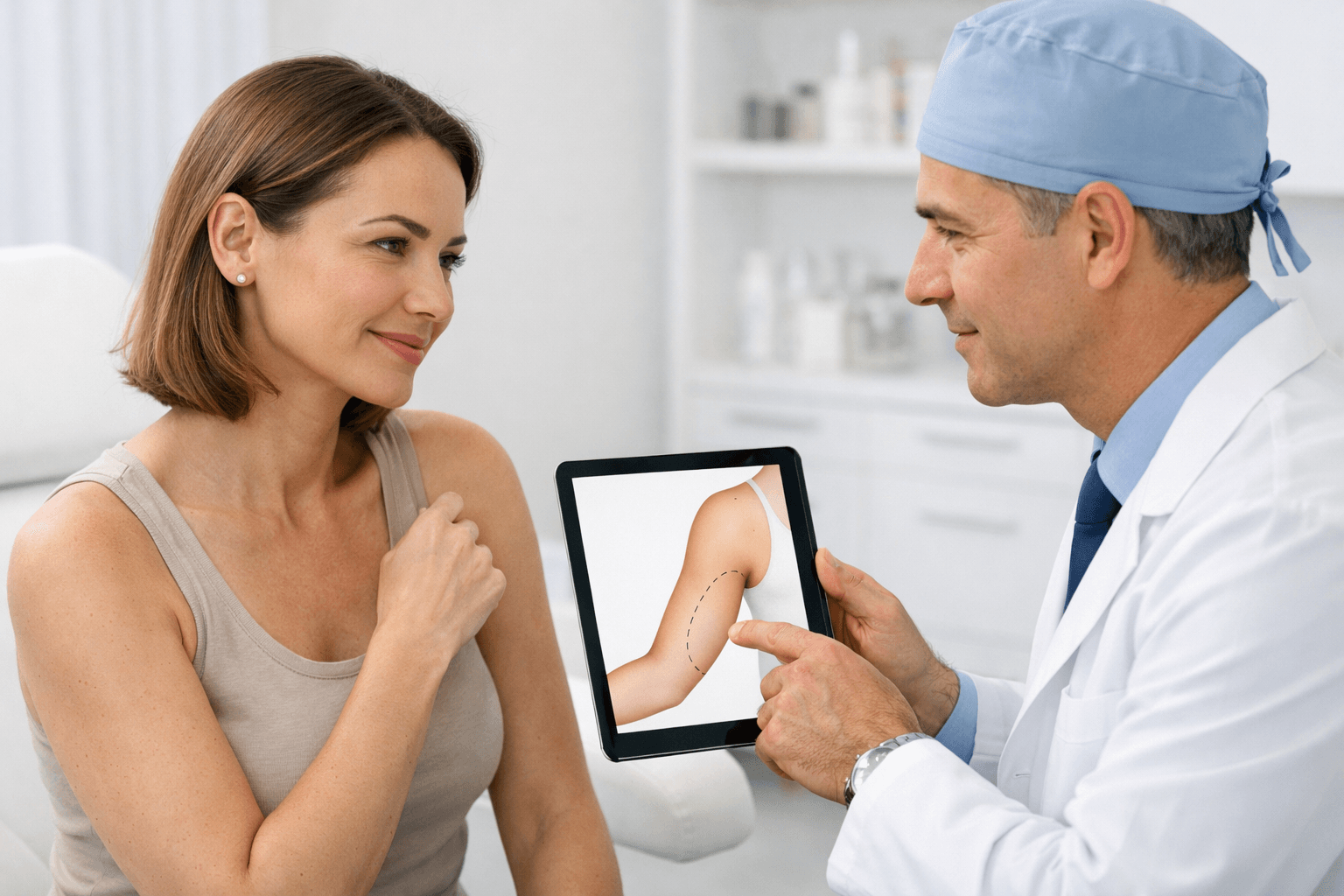
When the upper arms appear fuller, soft, or loose, many people ask whether an arm lift or liposuction would produce a better result. The answer depends on what is creating the contour concern: localized fat, excess skin, reduced skin elasticity, or a combination of these factors.
Upper-arm liposuction primarily removes unwanted fat beneath the skin. An arm lift, also called brachioplasty, removes redundant skin and reshapes the upper arm. In some cases, both procedures may be considered together. Neither treatment is universally better, and the most appropriate option can only be determined after an assessment by a qualified plastic surgeon.
At Estexper Clinic, international patients can discuss their concerns, medical history, skin quality, expectations, and treatment goals during an individual consultation. This article explains the main differences between arm lift surgery and upper-arm liposuction so you can prepare more informed questions for your consultation in Turkey.
What Is the Difference Between an Arm Lift and Arm Liposuction?
The key difference is that liposuction targets fat, while an arm lift targets excess skin. Although both procedures can improve the appearance of the upper arms, they are designed for different anatomical concerns.
Upper-arm liposuction
Liposuction uses small incisions and a cannula to remove localized deposits of subcutaneous fat. It may be suitable when the main issue is fullness in the upper arms and the skin still has enough elasticity to adapt to the reduced underlying volume.
Liposuction does not directly remove hanging or redundant skin. If the skin is significantly stretched or has limited ability to contract, removing fat alone may leave the arm looking loose or may not create the improvement the patient expects.
Arm lift surgery
An arm lift removes excess skin from the upper arm and reshapes the contour. It is generally the more definitive option when loose or hanging skin is the dominant concern. An arm lift may be considered after substantial weight loss, with marked age-related skin laxity, or when the skin excess is too significant to be addressed by liposuction alone.
Liposuction may also be included in an arm lift when both excess fat and loose skin are present. The exact approach depends on the amount and location of fat, the distribution of skin laxity, and the quality of the skin.
Arm Lift vs Arm Liposuction: Which Problem Does Each Treat?
| Concern | Usually more relevant | Why |
|---|---|---|
| Localized upper-arm fat with firm or relatively elastic skin | Arm liposuction | It removes targeted fat without requiring a long skin-excision scar. |
| Hanging or redundant upper-arm skin | Arm lift | It directly removes excess skin and reshapes the arm. |
| Significant weight-loss-related skin excess | Arm lift, sometimes with liposuction | Skin removal is usually the central part of treatment when laxity is substantial. |
| Fat combined with noticeable skin laxity | Combined approach may be considered | Fat reduction and skin excision may address different parts of the contour concern. |
This comparison is a general guide rather than a diagnosis. Two people with a similar arm circumference may need different procedures because skin thickness, elasticity, fat distribution, age, previous weight changes, and expectations can vary considerably.
Who May Be a Candidate for Upper-Arm Liposuction?
Upper-arm liposuction may be considered for adults with localized fat in the upper arms and relatively good skin elasticity. The amount of loose skin should be minimal or mild enough that the skin may adapt to the new contour. A patient should also have realistic expectations about what fat removal can and cannot achieve.
Liposuction is not a direct treatment for significant hanging skin. If the skin has been substantially stretched, removing the underlying fat may not adequately correct the looseness. In selected patients with mild-to-moderate laxity, some skin contraction may occur after liposuction or energy-assisted liposuction. However, the available evidence for these approaches is mainly based on observational studies and small trials. They should not be presented as equivalent to surgical skin excision for substantial skin excess.
Who May Be a Candidate for an Arm Lift?
An arm lift may be more appropriate when excess skin is clearly visible, hangs from the upper arm, or remains after substantial weight loss. It may also be considered when age-related changes have reduced the skin’s ability to retract after fat reduction.
Because an arm lift involves skin removal and a longer incision, the decision includes both the expected contour benefit and the patient’s willingness to accept a visible scar. The surgeon will assess the location and severity of the laxity, the amount of fat, skin quality, previous operations, general health, and treatment expectations.
An arm lift is not automatically the best choice for every patient with fuller arms. If skin laxity is limited and fat is the main concern, a surgeon may recommend liposuction rather than skin excision. Conversely, liposuction alone may be insufficient when the primary problem is loose skin.
What Happens During Each Procedure?
Upper-arm liposuction procedure
During liposuction, the surgeon makes small access incisions and uses a cannula to remove selected areas of subcutaneous fat. The treatment plan is designed around the distribution of fullness and the desired arm contour. The procedure does not involve cutting away a strip of redundant skin.
Some liposuction techniques use additional energy to support tissue tightening. However, the suitability and effectiveness of these methods depend on patient selection and the specific technology used. Current evidence does not establish that liposuction-based skin-tightening methods replace brachioplasty when there is substantial excess skin.
Arm lift procedure
During brachioplasty, the surgeon removes redundant skin and reshapes the upper arm. Liposuction may be added if localized fat is also present. The incision is longer and more visible than the small access incisions used for liposuction because skin excision requires a surgical line along the arm.
There is no single technique that is proven to be universally superior for every patient. The surgical approach is selected according to the extent of fat excess, skin laxity, and the location of the tissue that needs to be removed or reshaped.
Scars, Recovery, and Aftercare
Scarring is one of the most important differences between the procedures. Liposuction generally involves small incisions, while an arm lift produces a longer scar because redundant skin is removed. The final appearance of any scar can vary according to individual healing, skin characteristics, incision placement, and aftercare. A surgeon should explain where the scar is expected to lie and how visible it may be.
After either procedure, patients should follow the specific instructions provided by their surgical team. These instructions may address wound care, compression garments, activity, bathing, medication, and follow-up appointments. The appropriate recovery plan depends on the procedure performed and the individual patient’s condition.
International patients planning treatment in Turkey should allow time for preoperative assessment, the procedure, early follow-up, and clearance from the treating team before travelling home. Travel arrangements should not be finalized without discussing the expected schedule and follow-up requirements with the clinic. Patients should also provide accurate information about medications, previous operations, allergies, health conditions, and any relevant history of wound-healing problems.
After returning home, patients should know how to contact the clinic and should arrange appropriate local medical support if advised. Any unexpected or worsening symptoms should be reported promptly to the treating team or a qualified local healthcare professional.
Risks and Important Trade-Offs
Every surgical procedure has potential risks, and the risks should be discussed during an individual consultation. An arm lift may involve bleeding, seroma, infection, wound-healing problems, sensory changes, pain, damage to nerves or blood vessels, fat necrosis, unsatisfactory scarring, and possible revision surgery. Anesthesia-related risks may also apply.
Liposuction also has procedure-specific risks and limitations that should be discussed with the treating surgeon. Results may be affected by factors such as the amount and distribution of fat, skin elasticity, healing, and the individual treatment plan. Liposuction does not directly remove redundant skin and may not produce the desired contour when skin laxity is substantial.
The main trade-off is often between the degree of skin correction and the visibility of the scar. An arm lift can provide more direct correction of substantial loose skin, but it requires skin excision and leaves a longer scar. Liposuction may involve less visible incisions, but it cannot directly remove redundant skin.
Can Liposuction and an Arm Lift Be Combined?
When both localized fat and significant loose skin are present, a combination of liposuction and brachioplasty may be considered. Liposuction can address fullness in selected areas, while the arm lift removes the excess skin that cannot be corrected through fat removal alone.
A combined approach is not suitable for everyone. The surgeon must consider the amount of tissue involved, skin quality, healing factors, overall health, and the safety of the proposed treatment. The final plan should be individualized rather than selected solely because it appears more comprehensive.
Which Option Is Better After Major Weight Loss?
After substantial weight loss, the dominant concern is often redundant skin rather than isolated fat. In this situation, an arm lift may be more appropriate than liposuction alone because the procedure directly removes the excess skin. Some patients may still have areas of residual fat, in which case liposuction may be incorporated into the surgical plan.
However, a history of weight loss does not automatically determine the procedure. The surgeon must examine the current distribution of fat and skin, the stability of the patient’s weight, and the patient’s goals. A consultation is essential before making a decision.
Questions to Ask During Your Consultation
- Is my main concern localized fat, loose skin, or both?
- How much skin elasticity do I have?
- Would liposuction alone risk leaving noticeable laxity?
- Where would an arm-lift scar be placed, and how long might it be?
- Could a combined procedure be appropriate for my anatomy?
- What risks are particularly relevant to my medical history?
- What follow-up and aftercare would I need if I return home after treatment in Turkey?
- What changes should I realistically expect from the recommended procedure?
So, Is an Arm Lift or Liposuction Better?
There is no universal winner in the comparison of arm lift vs arm liposuction. Liposuction is generally better suited to localized upper-arm fat when skin elasticity is adequate and skin excess is limited. An arm lift is usually more appropriate when loose or hanging skin is the main concern, particularly after substantial weight loss or with marked laxity.
When both fat and skin excess are present, a combination may be discussed. The most appropriate choice depends on a professional assessment of your anatomy, health, expectations, and willingness to accept a scar. A qualified plastic surgeon should explain the available options, potential limitations, risks, and aftercare before you make a decision.
Medical References
- Arm Contouring: Review and Current Concepts — PubMed; Aesthetic Surgery Journal.
- Complications associated with brachioplasty: a literature review — Plastic and Reconstructive Surgery Global Open; PubMed Central.
- Arm Lift — American Society of Plastic Surgeons.
- Arm Lift Risks and Safety — American Society of Plastic Surgeons.
- Liposuction Handbook — American Society of Plastic Surgeons.
- Clinical Efficacy Analysis of Circumferential Upper Arm Liposuction with Double Incision: A Study of 496 Cases — Aesthetic Plastic Surgery; PubMed.