Written by: Estexper Medical Editorial Team
Medically reviewed by: Mehmet Kaya, MD
Internal hernia after gastric bypass is an uncommon but potentially life-threatening complication that requires prompt medical assessment. It can develop months or even years after Roux-en-Y gastric bypass (RYGB), including when mesenteric defects were reportedly closed during the original operation.
In Short
After RYGB, intermittent or severe unexplained abdominal pain can be caused by an internal hernia, which may lead to bowel obstruction or loss of blood supply to the bowel. In stable patients, CT of the abdomen and pelvis with intravenous contrast is usually the preferred initial test, but a normal or unclear CT does not reliably exclude the condition. Severe, persistent or worsening pain, vomiting, obstruction symptoms, or clinical deterioration require urgent medical assessment and may require surgical exploration.
The symptoms may be sudden and severe, but they can also be intermittent, vague or limited to unexplained abdominal pain. Because the anatomy has been changed by bypass surgery, diagnosis may be challenging. A contrast-enhanced CT scan is usually the preferred first imaging test in a stable patient, but a normal or unclear scan does not always exclude an internal hernia.
This guide from Estexper Clinic explains the symptoms to watch for, what doctors look for on CT, and when emergency surgical exploration may be necessary. It is general medical information and does not replace an examination by a qualified physician.
What is an internal hernia after gastric bypass?
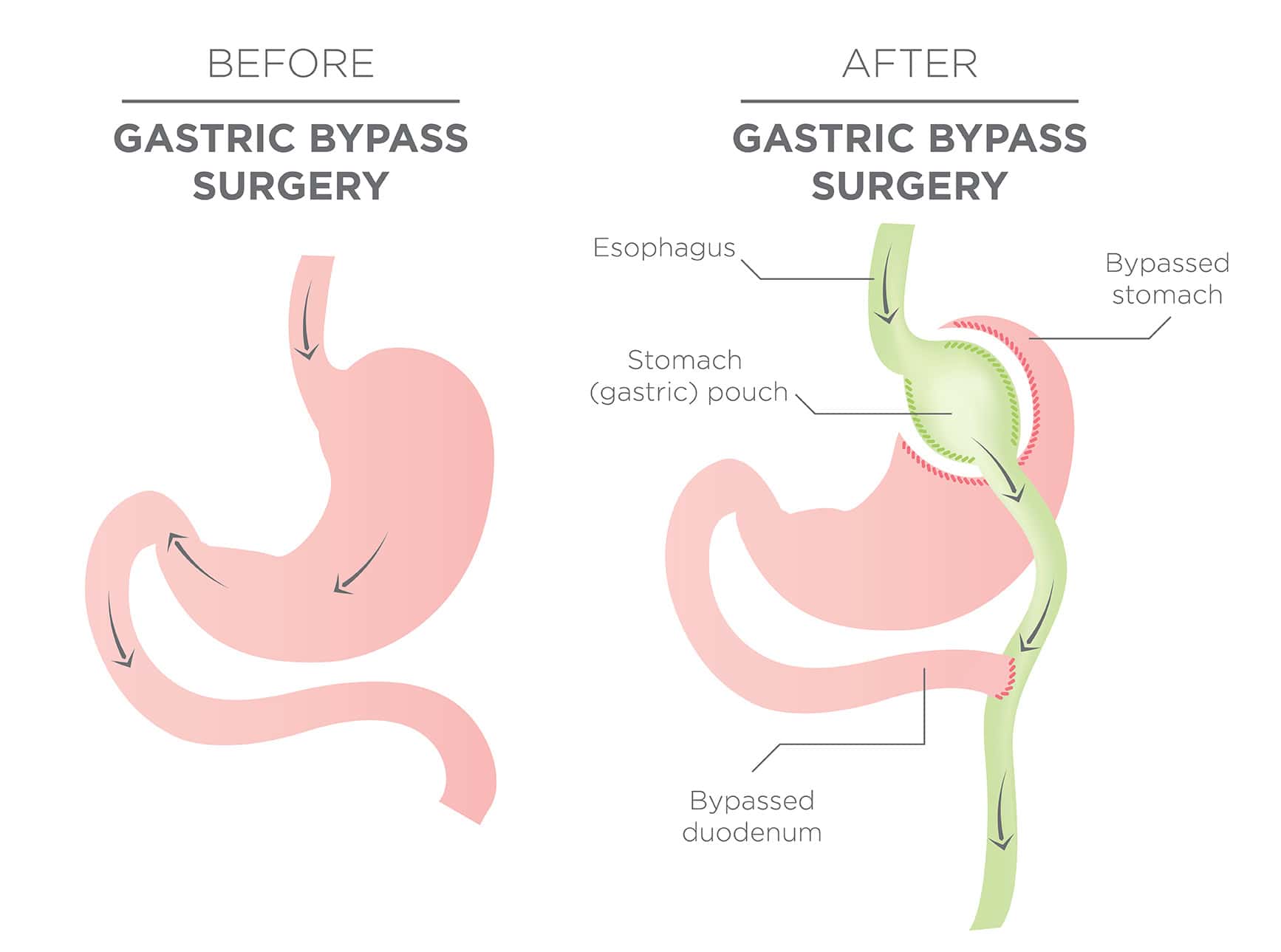
An internal hernia occurs when part of the small intestine moves through an opening inside the abdominal cavity. After RYGB, changes to the position of the small bowel and its supporting tissues can create potential spaces called mesenteric defects.
Two important locations are Petersen’s defect and the defect near the jejunojejunostomy, where sections of the small intestine are surgically connected. A loop of bowel may pass through one of these spaces, potentially causing a closed-loop obstruction or twisting of the mesentery.
If blood vessels are compressed, the bowel can lose its blood supply. This may lead to strangulation, ischemia, necrosis and, in severe cases, the loss of a significant length of small bowel. For this reason, suspected RYGB-associated small-bowel obstruction is generally treated as a surgical emergency.
Why internal hernia can be difficult to recognize
Internal hernia does not always cause the classic pattern of continuous vomiting, abdominal distension and complete bowel obstruction. The bowel may move in and out of the defect, producing symptoms that come and go. Some patients experience recurrent post-meal discomfort or unexplained abdominal pain for a period of time before an acute episode develops.
The pain may be colicky, severe, centrally located or spread across the abdomen. It can sometimes radiate toward the back. Nausea, vomiting, bloating and diarrhea may occur, but their absence does not rule out the diagnosis. Laboratory tests can also be unremarkable early in the course.
Previous closure of mesenteric defects reduces risk but does not make internal hernia impossible. Anyone with a history of RYGB and new, severe or unexplained abdominal pain should make sure the treating team knows about the previous bypass operation.
Symptoms of internal hernia after gastric bypass
Symptoms can vary widely from one person to another. Important warning signs include:
- Sudden, severe or worsening abdominal pain
- Intermittent or colicky abdominal pain without a clear explanation
- Pain that appears after eating or repeatedly returns
- Pain that may radiate to the back
- Nausea or vomiting
- Abdominal bloating or a feeling of fullness
- Diarrhea or changes in bowel movements
- Difficulty passing stool or gas, particularly with increasing pain
- Localized tenderness or signs of peritoneal irritation
- Weakness, faintness, rapid deterioration or other signs of serious illness
These symptoms can overlap with other conditions, including ulcers, gallbladder disease, adhesions and other causes of abdominal pain. However, a patient with previous RYGB should not assume that recurrent pain is harmless simply because it improves temporarily.
When to seek emergency care
Seek urgent medical attention for severe or persistent abdominal pain, repeated vomiting, a swollen abdomen, inability to pass gas or stool, faintness, marked tenderness or rapid deterioration. Peritoneal signs, shock or signs of bowel obstruction require immediate assessment.
If you are an international patient who has had gastric bypass surgery in Turkey or another country, tell the emergency team exactly when and where the operation was performed. If available, provide the operative report, discharge summary and details of any later abdominal procedures. Do not delay emergency evaluation while trying to arrange remote advice or travel to a preferred clinic.
How internal hernia is investigated
Assessment usually begins with a medical history and physical examination. The clinician will ask about the type and date of the bariatric operation, the pattern of pain, vomiting, bowel movements and previous complications. Blood tests may be used as part of the evaluation, but normal early results do not reliably exclude internal hernia.
In a stable patient, CT of the abdomen and pelvis with intravenous contrast is generally the preferred initial imaging study. The scan helps the radiologist assess the altered anatomy, bowel position, possible obstruction and the condition of the mesentery.
CT interpretation is more effective when the radiologist is familiar with post-RYGB anatomy and uses a structured review of relevant signs. Patients should mention their gastric bypass history before imaging so the scan can be interpreted in the correct clinical context.
What does a CT scan show?
The mesenteric swirl sign
The mesenteric swirl sign is the most consistently useful CT feature associated with internal hernia after RYGB. It refers to the twisting appearance of mesenteric vessels and fat around a central point. The sign can vary in degree, and its significance depends on the complete clinical and radiological picture.
Other CT findings
Radiologists may also look for:
- Clustered loops of small bowel in an unusual position
- Small-bowel obstruction or a transition point
- Venous congestion
- Mesenteric edema
- Abnormal positioning of the jejunojejunostomy
- The mushroom sign
- The hurricane-eye sign
- Abnormal orientation or crowding of mesenteric vessels
- Features suggesting a closed-loop obstruction, reduced blood supply or bowel injury
No single CT feature should be considered in isolation. The combination of multiple signs, the severity and pattern of symptoms, and the physical examination all influence the decision about treatment.
Can a CT scan miss an internal hernia?
Yes. CT is valuable, but it is not perfect. Internal hernia can be intermittent, and the bowel may return to a less abnormal position during the scan. Altered anatomy can also make interpretation difficult. As a result, CT may produce false-negative or equivocal findings.
A scan that does not clearly show an internal hernia should not automatically end the evaluation when clinical suspicion remains high. Persistent unexplained pain, a concerning examination, obstruction or clinical deterioration may justify urgent surgical consultation even when the CT report is negative or uncertain.
CT can also show findings that are not ultimately caused by an internal hernia. This is why the images should be interpreted together with the patient’s symptoms and examination by clinicians familiar with bariatric surgery and altered gastrointestinal anatomy.
When is emergency surgery needed?
Emergency surgical exploration is generally considered when internal hernia is suspected in a patient with acute severe pain, small-bowel obstruction, peritoneal signs, clinical deterioration or possible strangulation. The purpose is to identify the trapped bowel, release the obstruction and assess whether the bowel remains healthy.
Because blood supply can be compromised quickly, nonoperative measures such as decompression should not routinely delay surgical assessment in a patient with RYGB-associated obstruction. The appropriate decision depends on the examination, imaging, vital signs, overall condition and judgment of the surgical team.
A low threshold for operative exploration is also important in patients with persistent, unexplained intermittent pain after RYGB. This does not mean every episode of abdominal pain requires surgery, but it does mean that recurrent symptoms should be assessed seriously rather than repeatedly dismissed without a clear explanation.
What may happen during exploration?
If surgery is required, the surgical team examines the small bowel and mesenteric spaces to locate the hernia and any obstruction or twisting. The trapped bowel may be reduced, and the relevant defect may be repaired or closed. If bowel blood supply has been severely affected, additional treatment may be necessary. The exact procedure depends on the findings and the patient’s condition.
These decisions must be made by the treating surgeon during the operation. An online article cannot determine whether a patient requires surgery or predict the extent of treatment.
Recovery and aftercare
Recovery after treatment depends on how quickly the condition was diagnosed, whether the bowel was damaged, the type of operation performed and the patient’s general health. The surgical team monitors bowel function, pain, hydration, nutrition and signs of infection or other complications.
After discharge, patients should follow the individualized instructions provided by their surgeon. They should promptly report worsening pain, persistent vomiting, increasing abdominal swelling, fever, inability to eat or drink, or other concerning symptoms.
Patients who have undergone bariatric surgery abroad should arrange follow-up with a qualified bariatric or general surgeon who can review their operative history. Keeping copies of imaging, operative reports and discharge documents can help future clinicians understand the altered anatomy and previous treatment.
How can patients reduce delays in diagnosis?
- Tell every healthcare professional that you have had Roux-en-Y gastric bypass.
- Describe whether the pain is sudden, intermittent, postprandial or associated with vomiting.
- Bring previous surgical and imaging records when possible.
- Do not assume that a normal blood test or temporary improvement excludes a serious problem.
- Ask whether a radiologist experienced in post-bypass anatomy has reviewed the CT images.
- Seek surgical advice promptly if pain persists despite an inconclusive scan.
The best next step varies according to the individual situation. A qualified physician must assess the patient directly and decide whether observation, additional testing or urgent exploration is appropriate.
Frequently asked questions
Can internal hernia happen years after gastric bypass?
Yes. It may occur months or years after RYGB. Previous closure of mesenteric defects lowers risk but does not completely eliminate the possibility.
Is vomiting always present?
No. Vomiting, nausea and obstruction can occur, but internal hernia may also present with intermittent or unexplained abdominal pain without classic obstructive symptoms.
Does a normal CT rule out internal hernia?
No. CT is the preferred initial imaging test for many stable patients, but false-negative and equivocal results can occur. Ongoing clinical concern should prompt further assessment and surgical consultation.
Should patients wait for symptoms to become severe?
No. Severe or worsening pain requires emergency assessment, but recurrent unexplained pain after RYGB should also be investigated before an acute complication develops.
Medical References
- American Society for Metabolic and Bariatric Surgery literature review on prevention, diagnosis, and management of internal hernias after Roux-en-Y gastric bypass — American Society for Metabolic and Bariatric Surgery.
- The Diagnostic Accuracy of Abdominal Computed Tomography in Diagnosing Internal Herniation Following Roux-en-Y Gastric Bypass Surgery: A Systematic Review and Meta-analysis — Annals of Surgery; PubMed.
- Structured CT reporting improves accuracy in diagnosing internal herniation after laparoscopic Roux-en-Y gastric bypass — European Radiology; PubMed.
- Internal Hernias after Roux-en-Y Gastric Bypass: Clues to a Challenging Diagnosis — Radiological Society of North America; PubMed.
- Abdominal Pain following Gastric Bypass: Suspects & Solutions — PMC / peer-reviewed surgical review.