Medical review: Estexper Medical Editorial Team
Before a hair transplant, much of the attention naturally focuses on the areas where hair is thinning. However, the donor area—the scalp region from which follicles may be taken—is equally important. If the donor hair is already miniaturising, it may not provide a dependable long-term source for transplantation.
In Short
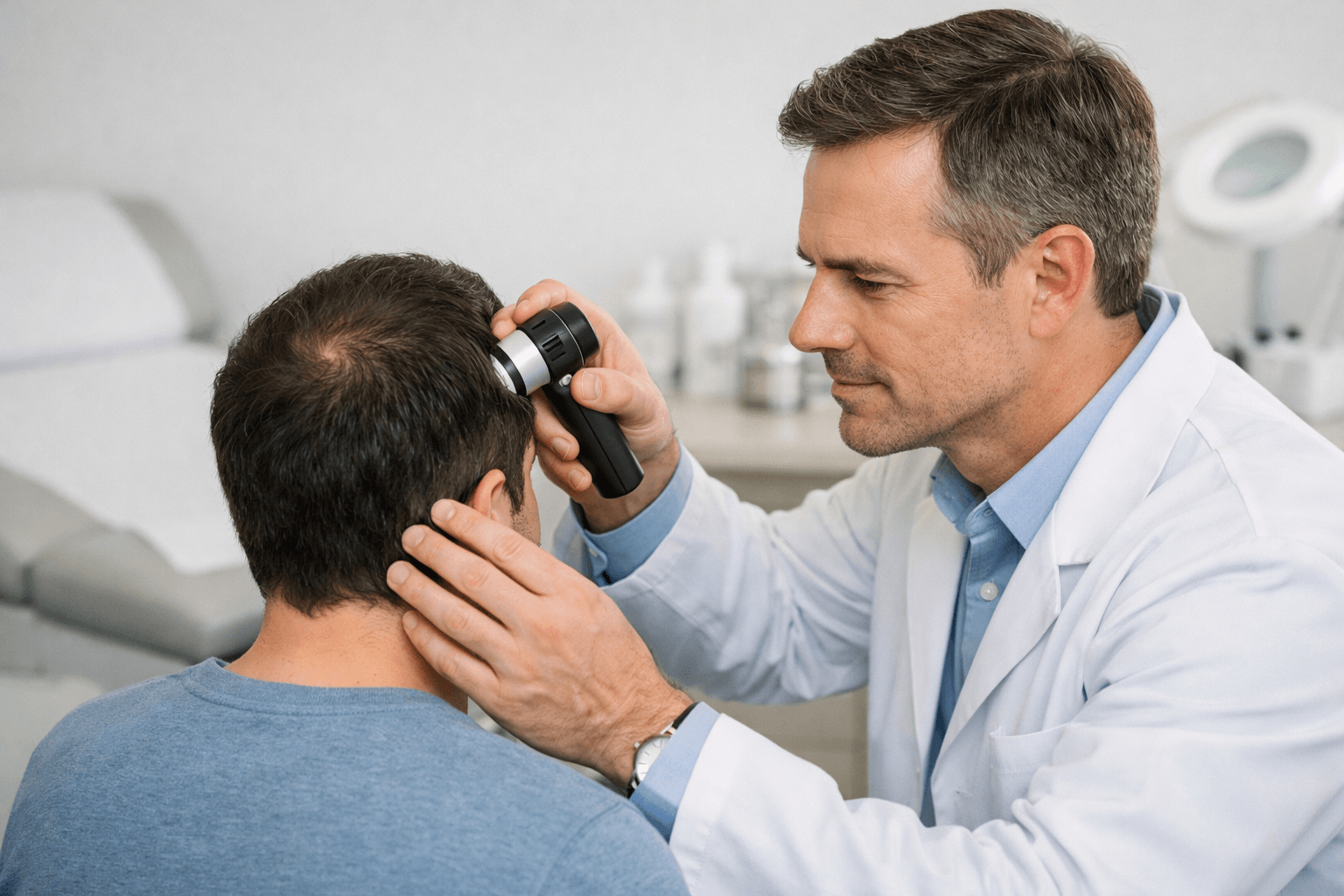
Donor area miniaturisation can be difficult to identify by sight alone. Trichoscopy or dermoscopy can help assess hair-calibre variation, fine or vellus hairs, density and follicular-unit patterns across several donor sites. Diffuse thinning involving the sides and back of the scalp may indicate that a dependable donor zone is limited or absent, so suitability should be determined by a qualified physician.
Donor area miniaturisation means that the hairs in the proposed donor zone are gradually becoming finer, less dense or more similar to vellus hair. This process can be subtle. A donor area may look normal during a routine visual examination while trichoscopy reveals differences in hair calibre, density and follicular-unit structure.
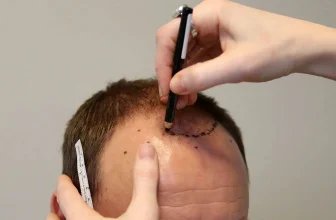
Donor assessment should be approached as a clinical evaluation rather than a simple visual check. The full scalp should be examined, several donor sites should be compared, and the findings should be interpreted alongside the patient’s hair-loss pattern, medical history and long-term expectations.
Why donor area miniaturisation matters
Hair transplantation relies on selecting follicles that are sufficiently stable for the individual’s expected future hair-loss pattern. If the donor area is also affected by miniaturisation, transplanted hairs may not have the durability expected from traditionally stable donor hair.
Miniaturisation may also reduce the number of usable follicular units. This can affect planning, including how much coverage may be realistic and whether the proposed donor area is suitable for surgery at all. A responsible assessment should therefore identify and discuss donor-area miniaturisation before a treatment plan is confirmed.
Importantly, not every change in hair density means that transplantation is unsuitable. The significance of a finding depends on its distribution, severity, possible cause and progression. Individual suitability must be determined by a qualified physician after an appropriate examination.
Can you identify donor miniaturisation by looking in a mirror?
Sometimes, but not reliably. A visibly thin donor area, obvious recession at the sides or widespread scalp thinning may raise concern. However, early miniaturisation can be missed because neighbouring thicker hairs may conceal finer follicles.
Unaided inspection also makes it difficult to compare hair-shaft diameter accurately or determine whether a reduction in density is present across several regions. Lighting, hair length, hairstyle and hair colour can further influence how dense the donor area appears.
For these reasons, a normal-looking donor area does not exclude early disease. Trichoscopy or dermoscopy provides magnified images of the scalp and hair shafts, helping the clinician assess features that may not be visible during a standard examination.
Warning signs of donor area miniaturisation
1. Greater variation in hair-shaft diameter
One of the most useful warning signs is marked variation between the thickness of individual hairs. A healthy-looking donor region may contain hairs of slightly different calibres, but a more pronounced mixture of thick, fine and very fine hairs can suggest miniaturisation.
Hair-shaft diameter variability is a recognised trichoscopic feature of androgenetic alopecia. Some published reviews describe variability above 20% as characteristic in the context of androgenetic alopecia, but this should not be treated as a universal cut-off for donor-area unsuitability. Numerical thresholds differ between studies and are not sufficiently standardised to replace clinical judgement.
2. An increased proportion of fine or vellus hairs
Miniaturising follicles may produce hairs that are shorter and finer than terminal hairs. When a higher proportion of fine or vellus hairs is found in the proposed donor region, particularly alongside other changes, it may indicate that the area is not as stable as it appears.
The finding must be interpreted in context. Fine hairs may occur for several reasons, and trichoscopy is useful partly because it can help distinguish pattern hair loss from other conditions that may affect the scalp.
3. Reduced hair or follicular-unit density
A donor area with reduced density may offer fewer usable follicles for transplantation. Trichoscopy can help measure or compare density at different points on the scalp, rather than relying on the appearance of one small region.
Reduced density is more concerning when it is diffuse, progressive or present in several areas, including the occipital, temporal and parietal scalp. The proposed safe donor area should also be checked for retrograde or diffuse thinning.
4. More single-hair follicular units
Follicular units commonly contain one or more hairs. An increased proportion of single-hair units in a donor region can be a trichoscopic sign of miniaturisation, especially when found together with lower density and greater hair-calibre variation.
This does not mean that every single-hair unit is abnormal. The clinician should compare different scalp regions and assess the overall pattern rather than using one isolated observation.
How doctors assess the donor area before surgery
A thorough assessment should cover more than the commonly assumed permanent zone at the back of the scalp. Recommended evaluation includes multiple points in the occipital, temporal and parietal regions, as well as comparison with the recipient area.
The examination may include:
- Clinical inspection of the entire scalp
- Trichoscopy or dermoscopy of several donor and recipient sites
- Assessment of hair density and hair-shaft calibre
- Evaluation of follicular-unit composition, including single-hair units
- Inspection for retrograde thinning or diffuse loss at the sides and back
- Documentation of unusual scalp findings, inflammation, scaling or scarring
- Review of the patient’s hair-loss history and progression
Comparing several areas is important because miniaturisation may not be uniform. One apparently dense patch should not be used to represent the entire donor region. A clinician should also consider whether the pattern is consistent with androgenetic alopecia or whether another diagnosis may be involved.
What is diffuse unpatterned alopecia?
Diffuse unpatterned alopecia, often abbreviated as DUPA, describes diffuse miniaturisation that can extend beyond the usual patterned areas and involve the sides and back of the scalp. In this situation, the traditional concept of a stable donor zone may not apply.
When miniaturisation affects the temporal, parietal and occipital scalp, there may be no reliably stable donor area. This can make transplantation inappropriate or create a poor prognosis for durable results. The diagnosis can be difficult, and current literature does not provide universally accepted diagnostic or trichometric criteria for DUPA.
For this reason, a doctor should not diagnose donor unsuitability from a single numerical measurement alone. The distribution of miniaturisation, the clinical appearance, trichoscopic findings and the possibility of other causes of hair loss all need to be considered.
Conditions that can mimic donor miniaturisation
Not every abnormal trichoscopic finding represents androgenetic miniaturisation. Trichoscopy may also help identify or raise suspicion of conditions such as alopecia areata, telogen effluvium or scarring alopecia.
Other findings that deserve particular attention include inflammation, scalp changes, rapid progression, patchy loss or scarring. If the diagnosis is uncertain, a dermatology assessment may be appropriate. In selected cases, a physician may consider a scalp biopsy before surgery to clarify the diagnosis.
This additional evaluation is important because a transplant does not address every cause of hair loss, and performing surgery without understanding the underlying process may lead to an unsuitable plan.
When might a patient not be a suitable candidate?
Possible concerns include:
- Miniaturisation extending throughout the proposed donor zone
- Diffuse thinning involving the occipital, temporal and parietal areas
- Progressive or rapidly changing hair loss without a clear diagnosis
- Very low donor density or substantial hair-calibre variation
- Signs of inflammatory or scarring scalp disease
- Uncertainty about whether the donor area is stable enough for the patient’s goals
These findings do not automatically produce the same decision for every patient. A qualified physician must determine whether surgery should proceed, be postponed for further investigation or be considered inappropriate. A cautious recommendation is preferable to promising coverage that the donor area cannot sustainably support.
How to prepare for a donor-area assessment in Turkey
International patients considering treatment in Turkey should provide an accurate history of their hair loss before travelling. Useful information includes when thinning began, how quickly it has changed, whether close relatives have similar loss and whether the sides or back of the scalp have become thinner.
Patients should also share information about previous hair-loss diagnoses, scalp symptoms and any earlier procedures or treatments. Clear photographs taken from the front, top, sides and back can help with an initial review, although photographs cannot replace an in-person examination and trichoscopy.
During a consultation, ask whether the assessment will include the entire scalp and multiple donor sites. It is also reasonable to ask how the clinic has evaluated hair calibre, density, follicular-unit structure and possible retrograde thinning. If findings are atypical or uncertain, ask whether dermatology review or further diagnostic testing is recommended before surgery.
Questions to ask before agreeing to transplantation
- Has the entire scalp been examined, rather than only the central occipital area?
- Were the temporal, parietal and occipital regions compared?
- Does trichoscopy show hair-calibre variation or an increased number of fine hairs?
- Is donor density reduced or are single-hair follicular units unusually common?
- Is there evidence of retrograde or diffuse thinning?
- Could another scalp condition be causing the abnormal findings?
- Are the findings sufficiently clear to make a reliable surgical plan?
- Would a dermatology consultation or biopsy be appropriate?
Key takeaway
Donor area miniaturisation may be difficult to recognise without magnified examination. The most useful warning signs include heterogeneous hair-shaft calibre, a higher proportion of fine or vellus hairs, reduced density and more single-hair follicular units.
The donor area should be assessed at multiple locations, including the occipital, temporal and parietal regions, while also checking for retrograde or diffuse thinning. If miniaturisation extends across the sides and back, diffuse unpatterned alopecia may be a concern and a dependable donor zone may not exist.
There is no universally validated numerical threshold that alone determines whether a donor area is suitable. A qualified physician should interpret trichoscopy alongside the clinical examination, hair-loss history and long-term expectations. When findings are unusual, inflammatory, scarring, rapidly progressive or uncertain, further dermatological assessment may be needed before a transplant decision is made.
Explore our Hair Transplant services in Turkey for an overview of treatment options and individual assessment.
TREATMENT OPTIONS
Explore Your Treatment Options
Find out more about our services and discuss which options may suit your individual needs.
YOUR NEXT STEP
Discuss Your Questions With Our Team
Request an individual assessment or ask our team about treatment planning and follow-up arrangements.
Medical References
- Hair Transplant Practice Guidelines — Journal of Cutaneous and Aesthetic Surgery. Supports multi-site donor assessment, trichoscopic evaluation of density and calibre, and documentation of donor-area miniaturisation.
- Trichoscopy for the Hair Transplant Surgeon—Assessing for Mimickers of Androgenetic Alopecia and Preoperative Evaluation of Donor Site Area — Indian Journal of Plastic Surgery; Association of Plastic Surgeons of India. Supports the use of trichoscopy to assess hair-shaft variability, density and follicular-unit structure.
- Is Every Patient of Hair Loss a Candidate for Hair Transplant?—Deciding Surgical Candidacy in Pattern Hair Loss — Indian Journal of Plastic Surgery; International Society of Hair Restoration Surgery. Supports full-scalp evaluation, recognition of donor miniaturisation and referral when diagnosis is uncertain.
- Trichoscopy of Androgenetic Alopecia: A Systematic Review — Journal of Clinical Medicine. Reviews hair-diameter variability, vellus hairs and other trichoscopic indicators, while noting limitations in the available evidence.
- Revisiting Diffuse Unpatterned Alopecia: Reappraisal of a Controversial Diagnosis — Skin Appendage Disorders; S. Karger. Reviews diffuse miniaturisation, possible donor-area implications and the lack of standardised diagnostic thresholds.