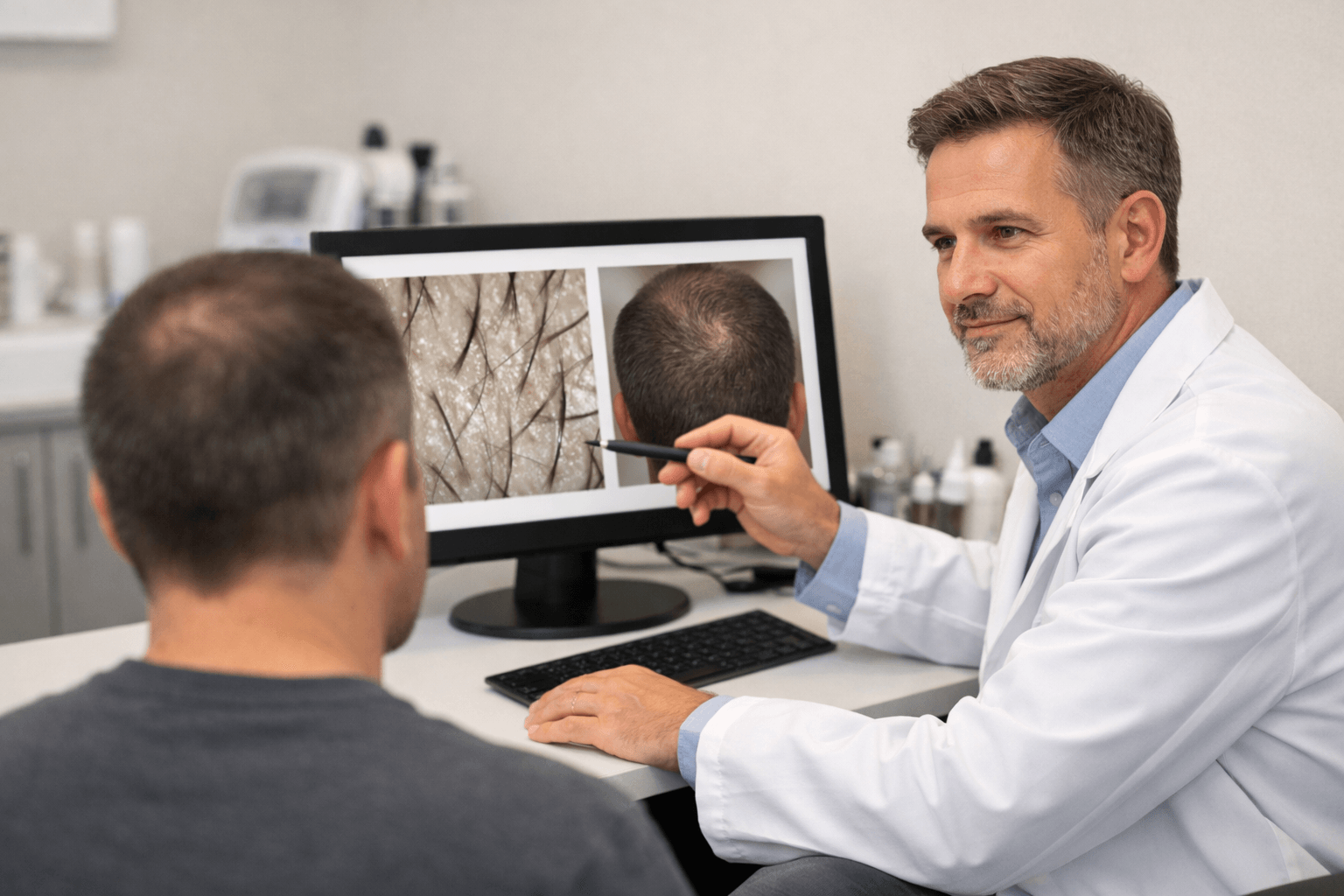
A hair transplant is intended to create a natural-looking hairline and improve visible thinning. However, some patients are left with an unnatural hairline, poorly positioned grafts, patchy growth, visible scarring, or a donor area that looks noticeably depleted. This can be distressing, particularly when further hair loss continues after the original procedure.
In some cases, a hair transplant can be repaired or improved. However, revision surgery is more complex than an initial transplant because the surgeon must work with existing grafts, scar tissue, limited donor reserves, and the effects of any ongoing hair loss. The realistic goal is usually improvement and camouflage rather than a guaranteed return to the appearance of an untouched scalp.
At Estexper Clinic, revision planning should begin with a detailed medical assessment rather than an immediate decision to perform another procedure. A qualified hair-restoration physician should determine what caused the unsatisfactory result and whether further surgery is appropriate and likely to provide meaningful benefit.
What Can Cause a Bad Hair-Transplant Result?
A poor result may involve one problem or several at the same time. Common concerns include:
- An excessively low, straight, or otherwise unnatural hairline
- Grafts placed at an incorrect angle or direction
- Visible clusters of hair or a plug-like appearance
- Insufficient density in the recipient area
- Uneven or patchy growth
- Grafts that have been placed outside the appropriate hairline
- Visible scarring or changes in skin colour
- Progressive hair loss around the transplanted hair
- An overharvested donor area with thinning or a moth-eaten appearance
The cause is not always a surgical technical problem. Ongoing androgenetic alopecia, miniaturisation in the donor area, scarring alopecia, infection, or another diagnosis may contribute to the appearance. For this reason, revision should not be planned solely from photographs or from the number of grafts previously used.
How Is Hair Transplant Repair Assessed?
A revision consultation should assess both the recipient and donor areas. The physician may review previous treatment records, including the technique used, the estimated number of grafts harvested, the extraction pattern, and any complications during recovery.
Assessment of the recipient area
The recipient area is examined for hairline design, graft direction, density, distribution, scarring, and the quality of existing growth. The physician also considers whether transplanted grafts are still producing hair and whether native hair has continued to thin around them.
Assessment of the donor area
The donor area should be examined for remaining density, hair calibre, follicular-unit miniaturisation, scarring, hypopigmented punch marks, and the distribution of previous extractions. A donor area may appear acceptable when the hair is long but show obvious depletion when cut short or viewed under bright lighting.
There is no single extraction limit that is safe for every patient. Donor density, hair thickness, skin characteristics, extraction pattern, punch size, previous procedures, and the definition of the safe donor area all affect the risk of visible depletion. If additional scalp FUE would create further visible thinning, further scalp harvesting may not be appropriate.
Review of expectations
Revision surgery is limited by the amount and quality of hair that remains. A patient may want complete coverage, but the available donor supply may only support improvement in the hairline, selected areas, or visual camouflage. A responsible consultation should explain these limits before treatment is planned.
Can Poorly Placed Grafts Be Corrected?
In selected cases, poorly positioned grafts can be removed, partially removed, or relocated. This may be considered when grafts create an artificial hairline, are placed too low, grow in the wrong direction, or form visible groupings.
Some grafts may be carefully extracted and reimplanted in a more suitable location. In other situations, removal is used to soften an excessively low hairline or reduce an obvious irregularity. The choice depends on the position of the grafts, the amount of surrounding scar tissue, the condition of the follicles, and the risk of further damage.
Relocating grafts does not always produce a perfect result. Existing scars, transection risk, limited donor hair, and reduced follicle quality can make revision technically demanding. The procedure may also require more than one stage, especially when the problem affects a large area or when the desired change is significant.
What Is an Overharvested Donor Area?
Overharvesting occurs when too many follicular units are removed from the donor area or when extractions are distributed in a way that makes depletion visible. It is most often discussed in relation to FUE, although the donor area can also be affected by other surgical factors.
Possible signs include permanent thinning, patchy areas, visible hypopigmented punch scars, an uneven appearance, or a moth-eaten pattern. In more severe cases, tissue injury or necrosis may occur. The likelihood of visible depletion is influenced by the original donor density, hair calibre, the extraction pattern, punch size, the number of previous procedures, and whether the safe donor area was accurately identified.
It is important to understand that an overharvested donor area cannot always be restored to its original density. When the area is visibly depleted, performing more scalp FUE may worsen the appearance rather than improve it. A physician should first determine whether enough stable donor hair remains and whether another procedure would create additional visible damage.
How Can an Overharvested Donor Area Be Improved?
The most suitable approach depends on the degree and pattern of depletion. Options may include:
Carefully selected reconstruction
If adequate donor hair remains elsewhere within the safe donor area, a carefully planned procedure may place grafts into selected depleted zones. This is not suitable for every patient. Further extraction should not create additional visible thinning, and the potential cosmetic benefit should outweigh the risk of another operation.
Camouflage with scalp micropigmentation
Scalp micropigmentation may help reduce the contrast between the scalp and hair in areas with thinning, patchiness, or certain types of scarring. It does not restore hair or increase donor density, but it may improve the visual appearance without using additional grafts. Its suitability depends on the patient’s hair length, skin characteristics, scar pattern, and expectations.
Selected use of non-scalp donor hair
When scalp donor reserves are limited, selected patients may be assessed for body-hair transplantation, particularly using beard or chest hair. Body hair does not fully replace scalp hair, and its texture, growth pattern, length, and cosmetic behaviour may differ. A physician should determine whether the expected benefit justifies the complexity of the procedure.
What Does a Hair Transplant Repair Procedure Involve?
There is no single repair technique. The procedure may involve one or more of the following steps:
- Selective removal of grafts that are too low, poorly angled, or visibly clustered
- Relocation and reimplantation of suitable grafts
- Additional graft placement to improve density or soften transitions
- Strategic distribution of grafts to camouflage thin or scarred areas
- Use of carefully chosen non-scalp donor hair in selected cases
- Camouflage methods when further graft harvesting is inadvisable
The surgeon should account for existing scars and the effects of prior surgery on the recipient and donor areas. Graft angulation, direction, spacing, and distribution are particularly important during revision because small irregularities may remain visible when the surrounding density is limited.
Repair may require multiple procedures. A staged plan can allow the physician to address the most visible problem first, evaluate healing, and then decide whether further improvement is appropriate and worthwhile. The number of procedures cannot be predicted accurately without an examination.
Preparation for Hair Transplant Revision
Before travelling to Turkey or scheduling treatment, international patients should provide clear photographs, previous operative reports, details of any complications, and information about ongoing hair loss. Photographs should show the hairline, top, sides, crown, and donor area under consistent lighting.
An in-person assessment remains important because donor density, miniaturisation, scarring, and skin changes cannot always be judged reliably from images. The physician may recommend delaying or avoiding surgery if ongoing hair loss, active scalp disease, scarring alopecia, infection, or inadequate donor supply is present.
Patients travelling internationally should also allow sufficient time for consultation and treatment planning rather than arranging surgery immediately after arrival. They should understand who will perform the medical assessment, who will carry out the surgical steps, what follow-up is available, and how complications will be managed after returning home.
Recovery and Aftercare
Recovery after revision depends on the techniques used and whether grafts are removed, relocated, or added. Patients should follow the clinic’s personalised washing, sleeping, activity, and medication instructions. Previously operated skin may respond differently from untreated skin, so aftercare should be individualised.
International patients should receive written aftercare instructions and a clear method for contacting the medical team after leaving Turkey. Follow-up photographs may be useful, but they do not replace an examination if there is increasing pain, marked swelling, discharge, unexpected skin changes, or another concerning symptom.
Patients should avoid judging the final appearance too early. Hair growth and visual blending develop gradually, and revision cases may take longer to assess because the scalp has already undergone previous surgery. The treating physician should explain the expected evaluation period for the specific procedure.
Risks and Limitations of Repair
Revision surgery carries many of the risks associated with hair transplantation, including infection, bleeding, scarring, graft damage, incomplete growth, uneven density, and an unsatisfactory cosmetic result. Previous procedures may increase technical difficulty and reduce the amount of hair available for correction.
Additional scalp FUE can make donor thinning more visible if the area is already depleted. Attempting to correct an excessively low hairline may also require removing grafts that cannot all be successfully reused. Body-hair transplantation has its own limitations, and camouflage methods cannot recreate natural hair growth.
Evidence about hair-transplant repair is based largely on surgical reviews, practice guidance, and small observational studies rather than high-quality comparative clinical trials. Outcomes and feasibility therefore vary substantially. A consultation should include the possibility that further surgery may not be advisable or may provide only partial improvement.
When Might Further Surgery Not Be Recommended?
Further surgery may be inappropriate when the donor area is visibly overharvested, when diffuse miniaturisation leaves little stable hair, or when the patient’s goals require more grafts than remain available. It may also be unsuitable when active scalp disease, scarring alopecia, infection, or uncontrolled ongoing hair loss is contributing to the problem.
A physician may recommend medical management, observation, or camouflage instead of another transplant. This is not a failure of treatment planning. In some cases, avoiding additional damage is the safest and most realistic decision.
Frequently Asked Questions
Can every failed hair transplant be repaired?
No. Some results can be improved, but repair depends on the recipient area, donor density, scarring, remaining grafts, ongoing hair loss, and the patient’s expectations. A qualified physician should determine feasibility.
Can an overharvested donor area grow back?
Overharvesting can permanently reduce donor density and may cause visible patchiness or scarring. Some areas may be improved through carefully selected reconstruction or camouflage, but the original density cannot always be restored.
Is body hair suitable for every repair case?
No. Body hair may be considered in selected patients when scalp donor reserves are limited, but its characteristics differ from scalp hair and the cosmetic benefit is variable.
Will one repair procedure be enough?
Not necessarily. Revision may require more than one procedure, particularly when both the recipient and donor areas need attention. The number of procedures depends on the extent of the problem and the available donor supply.
Can repair be arranged directly from abroad?
International patients may begin with a remote review, but an in-person examination is important before treatment. The clinic should assess the donor and recipient areas, explain limitations, and provide a realistic plan before surgery.
Conclusion
A bad hair-transplant result or overharvested donor area may sometimes be improved, but repair is an individualised form of treatment. Selective graft removal, relocation, additional transplantation, body-hair transplantation in selected cases, and scalp micropigmentation may all have a role. However, each option has limitations, and further scalp harvesting can be harmful when the donor area is already depleted.
The safest next step is a detailed assessment by a qualified hair-restoration physician who can review previous procedures, examine donor and recipient areas, evaluate ongoing hair loss, and explain whether surgery is appropriate. At Estexper Clinic, realistic planning is essential for protecting remaining donor hair and choosing a correction strategy that matches the patient’s actual options.
Medical References
- Hair Transplant Practice Guidelines — Indian Association of Dermatologists, Venereologists and Leprologists; Indian Journal of Dermatology, Venereology and Leprology.
- Complications of Hair Transplant Procedures—Causes and Management — Indian Journal of Plastic Surgery.
- The Art of Repair in Surgical Hair Restoration—Part II: The Tactics of Repair — Dermatologic Surgery.
- Revision of the Unfavorable Result in Hair Transplantation — Plastic and Reconstructive Surgery Global Open.
- FUE Clinical Practice Guidelines — International Society of Hair Restoration Surgery.
- Revision and Repair of Previous Hair Transplants — International Society of Hair Restoration Surgery.