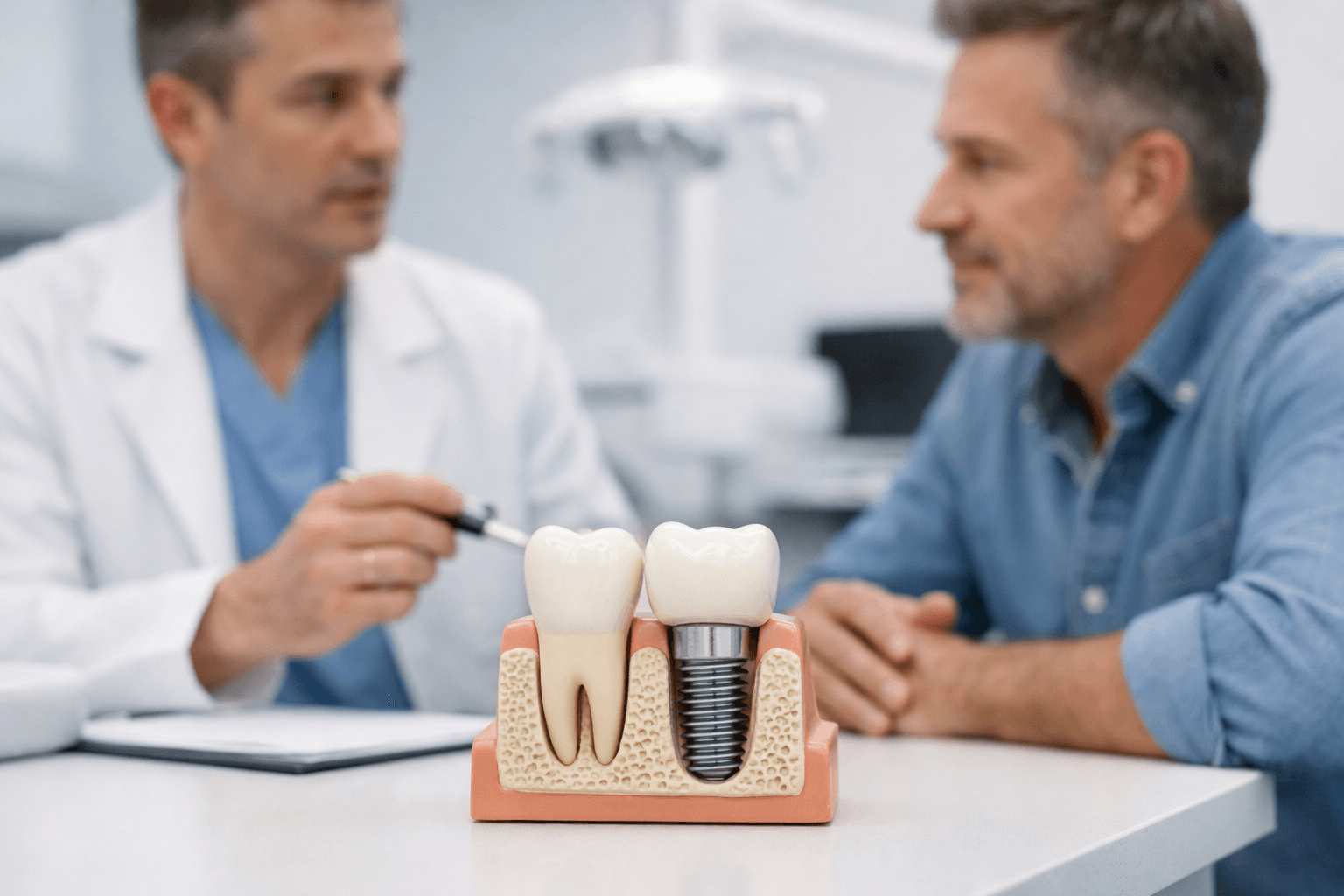
Dental implants are designed to provide long-term support for missing teeth, but they are not a single part with one guaranteed lifespan. An implant treatment usually includes an implant fixture anchored in the jawbone, an abutment that connects the fixture to the restoration, and a visible crown, bridge or overdenture. These parts experience different types of stress and do not necessarily need replacing at the same time.
So, how long do dental implants last? Contemporary evidence suggests that the implant fixture often has a high long-term survival rate. However, the visible restoration and smaller prosthetic components may need repair, adjustment or replacement during the life of the treatment. The exact outlook depends on factors such as oral hygiene, smoking, previous gum disease, bone quality, implant location, restoration design, general health and attendance at maintenance appointments.
This guide explains what may last for many years, what commonly wears or fails first, and how patients considering treatment in Turkey can plan for long-term care. A qualified dental professional must assess your individual suitability and expected prognosis.
How long can the implant fixture last?
The implant fixture is the part placed in the jawbone. When it remains integrated with the bone, stable and free from significant disease, it is not routinely replaced simply because a certain number of years have passed.
A 2019 systematic review and meta-analysis of contemporary implant systems estimated 10-year implant survival at approximately 96.4% in its traditional analysis. When the researchers accounted for missing follow-up data, the estimate was approximately 93.2%. These figures show that long-term survival is generally high, while also demonstrating that the exact percentage depends on study methods, follow-up and patient characteristics.
For single-tooth implant treatment, another systematic review reported approximately 95% implant survival at 10 years. These figures describe survival in groups of patients rather than a promise for an individual. Some implants may function for considerably longer, while others can develop biological or mechanical complications earlier.
The most important distinction is between implant survival and restoration survival. An implant can remain stable even when the crown above it has chipped, loosened or reached the end of its useful service. In that situation, replacing the crown may restore function without removing the implant fixture.
Which parts of a dental implant may need replacing?
1. The crown
The crown is the visible tooth-shaped restoration attached to a single implant. It can require repair or replacement because of ceramic chipping, fracture, wear, loss of retention or problems with the connection. In a systematic review of single implants followed for at least 10 years, the survival of the original implant crowns was approximately 89.5%, compared with approximately 95% for the implants themselves.
This difference does not mean that every crown needs replacement after ten years. It means that, across the studies, some crowns had been repaired or remade while the supporting implants continued functioning. The timing depends on the crown material, bite forces, location in the mouth, oral habits, hygiene and the quality of maintenance.
2. A bridge or full-arch prosthesis
Several implants may support a bridge or a larger fixed prosthesis. These restorations can develop ceramic or framework fractures, loosened components, loss of retention or other technical problems. A repair may sometimes be possible, while other situations require a new prosthesis. The need for replacement cannot be predicted reliably from the implant age alone.
Because larger restorations contain more components and may be exposed to substantial chewing forces, their maintenance should be planned as part of the original treatment. Your dentist can explain which parts are removable, how they are accessed, and what type of follow-up is recommended.
3. The abutment
The abutment connects the implant fixture to the crown, bridge or another restoration. It may be affected by loosening, fracture, wear or a problem with the prosthetic connection. If the implant fixture remains stable and healthy, the abutment may be replaced without removing the fixture.
4. Prosthetic screws
Small screws may secure the abutment or restoration. Screw loosening and, less commonly, screw fracture are recognised mechanical complications. A loose screw should not be ignored because continued movement can damage other components or affect the fit of the restoration. Prompt professional assessment may allow the component to be tightened or replaced before more extensive damage occurs.
5. Overdenture attachment components
Implant-retained overdentures are supported by implants but can be removed by the patient. Their attachment system may include inserts, clips, bars or related parts. These components can wear, loosen or lose retention even when the supporting implants remain in place. Maintenance may involve adjustment or replacement of the attachment parts rather than replacement of the implants.
Why might an implant restoration need repair or replacement?
Technical complications are among the main reasons that the visible parts of implant treatment may need attention. Common examples include:
- Ceramic chipping or fracture
- Crown, bridge or framework fracture
- Loss of cement or other retention
- Loosening or fracture of prosthetic screws
- Abutment problems
- Loss of retention in an implant-retained overdenture
The risk varies according to the restoration design, material, implant position, bite, number of implants, follow-up period and individual habits. Teeth grinding or clenching may place additional stress on a restoration, but the appropriate assessment must be made by a dental professional rather than assumed from symptoms alone.
Can gum disease affect how long implants last?
Yes. Biological health around an implant is essential for long-term function. Peri-implant mucositis is inflammation of the soft tissues around an implant without supporting bone loss. Peri-implantitis involves inflammation together with progressive bone loss and can threaten implant survival.
Risk factors include a history of periodontitis, inadequate plaque control, smoking and diabetes. This does not mean that a person with one of these factors cannot receive implant treatment. It means that risk assessment, disease control and continuing maintenance are particularly important. A qualified dentist or periodontist can evaluate the condition of your gums and the tissues around any existing implants.
Warning signs can include bleeding during cleaning, persistent swelling, redness, tenderness, pus, bad taste, unpleasant odour, increasing looseness or a change in the way the restoration feels when you bite. These symptoms should be assessed promptly. Early inflammation may be easier to manage than advanced disease with bone loss.
What affects dental implant longevity?
There is no guaranteed fixed lifespan because several factors influence the result:
- Oral hygiene: Effective plaque control helps protect the tissues around the implant and the restoration.
- Professional maintenance: Regular examinations can identify inflammation, loosened components or damage before problems become more extensive.
- Previous periodontal disease: A history of gum disease can increase the need for careful monitoring.
- Smoking: Smoking is associated with a less favourable environment for oral and peri-implant health.
- General health: Conditions such as diabetes may affect risk and require appropriate medical and dental coordination.
- Bone quality and implant location: The available bone and the forces in different areas of the mouth can influence outcomes.
- Restoration design and materials: Crowns, bridges and overdentures have different mechanical demands.
- Daily forces and habits: Clenching, grinding or using teeth to open objects can increase stress on restorations.
These factors should be considered together. One factor alone cannot determine whether an implant will succeed or how long a crown will remain serviceable.
How can you protect your investment?
Long-term care begins before treatment. During an assessment, ask which implant system and restoration design are being proposed, how the components are connected, and what maintenance will be needed. Keep copies of your treatment records, implant details and restoration information. This can be particularly useful for international patients who may later need maintenance in Turkey or in their home country.
After treatment, follow the cleaning instructions provided by your dental team. Attend professional reviews at the intervals recommended for your situation. Maintenance may include examination of the implant and restoration, assessment of the surrounding tissues, professional cleaning and checking for movement or damage.
Do not attempt to tighten a loose restoration yourself. Contact a qualified dental professional if a crown moves, an overdenture loses retention, a screw problem is suspected, or you notice bleeding, swelling or pain. Timely evaluation may help preserve the implant and limit the extent of repair.
What should international patients ask when considering treatment in Turkey?
Patients travelling to Turkey for dental implant treatment should consider long-term care as carefully as the procedure itself. Before travelling, ask the clinic:
- Which parts are included in the proposed treatment: fixture, abutment and crown or other restoration?
- What maintenance or follow-up is recommended after returning home?
- What records will be provided, including implant and restoration details?
- How will a loose screw, chipped crown or other complication be managed?
- Who should be contacted if symptoms develop after returning home?
Any treatment plan should be based on a clinical examination and, where appropriate, diagnostic imaging and review of your medical and dental history. A remote discussion cannot determine individual suitability or guarantee the lifespan of an implant.
Frequently asked questions
Do dental implants need to be replaced every 10 years?
No. There is no universal 10-year replacement rule for the implant fixture. If it remains integrated, stable and free from significant disease, it may continue to support a restoration. The crown or other prosthetic parts may need maintenance or replacement earlier.
What usually needs replacing first: the implant or the crown?
Long-term studies generally report higher survival for the implant fixture than for the visible crown. Therefore, when a problem occurs, the crown or another prosthetic component may be repaired or replaced while the implant remains in place. This is a general pattern, not a prediction for every patient.
Can a crown be replaced without replacing the implant?
Often, this may be possible when the implant is stable and the surrounding tissues are healthy. The dentist must check the fixture, abutment, connection and restoration before deciding whether repair, component replacement or a new crown is appropriate.
How long will my dental implants last?
No clinician can guarantee an exact lifespan for an individual implant. Current evidence supports strong 5- to 10-year outcomes in many patients, but longer-term performance depends on biological health, maintenance, restoration design and personal risk factors.
Conclusion
The implant fixture and the visible restoration should be viewed as separate parts of a long-term treatment. Contemporary research reports approximately 93% to 96% implant survival at 10 years, while single implant crowns show lower reported survival of approximately 89% to 90% at the same point. This means that crowns, bridges, screws, abutments and overdenture attachments may need repair or replacement while the underlying implant continues to function.
Good plaque control, professional maintenance and early attention to symptoms are central to protecting both the implant and the restoration. If you are considering dental implants in Turkey, request a personalised assessment and a clear long-term maintenance plan from a qualified dental professional.
Medical References
- Long-term (10-year) dental implant survival: A systematic review and sensitivity meta-analysis — Journal of Dentistry; indexed in PubMed.
- A systematic review of survival of single implants as presented in longitudinal studies with a follow-up of at least 10 years — European Journal of Oral Implantology; indexed in PubMed.
- Prosthetic failures in dental implant therapy — Peer-reviewed review article; PubMed Central.
- Mechanical failures of dental implants and supported prostheses: A systematic review — Peer-reviewed systematic review; PubMed Central.
- Clinical Guideline: Prevention and treatment of peri-implant diseases — European Federation of Periodontology.
- Peri-Implant Diseases — American Academy of Periodontology.