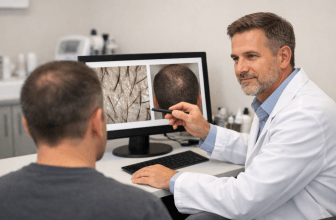
For international patients considering a hair transplant in Turkey, a video consultation can be a practical first step. It allows you to discuss your concerns, share photographs, review your medical history and understand whether an in-person assessment may be appropriate.
However, a remote consultation should be viewed as preliminary rather than definitive. Hair loss can have several causes, and a complete assessment may require direct scalp examination, dermoscopy, laboratory testing or, in selected cases, a biopsy. Individual suitability for surgery must be determined by a qualified physician.
Preparing the right information before your appointment helps the consultation become more useful. It also gives you an opportunity to assess the clinic, understand who will be responsible for your care and plan safely for treatment and follow-up in Turkey.
What Is a Hair Transplant Video Consultation?
A hair transplant video consultation is a remote appointment with a hair-restoration physician or clinical team. During the consultation, you may discuss the pattern and progression of your hair loss, your goals, previous treatments and your general health. The clinician may also review photographs of your scalp and donor area.
This process can support preliminary screening and treatment planning. It may help identify whether further information or an in-person examination is needed before surgery. It can also help you understand the proposed approach, expected limitations and practical arrangements for travelling to Turkey.
Video consultation cannot fully reproduce a physical examination. A camera may not show scalp texture, inflammation, scarring or hair density accurately, and it cannot replace palpation, dermoscopy or diagnostic testing. The final diagnosis and surgical plan may therefore need confirmation when you attend the clinic.
Who May Be Suitable for Further Assessment?
The initial assessment should consider more than the visible degree of hair loss. A physician may review the likely cause and pattern of alopecia, the availability of donor hair, scalp findings, the risk of continued progression, your general health and your expectations.
Not every type of hair loss is suitable for transplantation. For example, a history of rapid shedding, patchy loss, inflammation, scarring or an unexplained change in the scalp may require additional investigation before surgery is considered. A transplant does not diagnose or treat every underlying cause of hair loss.
A remote consultation can indicate whether you appear suitable for an in-person evaluation, but it should not be presented as a guarantee of candidacy. The physician must make the final decision after reviewing all relevant information and, where necessary, examining you directly.
Photographs to Send Before the Consultation
Clear, standardized photographs are among the most important parts of a remote hair-loss assessment. They allow the clinician to review the hairline, the affected areas and the potential donor region. They may also provide a useful baseline for future comparison.
Recommended views
Prepare photographs showing:
- The front of the hairline and frontal region
- Both temples and the sides of the head
- The top of the scalp
- The crown or vertex area
- The back of the scalp, including the potential donor area
- Both sides of the head
- Close-up images of areas where hair loss, thinning, scaling, redness or scarring is visible
Use several angles rather than relying on a single image. If possible, include both wider views that show the overall pattern and closer views that show the hair and scalp more clearly.
How to take useful images
- Use a sharp camera image with adequate lighting.
- Take photographs in consistent, even light and avoid strong shadows.
- Do not use filters, beauty modes or image-enhancement effects.
- Keep the camera at a similar distance for each view.
- Make sure the hairline and scalp are not hidden by a hat, heavy styling product or hair arrangement.
- Follow the clinic’s instructions about whether the hair should be dry, clean or arranged in a particular way.
- Use a secure clinic portal or another approved method for sending medical images.
Photographs are helpful but have limitations. They do not provide a precise measurement of hair density and may not reveal subtle scalp disease. If the images are unclear, the physician may request additional photographs or recommend an in-person examination.
Medical Information to Prepare
Before the video consultation, write down a brief but complete history of your hair loss. This can help the physician understand whether the pattern is stable, progressive, sudden or potentially related to another condition.
Hair-loss history
- When you first noticed hair loss or thinning
- Whether it began gradually or suddenly
- How it has changed over time
- Which areas are affected
- Whether you have experienced patchy loss or rapid shedding
- Whether close relatives have experienced similar hair loss
- Whether the scalp has been painful, itchy, inflamed or scaly
- Any history of injury, surgery or scarring on the scalp
Previous treatment and medical history
- Previous hair-loss medicines, supplements or topical products
- Earlier scalp treatments or hair-restoration procedures
- Relevant medical conditions and previous operations
- Current prescription medicines and non-prescription products
- Vitamins, supplements and herbal products
- Known allergies or reactions to medicines, anaesthetic agents or other substances
- Any condition that affects healing or may be relevant to surgery
Do not stop or change a prescribed medicine simply because you are planning a hair transplant. Discuss your full medication list with the physician and, when appropriate, with your usual healthcare professional.
Questions to Ask During the Video Consultation
A consultation should be a two-way discussion. You should have enough time to ask who will provide your care, what the assessment involves and what arrangements will be available after you return home.
Questions about diagnosis and suitability
- What is the most likely cause and pattern of my hair loss?
- Could I need a scalp examination, dermoscopy, blood tests or another diagnostic test?
- Am I being assessed for a transplant, or is further investigation needed first?
- Is my donor area adequate for the proposed plan?
- Could my hair loss continue after surgery?
- How will my expectations and long-term hair pattern affect the plan?
Questions about the surgical team
- Which physician is medically responsible for my diagnosis, treatment plan and surgery?
- What are the physician’s qualifications, training and licence to practise?
- Who will design the hairline?
- Who will harvest the grafts?
- Who will create the recipient sites?
- Who will administer anaesthesia or local anaesthetic?
- Which staff members will provide postoperative care?
- Will the physician be present and directly involved in the surgical steps?
These questions are important because the people carrying out each step can differ between clinics. Ask for clear, specific answers rather than relying only on general statements about the clinic.
Questions about planning and follow-up
- What information will be confirmed when I arrive in Turkey?
- Will the proposed plan change after direct examination?
- What records, instructions and medication information will I receive?
- How can I contact the medical team after returning home?
- What happens if I develop a concern or complication abroad or after my return?
- Will my records be available in English if I need care from another doctor?
- What emergency arrangements are available?
What to Clarify Before Travelling to Turkey
Medical travel requires planning beyond the consultation itself. Confirm the identity of the physician and the facility where treatment will take place. Check the clinician’s qualifications, professional licence and experience, and ask which organisation is responsible for the facility and postoperative care.
Request a written summary of the proposed plan and the information discussed during the consultation. It should be clear what has been assessed remotely and what still needs to be confirmed in person. You should also understand who will provide care if the physician is unavailable after surgery.
Discuss practical communication arrangements before travelling. Ask whether you will have access to an English-speaking contact, how medical records will be shared and how urgent concerns will be handled. Consider whether your travel or health insurance provides relevant cover and whether additional arrangements are needed.
A pre-travel consultation with your usual clinician or a travel-medicine specialist may also be appropriate. This is particularly useful when you have existing medical conditions, take regular medicines or need advice about travelling after a procedure.
What Happens After You Arrive?
The assessment in Turkey should not simply repeat the video call without checking the findings directly. The physician may examine the scalp, review the donor area and reconsider the diagnosis or treatment plan. The final decision should take account of any information that could not be evaluated accurately on video.
If the clinical findings differ from the initial remote impression, ask the physician to explain what has changed and why. You should have the opportunity to give informed consent based on the confirmed diagnosis, proposed procedure, possible limitations and relevant risks before treatment begins.
Do not feel pressured to proceed if important questions remain unanswered or if the final plan differs substantially from what was discussed remotely. A responsible treatment decision should allow time for clarification.
Recovery and Aftercare Planning
Aftercare should be discussed before you travel, not only after surgery. Ask for written instructions covering wound and scalp care, prescribed medicines, activities, travel arrangements and warning signs that require medical attention. The exact advice should be individualized by the treating physician.
Agree how follow-up will take place once you return home. This may involve scheduled remote reviews, photographic updates or communication with a local healthcare professional if a concern develops. Make sure you know whom to contact, how quickly concerns will be answered and how your medical records can be obtained.
International patients should also consider the possibility that a problem may appear after leaving Turkey. Confirm how the clinic manages complications, whether additional assessment can be arranged and what support is available if you need local medical care.
Risks and Limitations of Remote Assessment
The main limitation of a video consultation is that the physician may not be able to establish the diagnosis or surgical suitability with certainty. Image quality, lighting, hair styling and camera angles can affect the assessment. A remote appointment may also miss scalp findings that require direct examination.
There are also risks associated with travelling abroad for medical care, including difficulty accessing follow-up, communication problems, managing complications after returning home and the need to coordinate care between different healthcare professionals. These issues should be discussed openly before booking treatment.
Video consultation is therefore best used as an early planning tool. It can help organize your questions and determine what further assessment is needed, but it should not replace appropriate medical evaluation.
Video Consultation Checklist
Before your appointment, prepare the following:
- Sharp, well-lit photographs of all relevant scalp and donor-area views
- A timeline of when your hair loss began and how it has progressed
- Information about family history and scalp symptoms
- A list of previous treatments and procedures
- A complete list of medicines, supplements and allergies
- Details of relevant medical conditions and operations
- Your goals, concerns and expectations
- Questions about the physician, surgical team and facility
- Questions about diagnosis, in-person confirmation and follow-up
- A plan for travel, communication, records and management of complications
At Estexper Clinic, a video consultation can help begin a structured discussion about your hair loss and treatment goals before travelling. The next steps should always be based on an individualized assessment by a qualified physician, with any necessary confirmation carried out in person.
Medical References
- Clinical Practice Guidelines for Virtual Consultations in the Practice of Hair Restoration Surgery — International Society of Hair Restoration Surgery.
- A practical guide to the standardization of hair loss photography for clinicians — British Association of Dermatologists / Oxford University Press.
- Patient selection, candidacy, and treatment planning for hair restoration surgery — Facial Plastic Surgery Clinics of North America.
- Evaluation and Management of the Hair Loss Patient in the Primary Care Setting — Primary Care.
- Medical Tourism: Travel to Another Country for Medical Care — Centers for Disease Control and Prevention.
- Consumer Advocacy — International Society of Hair Restoration Surgery.