Medical review: Estexper Medical Editorial Team
Crown baldness, also called vertex hair loss, is a common concern for people with androgenetic alopecia. Because the crown sits at the centre of the scalp and is visible from above, thinning in this area can affect confidence even when the frontal hairline remains relatively strong.
In Short
A crown hair transplant can often improve the appearance of vertex baldness, but it cannot routinely restore youthful hair density. The crown requires careful whorl-based graft placement, and the available donor hair may need to be reserved for the frontal hairline or mid-scalp if future hair loss is likely. The right approach depends on donor supply, the extent and stability of hair loss, and a qualified physician’s assessment.
A crown hair transplant can often improve coverage and reduce the appearance of a bald spot. However, restoring the crown is not the same as recreating the original density of youthful hair. The crown has a large surface area, a distinctive circular whorl and a tendency to change as androgenetic alopecia progresses. These factors make treatment technically demanding and require careful long-term planning.
The most important question is not simply how many grafts can be placed in the crown. It is how the available donor hair should be used to create the most natural and durable overall result. A qualified hair-transplant physician must assess your diagnosis, donor supply, existing hair and likely future pattern before recommending treatment.
Can crown baldness be restored with a hair transplant?
In many suitable patients, follicular-unit hair transplantation can cosmetically improve crown baldness. Transplanted follicles from the donor area may be used to add coverage to the thinning or bald vertex. The aim is usually to create the appearance of greater density rather than reproduce every follicle that was present before hair loss.
Complete restoration to original density is not usually realistic. The crown may require a substantial number of grafts because the area can be broad, while the total supply of donor hair is limited. Visual coverage also depends on several personal factors, including hair calibre, the contrast between the hair and scalp, the density of remaining native hair and the size of the bald area.
Patients with thicker hair, lower scalp-to-hair contrast and some remaining native hair may obtain more visible coverage from the same number of grafts than someone with fine hair, a large bald area and high contrast. For this reason, a consultation should focus on realistic improvement and long-term design rather than a promise of complete restoration.
Why is the crown technically challenging?
The vertex is different from the frontal hairline and mid-scalp. Hair in the crown usually follows a whorl or spiral pattern, with the direction and angle of the follicles changing around the centre. A natural-looking transplant must follow this pattern rather than placing grafts in straight rows or using one uniform direction.
During planning, the surgeon considers the centre of the whorl, the surrounding circular zones and the transition into the mid-scalp. Grafts may need to be placed with changing angles and directions so that the result blends with existing hair. Poorly planned angulation can make transplanted hair appear unnatural, particularly when viewed from above or under bright lighting.
Recipient-site design is also important. Excessive packing in a small area may not be appropriate because the surgeon must consider the recipient scalp and the survival of the grafts. The objective is a balanced distribution that provides useful visual coverage while respecting the anatomy of the scalp.
How should grafts be prioritised?
Graft prioritisation is the central planning issue in crown transplantation. Every patient has a finite donor supply. Even when the donor area appears dense, the physician must estimate the amount of hair that can be safely harvested and reserve grafts for possible future needs.
When donor hair is limited, many contemporary treatment plans prioritise the frontal hairline and mid-scalp before the crown. These areas are usually more important to the way the face and overall hairstyle are perceived, and restoration can create a more noticeable cosmetic change. A carefully designed frontal region may frame the face, while the mid-scalp can help connect the front with the remaining hair.
This does not mean that the crown should never be treated. It means that the vertex must be considered as part of the whole scalp rather than as an isolated problem. Using a large number of grafts only in the crown may leave insufficient donor hair for the frontal area later. If surrounding native hair then continues to thin, the patient could be left with an unnatural pattern in which transplanted coverage remains concentrated in the crown.
There is no single graft number or universal sequence that applies to every patient. The plan depends on age, diagnosis, donor density and stability, the current hair-loss pattern, the size of the crown, the condition of native hair, expectations and whether hair loss is medically controlled. Evidence for precise crown-specific graft counts is limited, so recommendations should be individualised rather than based on a fixed formula.
When might the crown be treated first?
In selected patients, a crown-focused procedure may be considered when the frontal hairline and mid-scalp are satisfactory, the donor area is adequate and the pattern of hair loss appears sufficiently stable. Some patients may also choose the crown because it is the area that concerns them most. Even in these situations, the physician should discuss how future progression could affect the overall appearance and whether donor reserves should be protected.
When might crown treatment be deferred?
Crown transplantation may be deferred when hair loss is actively progressing, the donor supply is limited, the bald area is extensive or the patient has unrealistic expectations about density. A staged plan may be more appropriate, with priorities reassessed after medical management and further observation. Deferring treatment is not a rejection of the patient’s concern; it can be a way to protect long-term options.
Who may be a candidate for a crown hair transplant?
Suitable candidates generally require a confirmed diagnosis, a donor area capable of supplying grafts and expectations that match what transplantation can realistically achieve. The physician should examine the density and stability of the donor zone, the extent of crown loss and the condition of the surrounding hair.
Assessment should also consider whether androgenetic alopecia is continuing to progress. Hair transplantation moves follicles into areas of loss, but it does not stop the underlying disease process in non-transplanted hair. For this reason, ongoing medical management may be recommended when appropriate to help preserve existing hair. The exact treatment should be discussed with a qualified physician after diagnosis and assessment of the patient’s health.
Scalp health is another part of candidate selection. Any relevant scalp condition should be identified and managed according to medical advice. International patients considering treatment in Turkey should provide accurate medical information, disclose current medication and share details of previous procedures or hair-loss treatment during the consultation.
What happens during crown transplant planning?
Planning begins with an examination rather than a predetermined graft package. The physician evaluates the pattern and severity of hair loss, donor density, hair characteristics, scalp condition and the likely direction of future change. Photographs or other clinical assessments may be used to document the current pattern and support a long-term design.
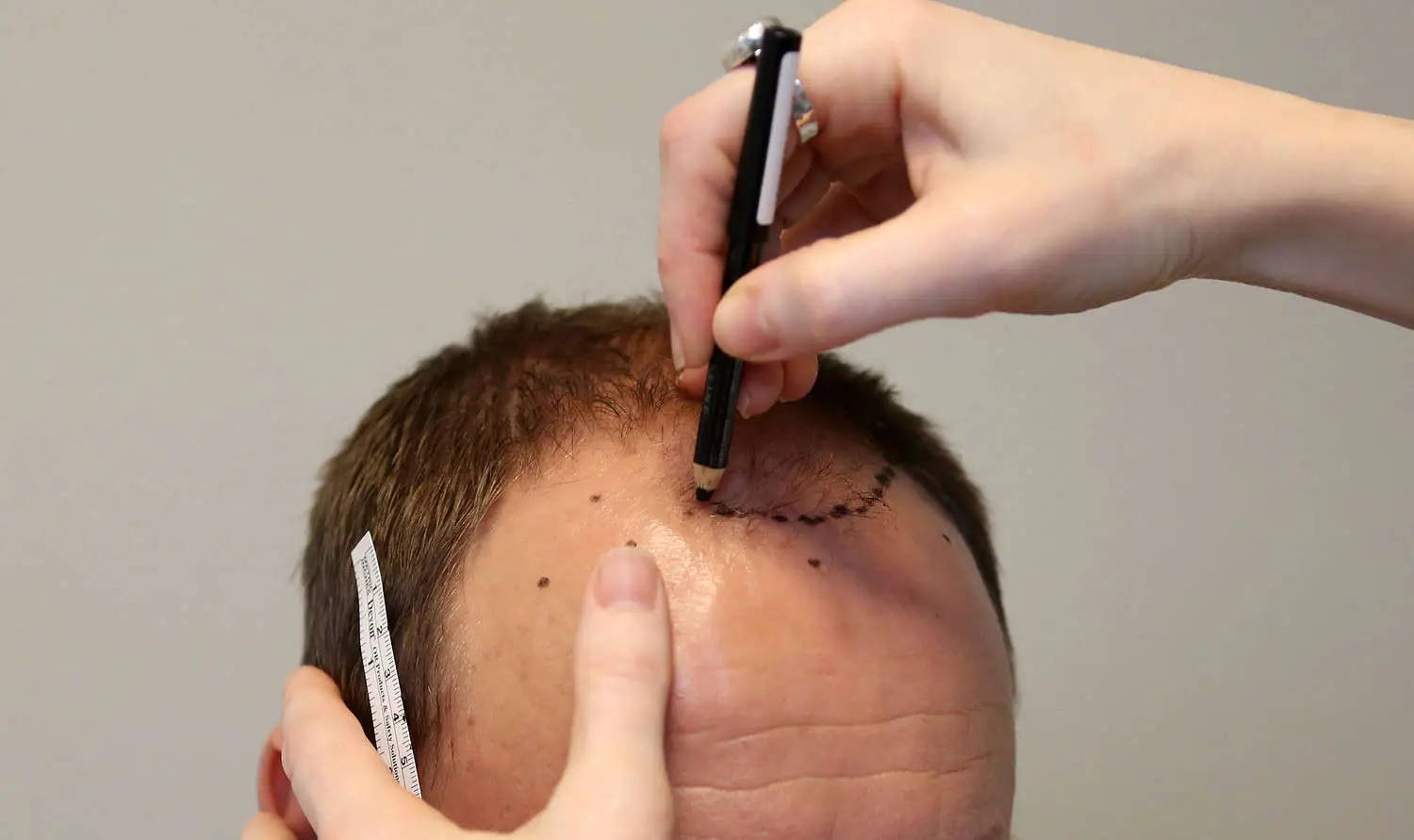
The recipient area is then mapped according to the crown’s whorl. Graft distribution and density may vary across the crown according to the patient’s anatomy, available donor supply and desired appearance. The surgeon must decide how to blend transplanted hair with native hair and how to avoid an abrupt border between areas.
The discussion should include more than the immediate crown. Patients should understand how many grafts may be used, what donor reserves might remain, whether the frontal and mid-scalp areas should be prioritised, and whether more than one stage could be appropriate. Because the crown may continue to change, a plan that looks acceptable today must also be considered in the context of future hair loss.
What should patients expect from the procedure and recovery?
Hair transplantation involves harvesting follicular units from the donor area and placing them into planned recipient sites. In the crown, placement follows the changing angles and directions of the whorl. The exact technique, number of grafts and session design depend on the clinical plan made by the physician.
After the procedure, patients should follow the clinic’s instructions for scalp care, washing, activity and follow-up. Recovery experiences vary, so the treating team should explain what to expect in the individual case. Patients travelling internationally should arrange enough time for their consultation, procedure and recommended follow-up, and should know how to contact the clinic if questions arise after returning home.
It is important to judge the result gradually and realistically. The appearance of the crown can change during the post-operative period, and the final assessment should be made according to the physician’s guidance rather than by comparing the scalp from day to day. The transplanted area may provide improved visual coverage, but it may not match the density of unaffected hair.
Risks and limitations of crown transplantation
As with any surgical procedure, hair transplantation has potential risks and limitations. The result may not provide the density or coverage the patient hoped for. Graft growth and the visual effect can be influenced by donor characteristics, recipient-site conditions, hair calibre, scalp contrast and the continuing loss of native hair.
The crown also presents specific design challenges. If the angle or direction of grafts does not follow the natural whorl, the result may look less natural. If grafts are concentrated too heavily in one area, the overall distribution of donor hair may be less balanced. A large bald crown may require more grafts than are reasonably available, making a lower-density or staged approach more appropriate.
Future progression is a major limitation. Transplanted hair does not prevent androgenetic alopecia from affecting non-transplanted follicles. Without an appropriate long-term plan, the surrounding hair may continue to thin and alter the appearance of the crown and neighbouring regions. This is why medical counselling and ongoing review are important parts of transplantation.
Crown hair transplant compared with prioritising the front
A crown-first strategy focuses donor grafts on the vertex, which may be appropriate for carefully selected patients. Its advantage is that it addresses the area the patient finds most noticeable. Its limitation is that it may consume donor resources that could later be needed for the hairline or mid-scalp.
A front-and-mid-scalp-first strategy usually aims to create a stronger facial frame and improve the areas most visible from the front. It may be preferred when donor supply is limited or when hair loss is likely to continue. The crown can then be monitored, treated later or addressed with a conservative density plan.
Neither approach is automatically correct. The best option depends on the individual pattern, the donor reserve and the patient’s priorities. A consultation should explain the advantages and trade-offs of each plan instead of presenting one universal rule.
Questions to ask during an international consultation
- Is my crown loss definitely caused by androgenetic alopecia, or is another diagnosis possible?
- How stable is my donor area, and how much donor supply should be reserved for future needs?
- Should the frontal hairline or mid-scalp be prioritised before the crown?
- What density and degree of coverage are realistic for my crown?
- How will the grafts follow my natural whorl pattern?
- Could a staged treatment plan be more appropriate than one crown-focused procedure?
- How should I manage existing native hair according to medical advice?
- What follow-up and aftercare support will be available if I return home after treatment in Turkey?
Key takeaways
A crown hair transplant can improve the appearance of vertex baldness, but complete restoration to original density cannot be promised routinely. The crown requires careful whorl-based design, changing angles and thoughtful graft distribution.
A long-term plan balances the patient’s current priorities with the possibility of future hair loss. When donor hair is limited, the frontal hairline and mid-scalp are commonly considered first because they may provide greater overall cosmetic benefit. The crown may be treated later, in stages or at a lower apparent density when appropriate.
Before deciding, seek an assessment from a qualified hair-transplant physician. A personalised plan should confirm the diagnosis, evaluate donor reserves, consider medical management, set realistic expectations and explain how the proposed treatment fits into your long-term hair-restoration goals.
Medical References
- Management of the crown — PubMed-indexed peer-reviewed review, Elsevier.
- Hair Transplantation — StatPearls Publishing, indexed in NCBI PubMed.
- Hair Transplant Practice Guidelines — Indian Association of Dermatologists, Venereologists and Leprologists Taskforce.
- Recipient Area — Peer-reviewed hair-transplantation review.
- Evidence-based (S3) guideline for the treatment of androgenetic alopecia in women and in men—short version — European Dermatology Forum guideline.