Written by: Estexper Medical Editorial Team
Medically reviewed by: Dt. Sait Gezer
Dental implants in Turkey can involve more than surgical placement. Long-term care may require maintenance, adjustment or replacement of prosthetic components, such as an abutment or fixation screw. If you plan to return home after treatment, it is important to know whether another dentist can identify your implant system and obtain compatible parts.
In Short
- Before leaving, request a written implant record with the exact manufacturer, model, dimensions, connection information and location of each implant.
- Ask the manufacturer or authorized distributor whether the exact system, prosthetic components and required instruments are available in your home country.
- Do not assume that parts from another brand, product line or third-party supplier will be compatible.
- Arrange follow-up with a qualified dentist at home where possible, as future care depends on clinical assessment and access to the correct components.
This issue depends less on the country where the implant was placed and more on whether the exact system and components are clearly documented and available through an appropriate manufacturer or distributor. Before leaving Turkey, request a complete written implant record and discuss future care with both your treating clinic and, where possible, a prospective dentist at home.
Why replacement-part availability matters
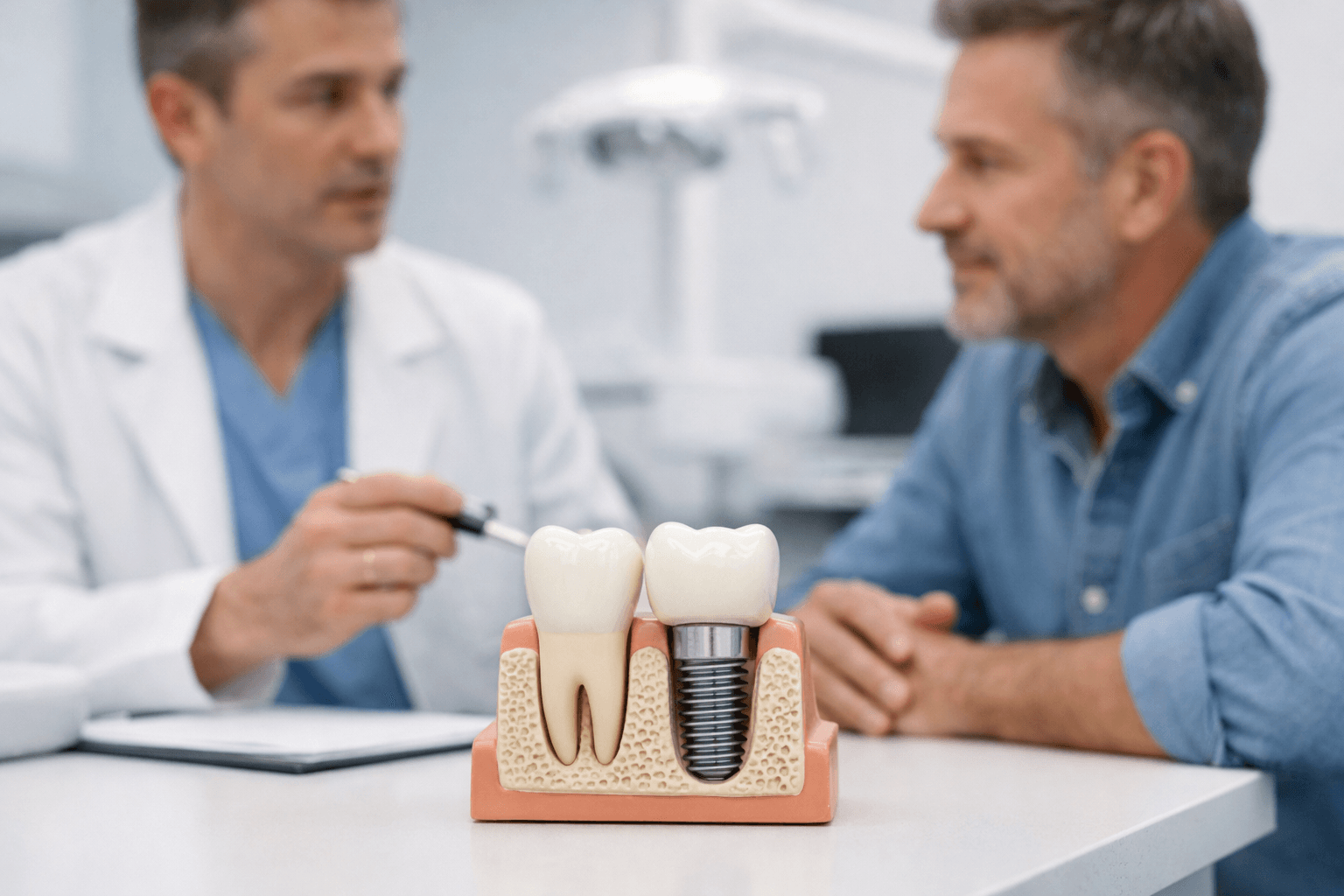
A dental implant restoration is usually made up of several components. These commonly include the implant body placed in the jaw, an abutment that connects the implant to the visible restoration, and an abutment fixation screw. The restoration may be a crown or another implant-supported prosthesis, often produced with the involvement of a dental laboratory.
These parts are designed as a system. They may differ in dimensions, connection geometry, materials and the instruments required for access or adjustment. If a screw becomes loose, an abutment needs replacement, or the restoration requires repair, the dentist may need the correct component and corresponding driver or other instrument.
Original and third-party components are not automatically equivalent. Differences in material or microgeometry may affect precision of fit and clinical performance. A future dentist should therefore confirm compatibility rather than relying on the appearance of a part or a general description such as a generic implant screw.
What information should you receive before leaving Turkey?
The U.S. Food and Drug Administration advises patients to record and retain the brand and model of their implant system. Professional guidance also emphasizes recording implant characteristics to support maintenance, retrievability and traceability.
Ask the clinic for a written record specific to you, rather than a general brochure about the implant brand. Ideally, the record should include:
- Implant manufacturer
- Product line, type or model
- Implant dimensions, including relevant length and diameter
- Connection type, when documented
- Location of each implant in the mouth
- Date of implant placement
- Abutment manufacturer and type
- Details of the crown, bridge or other restoration
- Restorative materials, where available
- Dental laboratory name and contact information
- Details of fixation screws or other prosthetic components, when recorded
- Copies of relevant radiographs and treatment records
The record should identify which information relates to each implant if you have more than one. A manufacturer name alone, without the model, dimensions and position, may not be sufficient for future treatment.
Request an implant card or equivalent documentation
Ask whether the clinic can provide an implant card or another document containing the system details. Keep the original document in a safe place and store a digital copy securely with your personal health records.
If the clinic provides labels from the implant packaging, ask whether copies can be added to your record. Packaging labels alone may not be enough: the final record should also explain where each implant was placed and which abutment or restoration was connected.
How to check availability before treatment
1. Ask the clinic for the exact system
Ask for the manufacturer, product line or model, dimensions and planned restorative components. Ask whether the same system is distributed in your home country and which company supplies it there.
Be cautious of answers that describe the implant only as premium, European or widely used without giving a precise model. A future dentist needs identifiable product information, not only a marketing description.
2. Contact the manufacturer or authorized distributor
Use the manufacturer’s official contact details to ask whether the exact implant system is distributed in your country. You can also ask whether the relevant abutments, fixation screws, restorative parts and instruments are available through authorized channels.
Availability may vary between countries, and a manufacturer may offer several product lines with similar names but different connections. Ask about the exact model, not only the brand. Request written confirmation when possible and keep it with your treatment records.
3. Ask a dentist at home to review the plan
Before travelling, contact a qualified dentist with experience in implant maintenance and ask whether they are willing to provide follow-up care. Give them the proposed manufacturer and model, if available, and ask whether they can identify a local supplier or authorized distributor.
The dentist may advise whether the planned restoration and components are practical for ongoing maintenance in your location. This does not replace an examination, and the dentist must make their own clinical assessment before providing care.
4. Confirm access to instruments as well as parts
Replacement components are only part of the issue. Implant systems may require specific drivers, tools or other equipment for removing, tightening or adjusting components. Ask whether the local dentist or distributor can access the instruments needed for the exact system.
A component may technically exist but still be difficult to use if the appropriate instrument is unavailable. Confirming both parts and tools may help avoid delays if maintenance is needed.
What to ask the clinic before booking
When comparing dental implant providers in Turkey, include documentation and future care in your questions. You may ask:
- Which implant manufacturer and exact model will be used?
- Will I receive the brand, model, size and location of every implant in writing?
- Will the abutment type, fixation screw and restorative materials be recorded?
- Will I receive copies of radiographs and treatment notes?
- Which dental laboratory will produce the restoration?
- Is the system distributed in my home country?
- Can you provide the manufacturer’s official contact details or local distributor information?
- What follow-up arrangements are available if I develop a mechanical or biological problem after returning home?
- Who should my dentist contact if a replacement component is required?
You should be able to understand what has been placed and how this information can be transferred to another dental professional.
Why original and third-party components should not be assumed to match
Some replacement parts may be described as compatible with a particular implant system. However, compatibility should be confirmed for the exact implant and restoration. Original and third-party components may differ in material, dimensions or connection microgeometry.
Even small differences in fit may affect how forces are transferred or how securely a component connects. The available evidence does not support assuming that every alternative part will perform in the same way as the original manufacturer’s component.
If a dentist suggests a third-party component, ask how compatibility has been verified and whether appropriate manufacturer information is available. The decision should be based on a professional assessment of your specific implant and restoration, not simply on whether the part looks similar.
What happens if you do not have complete records?
If your records are missing, a dentist may investigate the implant system using clinical information, radiographs, the shape of visible components or other identification tools. Radiographic identification resources may assist with an unknown implant, but identification is not always definitive.
An image alone may not show every detail required to select a replacement part. Different systems can have similar radiographic appearances, and the abutment or restoration may obscure important information. Written manufacturer documentation is therefore more reliable than relying on an image alone.
If you cannot obtain records from the clinic, contact the manufacturer or an experienced implant dentist. Do not remove or alter components simply to identify them. A qualified dental professional should decide what examination or imaging is appropriate.
Maintenance after returning home
Dental implants and implant-supported restorations require continuing professional monitoring. Follow-up visits may include assessment of the implant, abutments, restoration and surrounding tissues, together with evaluation of oral hygiene and any changes in comfort or function.
Regular maintenance can help identify biological and mechanical complications at an earlier stage. Mechanical problems may include loosening or damage involving restorative components, while biological problems may affect the tissues around an implant.
Contact a dental professional if you notice movement, a change in your bite, discomfort, swelling, bleeding around the implant, damage to the crown or a loose-feeling restoration. Do not attempt to tighten a screw or repair an implant-supported restoration yourself.
Preparing a practical document folder
Before leaving Turkey, create a document folder containing:
- Your implant card or written implant report
- Manufacturer and distributor contact details
- Implant and abutment model information
- Dimensions and mouth locations
- Placement and restoration dates
- Radiographs in a commonly readable digital format, when available
- Dental laboratory and restorative material details
- Names and contact details for the treating clinic and your dentist at home
- Any written instructions for maintenance and follow-up
Ask the clinic to check that the records are complete before you travel. If the documentation uses abbreviations, request an explanation in English or in a language your home dentist can understand.
Frequently asked questions
Are dental implant parts interchangeable between brands?
No. Parts should not be assumed to be interchangeable between brands or even between product lines from the same manufacturer. Compatibility must be confirmed for the specific implant, connection and restoration.
Can a dentist at home maintain implants placed in Turkey?
Often, a dentist may be able to provide maintenance, but this depends on their clinical assessment, the available records, the implant system and access to appropriate components and instruments. Arrange follow-up care in advance whenever possible.
Is the implant brand enough information?
Usually, more detail is needed. The model or product line, dimensions, location, abutment information, restoration details and relevant radiographs can all help with future care.
What if the exact replacement part is not available locally?
Ask the manufacturer or authorized distributor whether the part can be obtained through an appropriate channel. Your dentist may need to assess available options, but an alternative should not be selected solely because it appears similar.
Who decides whether dental implants are suitable for me?
Your suitability for implant treatment must be assessed individually by a qualified dental professional after reviewing your oral health, medical history, anatomy and treatment objectives. This article cannot determine whether implants are appropriate for you.
Key points for international patients
- Request the exact implant brand, model, dimensions and location in writing.
- Record abutment, fixation screw, restoration and laboratory details.
- Obtain copies of radiographs and treatment records.
- Ask the manufacturer or authorized distributor about availability in your home country.
- Ask a prospective dentist at home to review the system and confirm access to parts and instruments.
- Do not assume that third-party components are equivalent to original parts.
- Keep your records permanently and attend regular professional maintenance visits.
Explore our Cosmetic Dentistry services in Turkey for an overview of treatment options and individual assessment.
TREATMENT OPTIONS
Explore Your Treatment Options
Find out more about our services and discuss which options may suit your individual needs.
YOUR NEXT STEP
Discuss Your Questions With Our Team
Request an individual assessment or ask our team about treatment planning and follow-up arrangements.
Medical References
- Dental Implants: What You Should Know — U.S. Food and Drug Administration.
- Dental Implants — FDI World Dental Federation.
- Prosthetic design and choice of components for maintenance of optimal peri-implant health: a comprehensive review — British Dental Journal; PubMed.
- Maintenance protocols for implant-supported dental prostheses: A scoping review — Journal of Prosthetic Dentistry; PubMed.
- Mechanical and Technical Risks – Consensus Statements — International Team for Implantology.
- 2022 Council on Dental Practice Annual Report — American Dental Association.