Written by: Estexper Medical Editorial Team
Medically reviewed by: Dt. Sait Gezer
Many people who are considering or already have dental implants ask an important question: can dental implants get cavities? The short answer is no. The implant fixture itself is usually made from titanium or zirconium oxide rather than natural tooth tissue, so it cannot develop dental caries in the same biological way as a natural tooth.
In Short
Dental implants and implant-supported crowns do not get cavities because they are not made of natural tooth tissue. However, plaque can contribute to inflammation around an implant, and nearby natural teeth can still develop decay. Regular cleaning and professional monitoring remain important.
However, this does not mean that an implant-supported restoration is completely free from oral health problems. Bacterial plaque can collect around an implant crown or abutment, and inflammation may develop in the surrounding gum and bone. Natural teeth beside the implant can also still develop cavities, including decay between teeth or on exposed root surfaces.
Understanding the difference between tooth decay, implant complications, and peri-implant disease can help you protect your oral health and know when to seek a professional examination.
Why Dental Implants Do Not Get Cavities
Dental caries, commonly called tooth decay or cavities, is a biofilm- and sugar-driven disease affecting susceptible natural dental tissues. Bacteria in dental plaque use sugars and other fermentable carbohydrates, producing acids that can gradually demineralize enamel, dentin, or cementum.
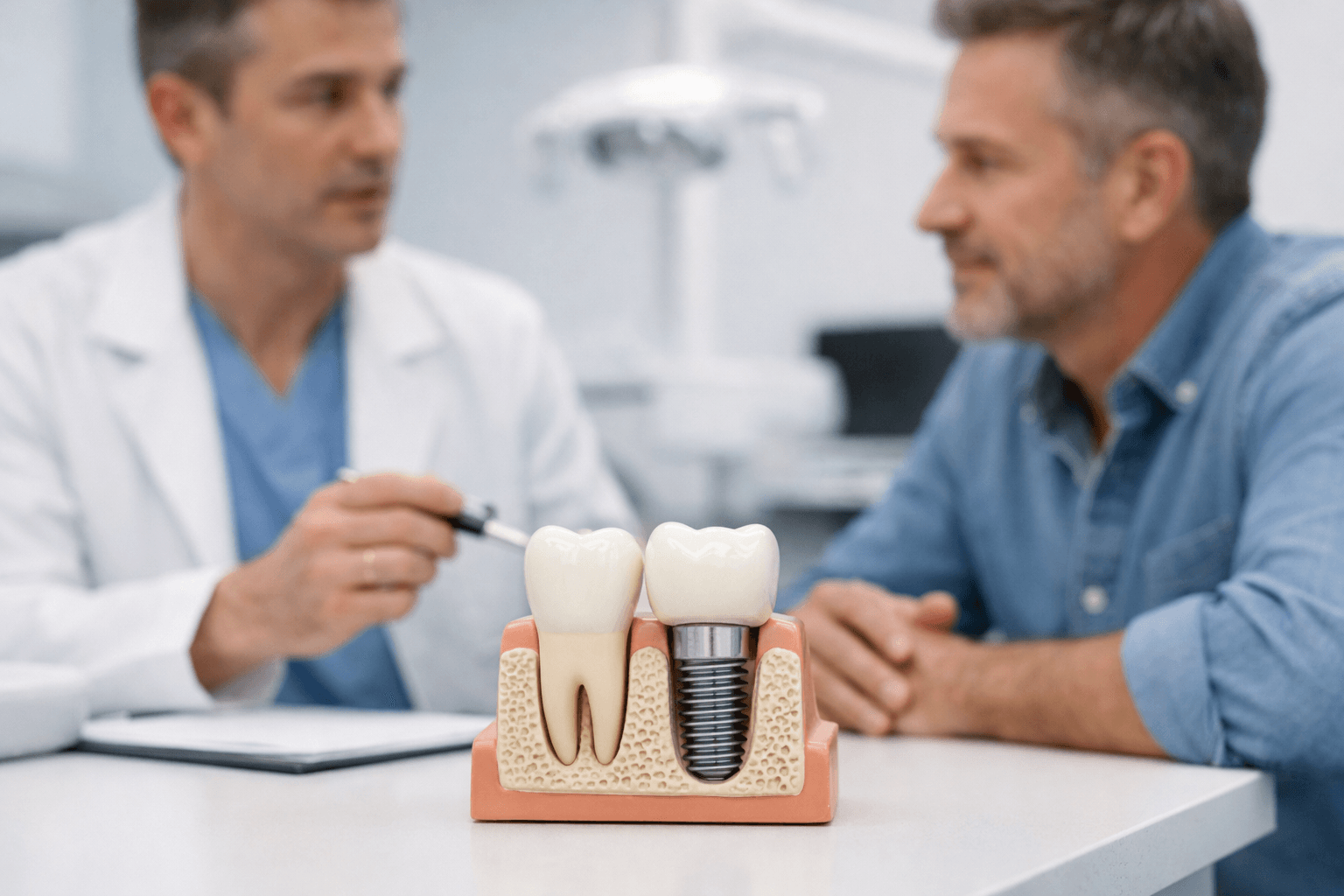
A dental implant is different from a natural tooth. The implant fixture placed in the jaw is generally made from titanium or zirconium oxide. These materials are not enamel, dentin, or cementum, so they do not undergo the same cavity-forming process.
The visible restoration may include an abutment and crown made from materials such as titanium, zirconia, ceramic, metal alloys, or other restorative substances. These components can experience wear, fracture, loosening, poor fit, or retention problems, but these issues are not dental caries.
What parts of an implant system can be affected?
- Implant fixture: The fixture itself does not develop a cavity.
- Abutment: The abutment does not decay like natural enamel or dentin, but its surface and surrounding area can collect plaque.
- Implant crown: The crown cannot develop a biological cavity, although it may fracture, wear, loosen, or become difficult to clean.
- Nearby natural teeth: These remain vulnerable to cavities and other dental diseases.
- Gum and supporting bone: These tissues can become inflamed around an implant, leading to peri-implant disease.
What Can Happen Instead of a Cavity?
Although an implant cannot get a cavity, it can be affected by biological and mechanical complications. The main biological concern is peri-implant disease.
Peri-implant mucositis
Peri-implant mucositis is inflammation of the soft tissue around an implant. Plaque accumulation is an important factor. The condition affects the tissue around the implant but does not mean that the implant has developed tooth decay.
Peri-implantitis
Peri-implantitis involves inflammation around the implant together with progressive loss of supporting bone. It is a different disease from dental caries, but it can threaten the stability and long-term function of an implant if it is not assessed and managed by a qualified dental professional.
Possible warning signs include bleeding during cleaning, persistent swelling, redness, tenderness, unpleasant taste or odor, or changes in how the restoration feels. These symptoms are not specific to one condition, so an examination is needed rather than self-diagnosis.
Mechanical and restorative complications
Implant restorations may also require maintenance for reasons unrelated to cavities. These can include:
- Fracture or chipping of ceramic or crown material
- Wear of restorative surfaces
- Loss of retention
- Screw loosening
- Poor fit or changes in the contact between teeth
- Problems related to excess cement
- Surfaces or contours that make plaque control more difficult
These complications should be evaluated by a dentist familiar with implant restorations. Continuing to use a loose, damaged, or uncomfortable restoration without assessment may make cleaning more difficult and allow irritation to continue.
Can the Natural Teeth Beside an Implant Get Cavities?
Yes. A natural tooth next to an implant remains a natural tooth and can still develop caries. This includes decay on chewing surfaces, between the implant and neighboring tooth, around an existing filling or crown, and on an exposed root surface.
Research has reported decay and the need for restorative, endodontic, or extraction treatment in natural teeth adjacent to restored implants. However, the available evidence is mainly retrospective and observational. This means that studies have identified associations, but they do not prove that the implant itself directly causes cavities.
Factors that may be associated with decay in adjacent teeth include oral hygiene, frequent dietary sugar exposure, existing restorations, the distance between the implant and natural tooth, loss of a proximal contact, and the shape or emergence profile of the implant restoration.
Why cleaning access matters
An implant crown should be designed and positioned so that the surrounding area can be cleaned as effectively as possible. If a space is too tight, a contact is difficult to access, or the restoration contour traps food and plaque, maintaining the neighboring natural tooth may become more challenging.
This does not mean every difficult-to-clean area will cause decay, nor does it prove that a particular restoration caused a cavity. It does mean that cleaning access and regular professional monitoring are important parts of implant care.
How to Protect Dental Implants and Natural Teeth
The fact that an implant cannot get a cavity does not eliminate the need for daily oral hygiene. Plaque can affect the gums around an implant, the neighboring teeth, and other natural teeth throughout the mouth.
Maintain careful plaque control
Follow the cleaning routine recommended by your dentist. Depending on your restoration and oral anatomy, this may involve a toothbrush, interdental cleaning, or other aids selected for the spaces around the implant. The goal is to clean the implant-supported restoration and adjacent teeth effectively and gently.
Pay attention to the natural teeth
Do not focus only on the implant. Natural teeth can still develop cavities, periodontal disease, cracks, and root-surface problems. Cleaning between teeth is particularly important because interproximal decay may not be obvious when looking in the mirror.
Discuss your individual caries risk
Your dentist can assess factors such as existing restorations, previous decay, oral hygiene, dietary sugar exposure, and the condition of the teeth near the implant. The appropriate preventive plan depends on your individual findings and should be determined by a qualified dental professional.
Attend regular professional monitoring
Implants and their surrounding tissues require ongoing observation. Professional appointments can help identify inflammation, bone changes, loose components, damaged restorations, or cavities in neighboring teeth. Patients who travel internationally for dental treatment should also arrange a practical follow-up plan with the treating clinic and, where needed, a local dentist after returning home.
What Happens During an Evaluation?
If you notice pain, bleeding, swelling, food trapping, a loose crown, or sensitivity near an implant, a dentist may examine both the implant restoration and the natural teeth around it. The assessment may include a clinical examination and, when appropriate, dental imaging.
The purpose is to determine whether the problem involves:
- A cavity in a natural tooth
- Inflammation of the soft tissue around the implant
- Possible supporting-bone changes
- A loose or fractured restoration
- A contact, contour, or cement-related issue
- Another dental condition unrelated to the implant
Because symptoms can overlap, an implant cannot be diagnosed as having a cavity simply because the area is painful or sensitive. A qualified dentist must identify the source of the problem before recommending care.
Can an Implant Be Connected to a Natural Tooth?
In some treatment situations, an implant-supported restoration may be positioned beside a natural tooth or may be part of a restoration involving both implant and natural-tooth structures. When natural tooth tissue is present, that tissue remains susceptible to decay.
The implant portion still does not develop caries, but any exposed enamel, dentin, cementum, or natural root surface can be affected. The design must also allow effective hygiene and appropriate professional monitoring. Whether a particular arrangement is suitable depends on the patient’s dental condition, bone and gum health, bite, existing restorations, and overall treatment plan.
Common Questions About Cavities and Dental Implants
Can bacteria damage a titanium implant?
Bacteria do not create a cavity in titanium in the way they demineralize natural tooth tissue. However, bacterial plaque around an implant can contribute to inflammation of the surrounding soft tissue and, in some cases, supporting-bone loss known as peri-implantitis.
Can an implant crown need a filling?
An implant crown does not receive a conventional filling for tooth decay because it is not a natural tooth. If it becomes damaged, worn, fractured, or loose, the dentist will assess whether it can be repaired, adjusted, or needs another form of restoration-related care.
Can the tooth next to an implant need a filling?
Yes. A natural tooth next to an implant can develop a cavity and may need restorative treatment. The implant itself is not the decayed structure.
Is pain around an implant always a cavity?
No. Pain or discomfort may be related to gum inflammation, peri-implant disease, a loose component, a damaged crown, an adjacent natural tooth, or another dental problem. Professional assessment is necessary to determine the cause.
Do dental implants require less care because they cannot decay?
No. Although the implant fixture cannot develop a cavity, the tissues around it and the natural teeth in the mouth still require daily care. Maintenance is important for reducing plaque accumulation and identifying problems early.
Key Takeaway
Dental implants do not get cavities because the implant fixture and restorative components are not natural tooth tissues affected by dental caries. Nevertheless, implant restorations can fracture, loosen, wear, or contribute to plaque retention, while the surrounding tissues can develop peri-implant mucositis or peri-implantitis.
Most importantly, natural teeth beside an implant remain vulnerable to decay. Good plaque control, suitable cleaning access, management of existing oral disease, and regular professional monitoring can help protect both the implant and the teeth around it. If you are considering treatment in Turkey or already have an implant, discuss your individual risks and follow-up needs with a qualified dentist.
Explore our Cosmetic Dentistry services in Turkey for an overview of treatment options and individual assessment.
TREATMENT OPTIONS
Explore Your Treatment Options
Find out more about our services and discuss which options may suit your individual needs.
YOUR NEXT STEP
Discuss Your Questions With Our Team
Request an individual assessment or ask our team about treatment planning and follow-up arrangements.
Medical References
- Dental Implants: What You Should Know — U.S. Food and Drug Administration.
- Caries Risk Assessment and Management — American Dental Association.
- AO/AAP Consensus on Prevention and Management of Peri-Implant Diseases and Conditions: Summary Report — Academy of Osseointegration and American Academy of Periodontology; Journal of Periodontology.
- Prevention and Treatment of Peri-Implant Diseases: The EFP S3-Level Clinical Practice Guideline — European Federation of Periodontology.
- Prevalence of Decay and Tooth Condition Changes Adjacent to Restored Dental Implants: A Retrospective Radiographic Study — PubMed; International Journal of Oral & Maxillofacial Implants.
- Influence of Implant-Tooth Proximity on Incidence of Caries in Teeth Adjacent to Implants in Molar Sites: A Retrospective Radiographic Analysis of 300 Consecutive Implants — PubMed; International Journal of Oral & Maxillofacial Implants.