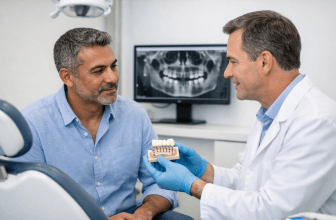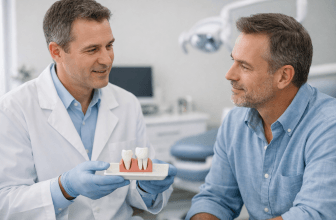
Can you get dental implants with gum disease? In many cases, people who have had gum disease may still be considered for dental implants. However, active or uncontrolled periodontitis should generally be treated and stabilized before elective implant placement.
This is important because dental implants need healthy surrounding tissues and effective plaque control. A history of periodontitis does not automatically mean that implants are impossible, but it can increase the risk of inflammation around the implant, marginal bone loss and, over time, implant loss. Your suitability must be assessed individually by a qualified dentist, periodontist or oral and maxillofacial surgeon.
This guide explains the usual treatment order, eligibility factors, risks, preparation and long-term maintenance for patients considering dental implants after gum disease, including international patients planning treatment in Turkey.
What is the connection between gum disease and dental implants?
Periodontitis is an inflammatory disease that can damage the gum and bone supporting natural teeth. Dental implants are also surrounded by gum tissue and bone, so the same risk factors that contribute to periodontal inflammation can affect the tissues around an implant.
Inflammation around an implant may begin as peri-implant mucositis and can progress to peri-implantitis, a condition associated with supporting bone loss. Poor biofilm control, smoking, uncontrolled diabetes and a previous history of periodontitis are recognized risk factors for peri-implant disease. Implant position, restoration design and other prosthetic factors may also influence risk.
For this reason, implant treatment is not usually planned simply by replacing a missing tooth. The dental team must first evaluate the condition of the gums, the remaining teeth, the bone and the patient’s ability to maintain oral health over the long term.
Can you get implants if you have had gum disease?
Yes, you may be eligible if your previous gum disease has been appropriately treated and is stable. Patients with a history of periodontitis can receive implant treatment, but they may need more careful planning and closer supportive maintenance than patients without this history.
Active, uncontrolled periodontal disease is generally a reason to delay implant placement. Placing an implant while periodontal inflammation and disease activity remain uncontrolled may make it more difficult to achieve stable tissues and may increase the risk of complications affecting the implant or other teeth.
Eligibility is not decided by the history of gum disease alone. Your dental team may consider:
- Whether periodontal inflammation and disease activity are currently controlled
- The condition of the remaining natural teeth and their supporting bone
- Your plaque and biofilm control at home
- Whether you smoke or use tobacco products
- Whether diabetes is present and adequately controlled
- The amount and quality of bone at the proposed implant site
- Your general health and ability to undergo dental treatment
- Your willingness to attend regular supportive periodontal and implant maintenance
A consultation and complete examination are needed before a decision can be made. Online photographs or a general medical history cannot determine implant eligibility on their own.
Recommended treatment order before dental implants
For patients with current or previous periodontitis, treatment is usually planned in stages. The exact sequence can vary according to the condition of your mouth, the teeth being replaced and the findings of your dental examinations.
1. Periodontal examination and diagnosis
The first step is a detailed periodontal assessment. This may include examination of the gums, evaluation of plaque control, assessment of tooth mobility and dental imaging where appropriate. The clinician will also review risk factors such as smoking, diabetes, oral hygiene habits and previous periodontal treatment.
This stage helps identify whether gum disease is active, which teeth have a poor prognosis and whether the proposed implant area has adequate supporting bone and suitable anatomy.
2. Active periodontal treatment and risk-factor control
If periodontitis is present, the priority is to manage it before proceeding with elective implant placement. Treatment may include non-surgical periodontal therapy and personalized oral hygiene instruction. Risk-factor control is also important, particularly improving plaque control, addressing smoking and coordinating care for uncontrolled diabetes where relevant.
Teeth that cannot be predictably maintained may require additional periodontal treatment or extraction. These decisions should be made after a careful assessment rather than solely because an implant is being considered.
3. Re-evaluation and confirmation of periodontal stability
After active periodontal treatment, the dental team should re-evaluate the gums and the patient’s home-care routine. The aim is to achieve periodontal stability where possible and confirm that the patient can maintain an appropriate level of oral hygiene.
If inflammation remains active, further treatment may be needed before implant planning continues. The European Federation of Periodontology emphasizes stepwise treatment, reassessment and ongoing supportive periodontal care as part of periodontal management.
4. Assessment of the proposed implant site
Once the periodontal condition is stable, the proposed implant site can be assessed in more detail. The clinician will consider the available bone, the position of nearby anatomical structures, the condition of neighboring teeth and the planned restoration.
If there is insufficient bone or an unfavorable site anatomy, additional procedures may be considered. The need for such treatment depends on the individual examination and imaging findings. Your dentist should explain the possible benefits, limitations and risks before recommending any additional procedure.
5. Implant placement and restoration
After the disease and risk factors have been reviewed, the implant can be planned according to the restorative goal. The implant placement and restoration should be coordinated with the condition of the surrounding tissues and the patient’s ability to maintain them.
The timing of each stage varies. A qualified clinician should provide an individualized plan rather than applying a fixed schedule to every patient.
6. Long-term supportive maintenance
Maintenance is not an optional final step. Patients with a history of periodontitis need ongoing supportive periodontal and peri-implant care to monitor the gums, natural teeth, implant tissues, plaque control and any changes in bone levels.
Professional review intervals are selected according to individual risk. Home care and regular attendance are especially important because an implant cannot be treated as a one-time procedure with no further monitoring.
What are the risks of implants after gum disease?
Research generally associates a history of periodontitis with higher risks of implant failure, peri-implantitis and marginal bone loss compared with patients who have no history of periodontitis. A recent systematic review of prospective cohort studies also reported these associations, although the certainty of evidence was rated low because randomized clinical trials were lacking.
Another recent review reported higher risks of implant loss, marginal bone loss and peri-implantitis in patients with previous periodontitis. The reported risk of implant loss was particularly increased with longer follow-up of 10 years or more and among patients with a history of rapidly progressive Grade C periodontitis.
These findings do not mean that every patient with previous gum disease will experience implant problems. They mean that the risk profile may be less favorable and that prevention, careful planning and maintenance are particularly important.
Potential concerns include:
- Inflammation of the tissues around the implant
- Progressive bone loss around the implant
- Problems affecting neighboring natural teeth if periodontal disease returns
- Implant complications or implant loss
- The need for additional treatment and long-term monitoring
Evidence is not completely uniform. Some older reviews did not find a statistically significant difference in short- or medium-term implant survival between patients with and without a history of periodontitis, although they still reported more marginal bone loss or peri-implant disease in patients with periodontitis. This is why implant survival should not be confused with overall treatment success or long-term peri-implant health.
How smoking, diabetes and oral hygiene affect eligibility
A previous diagnosis of gum disease is only one part of the risk assessment. Smoking, uncontrolled diabetes and poor plaque control can make tissue stability more difficult. The 2025 AO/AAP consensus also identifies obesity and unfavorable implant or prosthetic factors among considerations relevant to peri-implant disease.
This does not mean that every risk factor automatically prevents treatment. Instead, your dental team may recommend risk-factor management before implant placement or may advise that the expected risks are higher than average. Honest discussion of smoking, medications, diabetes and previous dental problems helps the clinician create a safer and more realistic plan.
What preparation may be needed?
Preparation depends on your periodontal and general health. It may include:
- A complete periodontal and dental examination
- Imaging to evaluate the proposed implant site and surrounding anatomy
- Professional periodontal treatment if active disease is present
- Improved home plaque-control techniques
- Review of smoking and diabetes status
- Assessment of teeth with a poor prognosis
- A discussion of the planned implant restoration and maintenance requirements
International patients considering treatment in Turkey should provide accurate medical and dental history, including previous periodontal treatment, current medications, smoking status and diabetes information. Ask the clinic how the periodontal assessment, implant planning, restoration and follow-up will be coordinated. You should also understand what arrangements are available if monitoring or further treatment is needed after returning home.
Recovery and aftercare considerations
Recovery instructions depend on the procedure performed and your clinician’s assessment. Follow the dental team’s instructions regarding oral hygiene, medication and review appointments. Do not assume that discomfort or swelling is a sign of success or failure; contact the treating clinic if you have concerns or symptoms that seem unusual.
After the restoration is completed, daily cleaning around the implant and remaining teeth is essential. Your maintenance plan may include professional plaque removal, periodontal assessments and monitoring of the tissues around the implant. The goal is to identify inflammation or changes early and to protect both the implant and the natural teeth.
Patients with a history of periodontitis should view supportive care as a continuing part of implant treatment rather than a temporary recommendation.
Are dental implants the only option?
Implants are not automatically the best choice for every patient with gum disease. The alternatives depend on the number and condition of missing teeth, the health of the remaining teeth, available bone, general health, personal preferences and the ability to attend maintenance appointments.
Your dentist may discuss whether maintaining a compromised natural tooth is predictable or whether a removable or fixed tooth-replacement option is more appropriate. Each option has its own advantages, limitations and maintenance requirements. The decision should be based on a full examination and an informed discussion of expected risks rather than on appearance alone.
Questions to ask before treatment
- Is my periodontal disease currently active or stable?
- What treatment is needed before implant placement?
- Which teeth have a poor long-term prognosis?
- How will my smoking, diabetes or other health conditions affect the plan?
- Is there enough bone and suitable anatomy at the implant site?
- What are my risks of peri-implantitis, bone loss or implant loss?
- What maintenance schedule will I need after treatment?
- How will follow-up be managed if I travel internationally for treatment?
Conclusion
Dental implants may be possible after gum disease, but active or uncontrolled periodontitis should generally be treated before implant placement. The usual order is periodontal diagnosis, active treatment and risk-factor control, re-evaluation, site assessment, implant planning and long-term supportive maintenance.
A history of periodontitis does not automatically exclude you from implant treatment. However, it can increase the risk of peri-implantitis, marginal bone loss and implant loss, especially when other risks such as smoking, uncontrolled diabetes or poor plaque control are present. A qualified dental professional must assess your individual suitability and explain whether the expected benefits and risks are acceptable for you.
Medical References
- Treatment of stage I–III periodontitis—The EFP S3 level clinical practice guideline — European Federation of Periodontology; Journal of Clinical Periodontology.
- AO/AAP consensus on prevention and management of peri-implant diseases and conditions: Summary report — Academy of Osseointegration and American Academy of Periodontology; Journal of Periodontology.
- History of periodontitis as a risk factor for implant failure and incidence of peri-implantitis: A systematic review, meta-analysis, and trial sequential analysis of prospective cohort studies — Clinical Implant Dentistry and Related Research; PubMed.
- Effectiveness of Implant Therapy in Patients With and Without a History of Periodontitis: A Systematic Review With Meta-Analysis of Prospective Cohort Studies — Journal of Periodontal Research; PubMed.
- Dental Implant Procedures — American Academy of Periodontology.
- Should implants be considered for patients with periodontal disease? — PubMed.