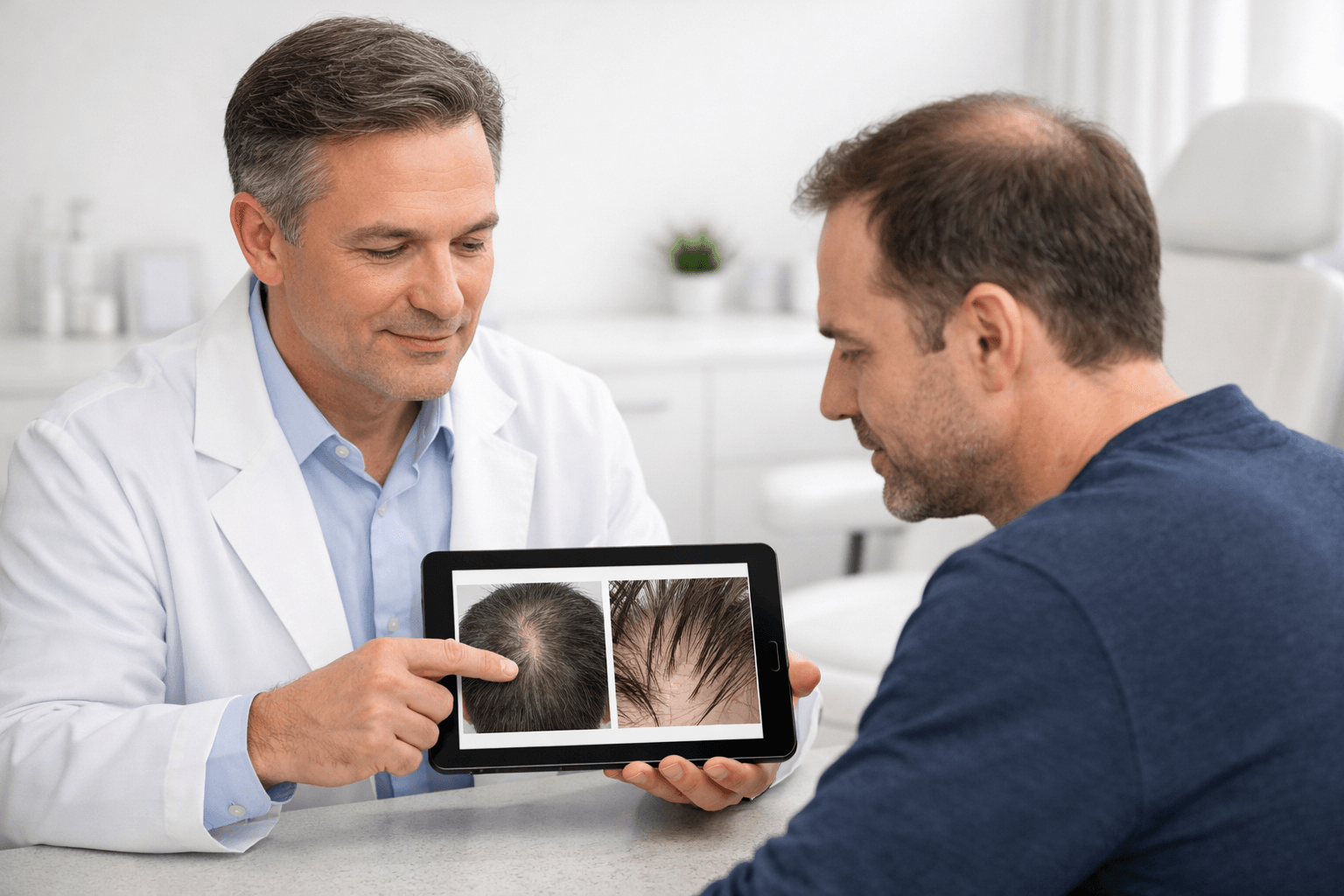
When researching hair restoration, one of the first decisions is often whether to choose FUE or FUT hair transplant surgery. Both techniques use your own hair follicles to restore areas affected by hair loss, but they differ in how grafts are removed from the donor area.
FUE removes follicular units individually with small punches, while FUT removes a strip of hair-bearing scalp that is then divided into individual follicular units under magnification. Neither method is universally better for every patient. The most suitable approach depends on your donor density, scalp characteristics, hair loss pattern, hairstyle, scar preferences, anticipated future procedures and the experience of the surgical team.
This guide explains the main differences between FUE and FUT, what the procedures involve, and which factors should be assessed during a consultation at Estexper Clinic. A qualified physician must determine your suitability after examining your scalp and discussing your medical history and goals.
What Is the Difference Between FUE and FUT?
FUE hair transplant
FUE, or follicular unit excision, involves removing individual follicular units from the donor area using a small punch. These follicular units usually contain naturally grouped hairs. After extraction, the grafts are prepared and placed into recipient sites created in areas of thinning or hair loss.
Because the grafts are removed separately, FUE does not create one continuous linear incision in the donor area. Instead, it produces multiple small, round scars. These scars may be less noticeable when the hair is worn short, although extensive extraction can lead to visible donor-area thinning or a moth-eaten appearance if harvesting is not carefully planned.
FUT hair transplant
FUT, also called follicular unit transplantation or strip harvesting, involves removing a strip of hair-bearing scalp from the donor area. The strip is dissected under magnification into follicular unit grafts, which are then transplanted to the recipient area.
FUT generally leaves one linear scar in the donor area. The appearance of this scar depends on factors such as surgical technique, wound healing, scalp laxity and how the hair is styled. FUT can be an efficient option when a larger number of grafts is needed, or when the patient’s donor characteristics and scalp laxity make strip harvesting appropriate.
FUE vs FUT: Main Differences
Both techniques can provide high-quality grafts when appropriately selected and performed by a properly trained surgical team. The main differences relate to graft removal, scar pattern, recovery, donor-area management and how future procedures may be planned.
| Factor | FUE | FUT |
|---|---|---|
| Harvesting method | Individual follicular units are removed with punches. | A strip of hair-bearing scalp is removed and dissected into grafts. |
| Donor-area scarring | Multiple small, round scars. | Usually one linear scar. |
| Early recovery | Generally associated with less early donor-site discomfort and a shorter donor-site recovery. | May involve more discomfort and sensory disturbance in the donor area during early recovery. |
| Short hairstyles | May be preferred by patients who wish to avoid a linear scar, although punctate scars can still be visible. | The linear scar may be more relevant for patients who wear their hair very short. |
| Large graft requirements | Can be suitable in selected cases, but the donor area must be carefully assessed. | May allow efficient harvesting of a larger number of grafts in appropriate patients. |
| Future planning | Requires careful control of extraction patterns to avoid overharvesting. | Requires consideration of the linear scar and available scalp laxity if further surgery may be needed. |
This comparison is a general guide rather than a treatment recommendation. Comparative research has limitations because many studies are retrospective, non-randomized or involve different patient groups and graft numbers. As a result, reported differences should be interpreted in the context of an individual assessment.
Is FUE Better Than FUT?
FUE is often attractive to patients who strongly prefer to avoid a linear scar. It is also generally associated with less early postoperative pain and less donor-site sensory disturbance than FUT. Some patients may value the possibility of wearing their hair shorter, although the punctate scars created by FUE are not always invisible.
However, FUE is not automatically the better technique. Extensive extraction can reduce the visual density of the donor area, particularly if grafts are removed too closely together or beyond the safe donor supply. FUE may also require shaving or shortening part of the donor area, depending on the plan and the surgeon’s technique. The physician must evaluate whether the donor area can support the planned extraction without excessive depletion.
Is FUT Better Than FUE?
FUT may be helpful when a patient needs a substantial number of grafts and has suitable scalp laxity and donor characteristics. Because a strip is removed and then dissected, it can provide an efficient way to harvest follicular units while limiting the number of individual punch sites across the donor area.
FUT can also be considered when preserving the appearance of overall donor density is important or when avoiding extensive donor-area shaving matters. On the other hand, it creates a linear scar and may involve more early postoperative discomfort or altered sensation than FUE. The scar may be significant for people who prefer very short hairstyles.
FUT is not appropriate for everyone. Scalp laxity, previous surgery, donor density, hair characteristics and the likely need for future procedures all influence whether strip harvesting is suitable.
Which Technique May Suit You?
The decision between FUE and FUT should be based on a complete consultation rather than on the technique’s popularity. Important factors include:
- Donor density: The physician must assess how much healthy donor hair is available and how safely it can be used.
- Scalp laxity: This is particularly relevant when considering FUT, because strip removal requires the scalp to close appropriately.
- Hair characteristics: Hair thickness, curl and the way hair grows can affect planning and graft handling.
- Extent of hair loss: The size of the recipient area and the number of grafts required influence the harvesting strategy.
- Hairstyle: Patients who regularly wear their hair very short may have different scar priorities from those who keep their hair longer.
- Future procedures: Ongoing hair loss and the possibility of another transplant should be considered when planning the donor supply.
- Personal preferences: Some patients prioritize avoiding a linear scar, while others prioritize efficient harvesting or limiting donor-area shaving.
- Surgeon expertise: Outcomes depend on diagnosis, donor planning, graft handling, recipient-site design and appropriate supervision of the surgical team.
A physician may recommend FUE, FUT or, in selected circumstances, discuss both as reasonable options. The aim is not simply to transplant as many grafts as possible, but to use the donor supply responsibly and create a natural, sustainable plan.
What Happens During a Hair Transplant?
Although the harvesting steps differ, both FUE and FUT involve several important stages. The process begins with an examination of the scalp, the pattern of hair loss and the donor area. The treatment plan should address the diagnosis, the design of the recipient area, the expected use of donor hair and the possibility of future hair loss.
During the procedure, the donor area is prepared and the follicular units are removed using the selected technique. The grafts are inspected and prepared before being placed into recipient sites. Graft handling is important because follicular units can be damaged during extraction, dissection or placement.
The recipient area should be designed according to the patient’s facial proportions, existing hair pattern and available donor supply. A responsible plan should avoid promising a density or result that the donor area cannot realistically support.
Preparation for Patients Travelling to Turkey
International patients should arrange a detailed medical consultation before travelling whenever possible. Share information about your hair loss history, previous procedures, medical conditions, medications and any concerns about scarring or recovery. Photographs can help with an initial discussion, but they do not replace an in-person examination.
Before confirming treatment, ask which physician will assess you, who will perform the key surgical steps, how the donor area will be evaluated and what follow-up support is available after returning home. You should also receive clear instructions about preparation, the planned technique, possible changes to the plan and the process for contacting the clinic after surgery.
Because patients travelling internationally may have limited time in Turkey, recovery planning is important. Discuss how long the clinic recommends remaining locally, how postoperative reviews are arranged and what documentation you will receive for follow-up with a healthcare professional at home if necessary.
Recovery and Aftercare
FUE is generally associated with less early postoperative pain and a shorter donor-site recovery than FUT, although the individual experience varies. FUT may cause more donor-site discomfort or altered sensation during the early recovery period because a strip of scalp has been removed.
After either procedure, follow the clinic’s instructions carefully. These may include guidance on washing, protecting the transplanted area, physical activity and monitoring the donor and recipient sites. Do not scratch, pick or apply products that have not been recommended by your medical team.
Temporary swelling, discomfort, altered sensation, folliculitis or shock loss may occur after hair transplantation. Contact the clinic or a qualified healthcare professional if you are concerned about symptoms or if your recovery does not seem to follow the instructions provided. Patients travelling home should ensure they understand who will provide postoperative advice once they leave Turkey.
Risks and Limitations
Hair transplantation is a surgical procedure and does not eliminate the possibility of complications. Potential problems include pain, swelling, infection, folliculitis, scarring, altered sensation, graft injury and shock loss. The appearance of the donor scars can also vary between individuals.
FUE may leave visible punctate scars or donor-area thinning if too many grafts are extracted or if harvesting is poorly distributed. FUT leaves a linear scar, and the scar may be more noticeable with short hairstyles. These risks should be discussed before treatment rather than after the procedure.
Evidence comparing FUE and FUT is not perfect. Differences in reported pain, recovery and outcomes may be influenced by patient selection, the number of grafts transplanted, surgical methods and follow-up. There is no reliable basis for claiming that one technique is always superior.
Questions to Ask During Your Consultation
- Which technique do you recommend for my donor area and why?
- How will you assess donor density, scalp laxity and the safe donor supply?
- What type of scar should I expect, and how may it look with my preferred hairstyle?
- How many grafts are planned, and how does this affect future hair-restoration options?
- Who will perform the extraction, graft preparation and recipient-site creation?
- What are the possible complications in my case?
- What aftercare and follow-up will be available if I return to another country?
FUE vs FUT: The Bottom Line
FUE and FUT are established hair-transplant harvesting techniques, and both can be effective when used for the right patient and performed with careful planning. FUE usually avoids a linear scar and is commonly associated with less early donor-site discomfort. FUT may allow efficient harvesting of a larger number of grafts and may preserve graft quality in appropriately selected patients, but it leaves a linear scar and can involve a more involved donor-site recovery.
The better option for you depends on your donor hair, scalp laxity, hair loss pattern, hairstyle, scar preferences, future plans and the expertise of the surgical team. At Estexper Clinic, your decision should be based on an individualized medical evaluation rather than a one-size-fits-all promise. A qualified physician can explain the advantages and limitations of each technique and help you choose a responsible treatment plan.
Medical References
- Old Friend or New Ally: A Comparison of Follicular Unit Transplantation and Follicular Unit Excision Methods in Hair Transplantation — PubMed; Dermatologic Surgery.
- FUE Clinical Practice Guidelines — International Society of Hair Restoration Surgery.
- Controversies in Hair Transplantation — PMC; Journal of Cutaneous and Aesthetic Surgery.
- Clinical Features of Patients Treated With Hair Transplants in Female Pattern Hair Loss — PMC; Annals of Dermatology.
- Complications in Hair Transplantation — PMC; Journal of Cutaneous and Aesthetic Surgery.