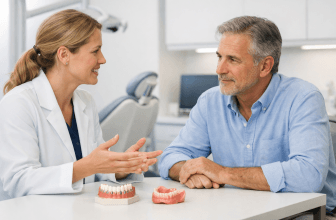
Losing one tooth can affect more than your smile. Depending on its location, a missing tooth may make chewing less comfortable and can influence how you feel about your appearance. Two commonly considered fixed options are a conventional dental bridge and an implant-supported crown.
So, which is better: a dental bridge or a dental implant? The answer is not universal. Both options can provide high long-term survival, but they involve different procedures, risks, maintenance needs, and effects on the neighboring teeth. The best choice depends on your oral health, bone and gum condition, the teeth next to the gap, aesthetic priorities, treatment preferences, and professional assessment.
This guide from Estexper Clinic explains the main differences between a dental bridge and a dental implant for replacing one missing tooth, including candidacy, treatment steps, recovery, possible complications, and considerations for international patients travelling to Turkey.
What Is a Dental Bridge?
A conventional dental bridge replaces a missing tooth with an artificial tooth connected to crowns that are supported by the neighboring teeth. These supporting teeth are known as abutment teeth. Once fitted, the bridge is fixed in place rather than being removed by the patient for daily use.
To support a conventional bridge, the neighboring teeth generally need to be prepared so the bridge can fit over them. This means that teeth beside the gap become part of the treatment, even if they were previously healthy. A bridge can be an appropriate option when the neighboring teeth already require crowns or substantial restoration, provided they are suitable to provide support.
Resin-bonded bridges
A resin-bonded bridge, sometimes called an adhesive bridge, is a more conservative alternative in selected cases. It may require little or no preparation of the adjacent teeth because the replacement tooth is attached using wings bonded to their inner surfaces. This approach can be particularly relevant for some front-tooth cases, but it is not suitable for every patient or every position in the mouth.
Debonding is a common complication of resin-bonded bridges. Evidence also shows that their long-term results vary according to case selection, design, tooth position, biting forces, and other clinical factors.
What Is a Dental Implant?
A dental implant replaces the root of a missing tooth. It is a titanium screw placed into the jawbone, which can later support an individual crown. Unlike a conventional bridge, an implant-supported crown does not use the adjacent teeth as bridge abutments.
Implant treatment includes a surgical phase and a healing period before or during the restoration process. The suitability of an implant depends on factors such as the condition of the jawbone and gums, oral hygiene, general health, and habits that may affect treatment or maintenance. A detailed examination is necessary before a treatment plan can be recommended.
Although implants avoid preparing the neighboring teeth, they are not free from potential complications. These may include biological problems around the implant, loosening of components, loss of retention, or fracture of part of the restoration.
Dental Bridge vs Dental Implant: Direct Comparison
Both a conventional bridge and an implant-supported crown can replace one missing tooth without requiring a removable appliance. However, they differ in how they are supported and in the type of treatment burden they create.
Support and effect on neighboring teeth
A conventional bridge depends on the teeth beside the gap. These teeth must be strong enough to support the restoration, and preparation may be required. This can be useful when the neighboring teeth already have extensive fillings, damage, or a need for crowns. However, it also means that healthy teeth may become involved in the treatment.
An implant-supported crown is supported by an implant in the jawbone rather than by the neighboring teeth. This can preserve the adjacent teeth from bridge preparation, but it requires surgery and adequate conditions for implant placement.
Survival and complication patterns
Available systematic-review evidence suggests that both conventional tooth-supported fixed bridges and implant-supported single crowns have high estimated survival. One review reported five-year survival of approximately 93.8% for conventional bridges and 94.5% for implant-supported single crowns. At ten years, the estimated survival was approximately 89.2% for conventional bridges and 89.4% for implant-supported single crowns.
These figures should not be interpreted as a guarantee for an individual patient. Survival does not mean that a restoration remains completely free from maintenance or complications. A restoration may survive while needing repair, adjustment, replacement of a component, or treatment of a biological problem.
The pattern of complications is different. Conventional bridges were more often associated with biological complications, including caries and loss of pulp vitality in supporting teeth. Implant-supported restorations were more often associated with technical complications, including veneer fracture, abutment or screw loosening, and loss of retention.
Invasiveness and treatment process
A conventional bridge does not require implant surgery. It involves preparing the supporting teeth, taking the necessary records, and fitting the fixed restoration. The exact sequence and treatment time depend on the condition of the teeth and the clinical plan.
An implant requires placement of a titanium fixture in the jawbone, followed by healing before or during the restorative stage. This makes implant treatment more surgically involved. Whether an implant is appropriate cannot be determined from the missing tooth alone; the bone, gums, bite, adjacent teeth, and general circumstances must be evaluated.
Maintenance
Both options need careful daily cleaning and professional follow-up. A bridge requires cleaning around and beneath the replacement tooth, as well as maintaining the supporting teeth. An implant-supported crown also requires attention to the gum tissues around the implant, the crown, and the implant components.
Good oral hygiene is important for either choice. Poor cleaning can contribute to biological complications affecting teeth, gums, or tissues around an implant. Patients should follow the specific cleaning and review instructions provided by their dentist.
Who May Be Suitable for a Dental Bridge?
A bridge may be considered when the teeth beside the gap are healthy enough and structurally suitable to support it. It can also be a practical option when those neighboring teeth already need significant restorative treatment. Some patients may prefer to avoid implant surgery or may value a treatment approach that does not involve placement of a fixture in the jawbone.
A resin-bonded bridge may be considered in selected situations where preserving the adjacent tooth structure is especially important. It is often more dependent on careful case selection and may be more vulnerable to debonding than a conventional bridge.
A dentist must assess the supporting teeth, gums, bite, available space, aesthetic requirements, and ability to maintain the restoration. A bridge is not automatically suitable simply because only one tooth is missing.
Who May Be Suitable for a Dental Implant?
An implant may be considered when the patient wants to replace the missing tooth without using the neighboring teeth as supports and when the jawbone and gum tissues are suitable for the planned treatment. It may be attractive when the adjacent teeth are healthy and the patient wishes to avoid preparing them.
However, an implant is not a universally better option. It involves surgery, a healing phase, ongoing maintenance, and possible biological or technical complications. Oral hygiene, periodontal condition, general health, behavioral factors, aesthetic expectations, and willingness to attend follow-up appointments all influence the decision.
Only a qualified dental professional who has examined you can determine whether an implant is appropriate. Patients should disclose relevant medical information and discuss any factors that may affect surgery, healing, oral hygiene, or long-term maintenance.
What Happens During Treatment?
Dental bridge treatment
Bridge treatment usually begins with an examination of the missing-tooth area and the neighboring teeth. The supporting teeth may be prepared, and clinical records are taken to plan the shape, fit, and appearance of the bridge. A temporary restoration may be used when appropriate before the final bridge is fitted and adjusted.
The treatment plan depends on the condition of the abutment teeth and the type of bridge selected. Your dentist should explain how the bridge will be supported, how to clean beneath it, and what follow-up care is required.
Dental implant treatment
Implant treatment begins with an assessment of the gums, jawbone, neighboring teeth, bite, and aesthetic requirements. The implant is surgically placed in the jawbone, followed by a healing period before or during the restorative stage. Once the implant is ready for restoration, an abutment and crown can be connected according to the treatment plan.
The number of visits and overall treatment sequence vary between patients. International patients considering treatment in Turkey should ask the clinic for a clear plan covering examinations, imaging, surgery, restoration, healing-related appointments, and follow-up after returning home.
Risks and Possible Complications
Every fixed tooth-replacement option has potential risks. With a conventional bridge, biological complications may affect the supporting teeth. These include caries and loss of pulp vitality. The bridge may also lose retention or require repair or replacement over time.
With an implant-supported crown, possible problems include biological complications around the implant, loosening of the abutment or screw, restoration fracture, and loss of retention. Implants can have high survival, but they still require professional monitoring and good home care.
For resin-bonded bridges, debonding is a commonly reported complication. If a bridge becomes loose or damaged, contact your dental provider rather than attempting to repair or reattach it yourself.
Which Option Is Better for You?
The better option is the one that provides an appropriate balance of health, function, appearance, treatment burden, maintenance, and personal preference for your individual situation. A conventional bridge may be reasonable when the neighboring teeth can support it or already need restoration. An implant may be preferable when preserving healthy adjacent teeth is a priority and the surgical and maintenance requirements are acceptable.
A resin-bonded bridge may offer a conservative approach in selected cases, particularly in the front of the mouth, but its risk of debonding and long-term predictability should be discussed.
Comparative research is heterogeneous, and much of the implant literature evaluates different implant designs or components rather than directly comparing implants and conventional bridges in identical patient groups. This is why a consultation should focus on your specific anatomy, oral health, aesthetic goals, treatment preferences, and long-term ability to maintain the restoration rather than on a single headline survival figure.
Considerations for International Patients Visiting Turkey
If you are considering treatment at Estexper Clinic in Turkey, request a personalized assessment before making travel arrangements. Ask which examinations are needed, whether your neighboring teeth and gums are suitable, what treatment stages are planned, and how many appointments may be required.
It is also important to clarify the expected follow-up process. Ask how the clinic manages adjustments or complications after you return home, what records you will receive, and which local dental professional could assist with routine maintenance if necessary. Treatment decisions should be based on clinical suitability and informed consent, not only on convenience or travel plans.
Frequently Asked Questions
Does an implant last longer than a dental bridge?
Neither option is guaranteed to last longer for every patient. Systematic-review evidence shows similar estimated five- and ten-year survival for conventional bridges and implant-supported single crowns, but their complications differ. Individual outcomes depend on oral health, design, hygiene, maintenance, and other patient factors.
Is a bridge less invasive than an implant?
A conventional bridge avoids implant surgery, but it involves using and potentially preparing the neighboring teeth. An implant involves surgery and healing but does not use adjacent teeth as bridge supports. The less invasive choice depends on which aspect of treatment is most important in your case.
Can I choose an implant because my neighboring teeth are healthy?
Healthy adjacent teeth may be an important reason to consider an implant, but this does not automatically make you suitable. The jawbone, gums, bite, oral hygiene, general health, and ability to maintain the implant must also be assessed.
Are resin-bonded bridges a permanent solution?
Resin-bonded bridges can provide a conservative replacement in selected cases, but debonding is a common complication and long-term results vary. Your dentist can explain whether this option is appropriate for the position of the missing tooth and your bite.
Conclusion
For one missing tooth, both a dental bridge and an implant-supported crown can be effective fixed replacement options. A bridge relies on neighboring teeth and may involve biological complications affecting those teeth. An implant avoids using adjacent teeth as supports but requires surgery, healing, and maintenance around the implant and restoration.
There is no universal winner. A qualified dentist should assess your teeth, gums, bone, bite, aesthetic requirements, health factors, treatment preferences, and long-term maintenance needs before recommending an option. At Estexper Clinic, an individualized consultation can help you understand the available approach and make an informed decision about treatment in Turkey.
Medical References
- Comparison of survival and complication rates of tooth-supported fixed dental prostheses (FDPs) and implant-supported FDPs and single crowns (SCs). PubMed; Clinical Oral Implants Research.
- Implants versus short-span fixed bridges: survival, complications, patients’ benefits. A systematic review on economic aspects. PubMed; Clinical Oral Implants Research.
- Dental treatments. NHS.
- Predictability of resin bonded bridges – a systematic review. PubMed; British Dental Journal.
- Single and partial tooth replacement with fixed dental prostheses supported by dental implants: A systematic review of outcomes and outcome measures used in clinical trials in the last 10 years. PubMed; Journal of Clinical Periodontology.