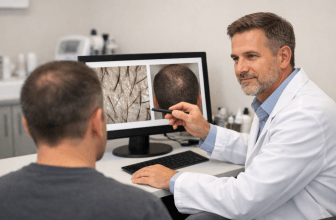
Hair transplant surgery for women can be an option when thinning is localized and the donor area contains enough stable, healthy hair. However, it is not a universal solution for female hair loss. Women often experience diffuse thinning across the part, crown or vertex, which can also affect the hair at the back and sides of the scalp. This makes diagnosis, donor-area assessment and expectation setting especially important.
At Estexper Clinic, the first step should be a qualified medical evaluation rather than an immediate decision about surgery. A physician must determine the cause of hair loss, assess the stability of the pattern and examine whether the donor follicles are suitable for redistribution. When surgery is appropriate, the goal is usually improved coverage and density, not complete restoration of all lost hair.
What does female hair loss usually look like?
Female-pattern hair loss commonly causes gradual thinning over the central part, crown or vertex. The part may appear wider, and the scalp can become more visible under bright light or when the hair is styled. Unlike many men, women may retain a relatively preserved frontal hairline while experiencing thinning behind it.
The pattern can be diffuse, meaning that individual hairs become finer across a broad region rather than disappearing in one clearly defined area. This matters for transplantation because surgery requires a dependable supply of thicker follicles from another part of the scalp. If miniaturization affects both the thinning region and the potential donor area, there may not be enough stable hair to move safely.
Not every case of thinning is female-pattern hair loss. Scarring alopecia, traction alopecia and systemic contributors can resemble or contribute to diffuse hair loss but require different management. A dermatologic assessment is therefore important before treatment. The American Academy of Dermatology recommends evaluation to confirm the diagnosis and rule out other causes.
Can a hair transplant help women with diffuse thinning?
Sometimes, but suitability depends on the distribution and cause of the hair loss. Transplantation works by moving follicles from a donor region, usually toward the back or sides of the scalp, to an area where greater coverage is desired. It can improve density in selected zones, but it cannot recreate every lost follicle or stop the underlying process of progressive female-pattern hair loss.
Diffuse thinning creates two main challenges. First, the recipient area may be broadly affected, so there may not be one small, clearly defined area to treat. Second, the donor hair may also be reduced in density or caliber. A person may have enough hair to appear generally covered but not enough strong, stable follicles to provide a meaningful improvement after redistribution.
For this reason, the expected benefit should be described as improved visual coverage or density. Complete restoration is not a realistic expectation for most women with widespread thinning. The physician may recommend surgery only when the likely improvement justifies using a limited donor supply.
Who may be a suitable candidate?
A favorable candidate generally has a diagnosis that is compatible with transplantation, a relatively stable pattern of hair loss and adequate donor hair in the occipital or temporal regions. The donor hair should be sufficiently thick and show limited evidence of miniaturization. The recipient area should also be suitable for implantation among existing hairs without causing unnecessary trauma.
Factors considered during assessment
- Diagnosis: The cause and pattern of hair loss must be evaluated before surgery.
- Donor density: The physician assesses whether the back and sides contain enough usable follicles.
- Hair shaft caliber: Thicker hairs may provide better visual coverage than highly miniaturized hairs.
- Donor stability: Hair that is likely to remain stable is more valuable for long-term planning.
- Pattern stability: Ongoing or rapidly changing loss may make the result less predictable.
- Expectations: The patient should understand that the objective is increased density rather than full restoration.
If the donor area is similarly thin or miniaturized, surgery may not be recommended. A careful assessment can prevent a procedure that uses valuable donor follicles without offering a reasonable improvement.
Why donor hair is so important in women
Donor hair is the limiting resource in transplantation. Once follicles are removed, they cannot simply be replaced, so the available supply must be planned carefully. In women with diffuse thinning, the back and sides may not be as dense or stable as expected. The clinician must examine not only how many hairs are present but also their thickness, distribution and signs of miniaturization.
The donor area should be assessed in relation to the intended recipient area. If a relatively small region needs additional coverage and the donor hair is strong, transplantation may be more feasible. If thinning extends broadly across the scalp, the amount of improvement may be limited by the available donor follicles.
During an international consultation, patients should ask how the donor area was evaluated, whether miniaturization was observed and what density improvement is realistically expected. A transparent plan should explain the limitations of the donor supply rather than promise a predetermined result.
What happens before a hair transplant?
Preparation begins with a consultation and examination. The physician reviews the history of hair loss, its progression and any symptoms or factors that may suggest another diagnosis. The scalp and donor zones are examined, and the proposed recipient area is assessed in relation to the available follicles.
Depending on the clinical situation, the physician may decide that further dermatologic assessment is needed before surgery. This is particularly important when the pattern is unusual, the loss is rapidly progressive, or there are signs that the scalp condition may be scarring or traction-related.
Patients should also discuss whether ongoing medical management is appropriate. Hair transplantation does not stop untreated female-pattern hair loss in native, non-transplanted hair. Medical treatment may be considered or continued to help stabilize existing hair, according to the physician’s diagnosis and recommendations. Surgery and medical management may therefore have different roles: transplantation can add coverage in selected areas, while medical care may help preserve surrounding hair.
How is the procedure planned?
The surgical plan is individualized according to the distribution of thinning, the quality of the donor hair and the patient’s goals. The physician determines which area may benefit most from additional coverage and how to use the donor supply conservatively.
In women with existing hairs in the recipient area, grafts must be placed carefully among those hairs. The plan should take account of the possibility that native hairs may continue to thin over time. This is one reason why conservative design and long-term planning are important.
Different harvesting and implantation approaches may be considered, including follicular unit extraction or other techniques selected by the medical team. The most appropriate method depends on the patient’s anatomy, donor characteristics, clinical goals and the surgeon’s assessment. The technique itself cannot compensate for insufficient or unstable donor hair.
Realistic results and expected timeline
Results should be judged in terms of coverage and density rather than complete restoration. A successful outcome may make the scalp less visible in a targeted area or improve the appearance of the part and crown. The degree of improvement varies according to donor quality, the number of usable grafts, the recipient area and the progression of native hair loss.
Temporary postoperative shedding can occur. This may affect transplanted or surrounding hairs and can make the appearance seem temporarily worse before it improves. Visible growth commonly begins after approximately three to six months, while the final appearance may not be assessable until about twelve months.
Not all transplanted hairs will produce the same visual effect, and a single procedure may not provide the density a patient initially imagines. The physician should explain what level of change is realistic for the individual’s donor supply. Results reported in studies should not be treated as guarantees for an individual patient. Evidence specific to women remains limited and consists largely of reviews and retrospective studies rather than high-quality comparative trials.
Recovery and aftercare
After surgery, the scalp may be sensitive and temporary swelling, discomfort or redness can occur. Patients should follow the clinic’s instructions for washing, protecting and handling the scalp. The precise aftercare plan depends on the procedure and the physician’s recommendations.
Patients travelling to Turkey for treatment should arrange enough time for the medical appointments and early postoperative review recommended by the clinic. They should also receive clear written instructions for care after returning home and know whom to contact if concerns arise. International patients should provide their complete medical history and disclose any relevant scalp conditions, medicines or previous hair procedures.
During the growth period, patience is essential. Early shedding does not necessarily indicate treatment failure, and visible growth is gradual rather than immediate. Follow-up allows the medical team to assess healing and discuss the developing result.
Risks and limitations
As with any surgical procedure, hair transplantation has limitations and potential complications. Reported issues in studies of women have included pain, facial edema, folliculitis, scarring, altered sensation and postoperative telogen effluvium. The likelihood and severity of complications vary, and the physician should explain the relevant risks during consultation.
A further limitation is continued thinning of native hair. Transplanted follicles may add coverage, but they do not cure the underlying female-pattern hair-loss process. If surrounding, non-transplanted hairs continue to miniaturize, the overall appearance may change over time. Ongoing medical management may be recommended to help preserve existing hair where clinically appropriate.
There is also a possibility that the improvement will be less than expected because of limited donor hair, diffuse miniaturization or progression of the condition. A responsible treatment plan includes the possibility that surgery may be unsuitable or that the anticipated benefit may be modest.
Hair transplant versus continued medical assessment
For women with diffuse thinning, the decision is not simply whether to have surgery. The first question is whether the diagnosis is clear and whether the hair-loss process can be stabilized or managed medically. Surgery may be considered when a suitable donor supply remains and a specific area can benefit from added density.
Some women may be better served by continued dermatologic evaluation and medical management rather than transplantation. This may apply when the donor zone is thin, the diagnosis is uncertain, the loss is actively progressing or the expected cosmetic improvement is too limited. A qualified physician should make this determination after examining the scalp and discussing the patient’s goals.
Questions to ask during an international consultation
- What is the most likely cause and pattern of my hair loss?
- Is the donor area sufficiently dense and stable for transplantation?
- Are there signs of miniaturization in the donor region?
- Which area is most likely to benefit from additional coverage?
- What degree of density improvement is realistic in my case?
- Could my native hair continue to thin after surgery?
- Should medical management be considered before or after transplantation?
- What are the expected shedding, growth and follow-up timelines?
- What aftercare and medical support will be available after I return home?
Frequently asked questions
Is hair transplantation suitable for every woman with thinning hair?
No. It is a selective treatment. Women with diffuse miniaturization affecting both the recipient and donor areas may not have enough stable follicles for a worthwhile procedure.
Can a hair transplant cure female-pattern hair loss?
No. Transplantation can improve coverage in selected areas, but it does not stop the underlying progressive process in untreated native hair. Medical management may be needed to help preserve existing hair.
When will I see the final result?
Temporary shedding may occur after surgery. Visible growth commonly starts after about three to six months, and the final appearance may be assessed at approximately twelve months.
Will the result restore my original density?
Usually, the goal is improved coverage or density rather than complete restoration. The result depends mainly on the quality and quantity of donor hair, the recipient area and the future course of hair loss.
Medical References
- Hair Transplantation in Women — Journal of Drugs in Dermatology / PubMed.
- Female-pattern hair loss: therapeutic update — Anais Brasileiros de Dermatologia / PubMed Central.
- Clinical Features of Patients Treated With Hair Transplants in Female Pattern Hair Loss — Annals of Dermatology / PubMed Central.
- Female pattern hair loss: A clinical, pathophysiologic, and therapeutic review — International Journal of Women’s Dermatology / PubMed Central.
- Thinning hair and hair loss: Could it be female pattern hair loss? — American Academy of Dermatology.