Written by: Estexper Medical Editorial Team
Medically reviewed by: Dt. Sibel Gokceer
For people who have lost all or most of their teeth, implant-supported full-arch treatment can offer an alternative to a conventional complete denture. Two commonly considered options are a fixed full-arch implant bridge and a removable implant-supported overdenture. Both can improve function and patient-reported quality of life, but they provide different daily experiences and involve different maintenance requirements.
In Short
Neither a fixed full-arch implant bridge nor a removable implant overdenture is universally better. Fixed bridges are generally rated as more stable, while overdentures can be removed for cleaning and may be suitable with fewer implants in selected mandibular cases. The appropriate option depends on the jaw, bone and implant plan, hygiene ability, expectations, maintenance needs, and costs.
So, which is better: a fixed implant bridge or an overdenture? Current evidence does not support one universally superior choice. A qualified implant dentist or prosthodontist must assess the relevant clinical factors before recommending a treatment plan.
What Is a Fixed Full-Arch Implant Bridge?
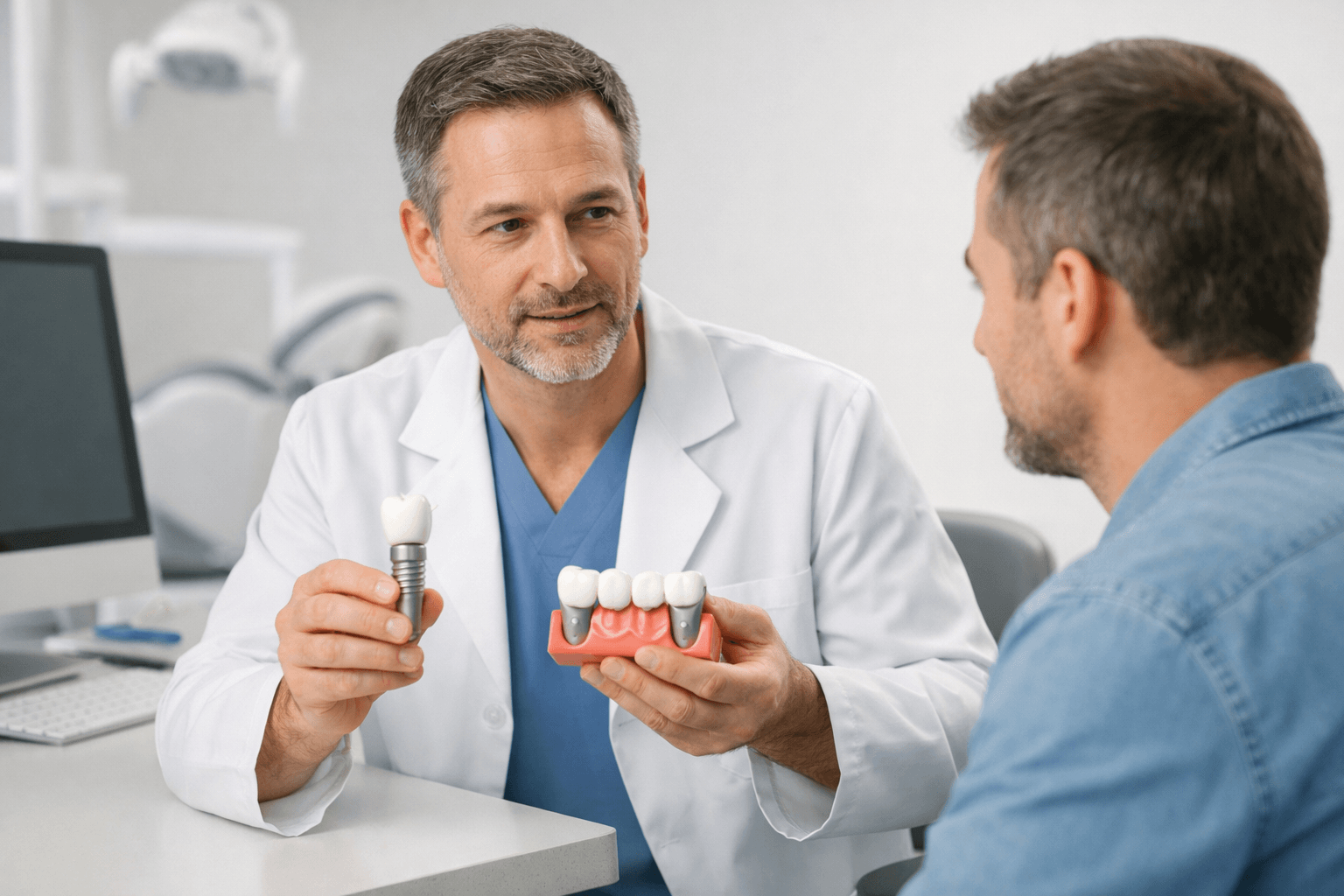
A fixed full-arch implant bridge is a complete arch of artificial teeth attached to dental implants. The prosthesis is designed to remain in place during eating, speaking, and sleeping, and the patient does not remove it at home. Depending on the clinical plan, it may be supported by several implants distributed across the upper or lower jaw.
Because the restoration is fixed, some patients may find it more similar to having non-removable teeth than a conventional denture. Many patients value the sense of stability, particularly when chewing or speaking. However, fixed does not mean maintenance-free. The area beneath and around the bridge must be cleaned carefully, often with tools recommended by the dental team, such as specialized floss, interdental brushes, or an oral irrigator.
What Is a Removable Implant-Supported Overdenture?
An implant-supported overdenture is a removable denture that attaches to dental implants through a retention system. The implants help stabilize the denture and reduce movement compared with a conventional complete denture, while the patient can remove the prosthesis for daily cleaning and maintenance.
Overdentures may be considered when a patient wants improved retention but also values the ability to remove the teeth for hygiene. In selected mandibular cases, two implants can provide better patient-reported outcomes than one implant. The ITI consensus report also found that placing more than two implants in mandibular overdenture treatment does not consistently produce additional patient-reported benefit, although the appropriate number and distribution must be decided individually.
Overdentures are not the same as ordinary dentures. Their performance depends on the implants, attachment components, denture design, fit, and regular maintenance. Attachment wear, retention loss, and denture repair or replacement may become part of long-term care.
Fixed Implant Bridge vs Overdenture: Main Differences
Stability during eating and speaking
Fixed restorations are generally perceived as highly stable because they do not move in and out during normal use. A 2023 systematic review and meta-analysis found that patients rated denture stability significantly higher with fixed restorations. This may be particularly important for people who are concerned about movement while speaking, chewing, or smiling.
Implant overdentures also provide substantially more retention than conventional complete dentures. Their removable design means that some movement may still be possible, depending on the attachment system, jaw anatomy, implant distribution, and prosthesis fit. Many patients nevertheless find the stability satisfactory and appreciate the ability to remove the overdenture.
Patient satisfaction and quality of life
Both treatment types can substantially improve oral-health-related quality of life and patient-reported outcomes compared with conventional complete dentures. In the available comparative evidence, a 2023 review involving 28 studies and 1,457 patients found large improvements with both fixed complete dentures and implant overdentures, without a statistically significant overall difference between them.
This finding is important because satisfaction is personal. One patient may prioritize the feeling of a permanent set of teeth, while another may prefer removable access for cleaning or the possibility of a simpler daily routine. Expectations should be discussed before treatment rather than assuming that one design will suit everyone.
Cleaning and hygiene
One of the clearest practical differences is how the prosthesis is cleaned. An overdenture can be removed, brushed, and cleaned outside the mouth. This may be helpful for patients who have limited dexterity, difficulty accessing the underside of a fixed bridge, or a strong preference for removable hygiene.
A fixed bridge remains in the mouth, so cleaning beneath the prosthesis and around the implants requires instruction and consistent effort. The restoration may need a specially designed hygiene routine and professional maintenance. A patient’s ability and willingness to maintain oral hygiene should therefore be considered during treatment planning.
Maintenance and repairs
Both options require long-term professional care. A fixed bridge can develop technical complications, including damage to acrylic teeth or fractures, as reported in evidence on four-implant maxillary restorations. Overdentures can experience retention loss and attachment-related maintenance, and the denture itself may require adjustment, repair, or replacement over time.
The type and frequency of maintenance vary according to the prosthesis material, implant system, bite, oral hygiene, opposing teeth, and individual use. Patients should ask what routine reviews, hygiene visits, attachment replacements, repairs, and future prosthetic costs may be expected before starting treatment.
What Does the Research Say About Survival?
Research findings should be interpreted carefully because studies differ in the jaw treated, the number and position of implants, prosthesis materials, follow-up duration, and definitions of success. These differences make direct comparisons difficult.
A 2025 systematic review and meta-analysis of four-implant restorations in the edentulous maxilla reported higher weighted medium-term implant survival for fixed restorations than overdentures: 98.5% compared with 94.5%. Prosthesis survival was also reported as higher for fixed restorations in that analysis, at 99.9% compared with 85.0%. However, the authors highlighted substantial heterogeneity and baseline differences that limit direct interpretation.
The same review reported less marginal bone loss at five years for overdentures, while retention loss was a common overdenture complication and acrylic tooth dislodgement or fracture was common with fixed restorations. These findings do not mean that one option is automatically safer or more durable for every patient. They show why the treatment design, jaw, implant positioning, materials, and maintenance plan matter.
Evidence from mandibular treatment is also generally supportive of both approaches. An overview of systematic reviews concluded that fixed prostheses and implant overdentures have high implant and prosthesis survival and are clinically successful options. When both are clinically appropriate, patient expectations and cost should help guide the decision.
Which Option May Be Suitable for You?
Suitability cannot be determined from preference alone. Your dentist will typically evaluate the following factors:
- Jaw: Maxillary and mandibular treatment can involve different bone anatomy, implant distribution, prosthetic designs, and evidence.
- Available bone: Bone volume and quality influence implant positioning and the possible restoration design.
- Implant number and distribution: The number of implants is not chosen in isolation; their position, angulation, support, and the proposed prosthesis are also important.
- Hygiene ability: Patients must be able to clean around implants and attend recommended maintenance visits.
- Functional expectations: Desired stability, chewing comfort, speech, and the feeling of a fixed or removable prosthesis should be discussed.
- Aesthetic expectations: Lip support, tooth display, gum appearance, and the ability to remove the prosthesis can influence the design.
- Maintenance preferences: Some people prefer a restoration that can be removed for cleaning, while others prefer not to remove their teeth.
- Budget and long-term costs: The initial treatment plan and future maintenance, repairs, attachment components, and prosthetic replacement should all be considered.
What Happens During Treatment Planning?
For international patients considering treatment in Turkey, the process should begin with a detailed assessment rather than choosing a package based only on the number of implants or the advertised prosthesis type. The clinic should review your medical and dental history, previous denture experience, medications, oral hygiene, and treatment goals.
Diagnostic records may include clinical photographs, dental imaging, and examination of the remaining teeth or edentulous areas. The dental team should explain whether the proposed restoration is fixed or removable, how many implants are planned, what type of prosthesis will be used, how hygiene will be managed, and what follow-up is available after returning home.
Ask for a written treatment plan that separates surgical treatment, temporary teeth if relevant, the definitive prosthesis, reviews, adjustments, and possible maintenance. You should also understand what happens if an implant or prosthetic component requires attention after you leave Turkey. A remote consultation can help with preliminary discussion, but final suitability requires an in-person clinical assessment by a qualified dental professional.
Recovery and Long-Term Aftercare
Recovery depends on the individual procedure, implant placement, prosthesis design, and whether temporary or definitive teeth are provided. Your treating clinician should give specific instructions about eating, cleaning, medication, appointments, and warning signs.
After the restoration is fitted, long-term success depends on regular hygiene and professional reviews. Fixed bridge patients need to clean around the implants and beneath the prosthesis as instructed. Overdenture patients should remove and clean the denture as directed and keep the attachment areas clean. The overdenture should not be left uncleaned simply because it is removable.
Contact the dental team if you notice persistent pain, swelling, bleeding, a loose prosthesis, changes in your bite, difficulty cleaning, or loss of retention. Do not attempt to repair, adjust, or glue an implant prosthesis yourself.
Advantages and Limitations at a Glance
Fixed full-arch implant bridge
- Provides a fixed, highly stable restoration during everyday use.
- May be preferred by patients who do not want to remove their teeth.
- Fixed restorations may offer higher stability ratings and, in some maxillary evidence, higher medium-term implant and prosthesis survival.
- Cleaning beneath the bridge can be more demanding.
- Technical complications may include acrylic tooth dislodgement or fracture.
- Professional maintenance remains necessary.
Removable implant-supported overdenture
- Can be removed for cleaning and maintenance.
- May provide improved retention compared with a conventional complete denture.
- In selected mandibular cases, two implants can improve patient-reported outcomes.
- Retention components may wear or require replacement.
- The denture may need adjustment, repair, or replacement.
- Some movement may remain, depending on the design and clinical situation.
Which Is Better: Fixed or Removable?
Neither option is universally better. A fixed full-arch implant bridge may be attractive when maximum prosthesis stability and a non-removable design are the main priorities, provided the patient can maintain hygiene around the restoration and is suitable for the required implant and prosthetic plan.
An implant overdenture may be preferable when removable cleaning, easier access, or a particular mandibular treatment design is important. It can still provide meaningful improvements in function and quality of life while allowing the patient to remove the prosthesis for daily care.
The most appropriate choice is the one that balances clinical suitability with your priorities and your ability to maintain the treatment over time. Discuss both options with a qualified implant dentist or prosthodontist, and ask for a clear explanation of expected benefits, limitations, complications, follow-up, and long-term maintenance before making a decision.
Frequently Asked Questions
Is a fixed bridge more comfortable than an overdenture?
Comfort varies between patients. Fixed restorations are often perceived as more stable, while overdentures may be preferred because they can be removed and cleaned. Comfort depends on fit, design, implant position, soft-tissue anatomy, bite, and adaptation.
Are overdentures only for people who cannot have fixed teeth?
No. Both fixed and removable implant-supported restorations may be clinically appropriate in selected patients. The choice depends on anatomy, implant planning, hygiene, expectations, maintenance, and cost rather than on a single factor.
Can an overdenture be converted to a fixed bridge later?
This may or may not be possible. It depends on the number and distribution of implants, bone and soft-tissue conditions, prosthetic space, restorative components, and the original treatment design. It should not be assumed without an assessment.
Does a fixed implant bridge need regular maintenance?
Yes. Fixed restorations still require daily cleaning and professional reviews. The dentist or hygienist should show you how to access the implant and prosthesis areas safely.
Explore our Cosmetic Dentistry services in Turkey for an overview of treatment options and individual assessment.
TREATMENT OPTIONS
Explore Your Treatment Options
Find out more about our services and discuss which options may suit your individual needs.
YOUR NEXT STEP
Discuss Your Questions With Our Team
Request an individual assessment or ask our team about treatment planning and follow-up arrangements.
Medical References
- Long-Term Comprehensive Results of Four-Implant-Supported Overdentures and Fixed Complete Dentures: A Systematic Review and Meta-analysis. International Journal of Oral & Maxillofacial Implants; PubMed.
- Treatment Effect of Implant-Supported Fixed Complete Dentures and Implant Overdentures on Patient-Reported Outcomes: A Systematic Review and Meta-analysis. Clinical Oral Implants Research; Wiley Online Library.
- A Comparison Between Fixed and Removable Mandibular Implant-Supported Full-Arch Prostheses: An Overview of Systematic Reviews. International Journal of Prosthodontics; PubMed.
- Group 4 ITI Consensus Report: Patient Benefits Following Implant Treatment in Partially and Fully Edentulous Patients. International Team for Implantology; Clinical Oral Implants Research; PubMed.
- Consensus Report of Group 1 of the 1st Global Consensus for Clinical Guidelines for the Rehabilitation of the Edentulous Maxilla: Number of Implants, Timing of Implant Placement and Loading. Global Consensus for Clinical Guidelines in Implant Dentistry; Clinical Oral Implants Research; PMC.
- Consensus Report of Group 4 of the 1st Global Consensus for Clinical Guidelines for the Rehabilitation of the Edentulous Maxilla: Conventional Dentures, Implant Overdentures and Implant-Supported Fixed Dental Prostheses. Global Consensus for Clinical Guidelines in Implant Dentistry; Clinical Oral Implants Research; PMC.
This article is for general educational purposes and does not replace an examination, diagnosis, or individualized treatment plan from a qualified dental professional.