Written by: Estexper Medical Editorial Team
Medically reviewed by: Dt. Sibel Gokceer
Dental implants are designed to replace missing teeth and restore comfort, function and appearance. Like natural teeth, however, implants require consistent cleaning and professional monitoring. In some patients, inflammation can develop in the gum tissue around an implant and progress to loss of the supporting bone. This condition is known as peri-implantitis.
In Short
Peri-implantitis is inflammation around a dental implant that is associated with progressive loss of supporting bone. Warning signs can include bleeding, swelling, discharge, recession, discomfort or changes around the restoration, although symptoms may be minimal. Diagnosis requires a dental examination, probing and radiographic assessment; treatment and follow-up depend on the individual implant, bone loss and contributing risk factors.
Peri-implantitis may develop gradually and can cause few or no noticeable symptoms in its early stages. Bleeding while brushing, redness, swelling, tenderness, pus, gum recession or a change in the way an implant restoration feels should not be ignored. Early assessment gives your dentist or periodontist an opportunity to identify contributing factors and plan appropriate care.
This guide explains peri-implantitis after dental implants, including its early symptoms, causes, diagnosis, treatment options and prevention. Patients considering dental treatment in Turkey or elsewhere should receive an individual evaluation from a qualified dental professional before any treatment decision is made.
What Is Peri-Implantitis?
Peri-implantitis is a plaque-associated inflammatory disease affecting the tissues around a dental implant. It involves inflammation of the peri-implant mucosa, together with progressive loss of the bone that supports the implant.
The condition is different from peri-implant mucositis. Mucositis involves inflammation around an implant without established progressive bone loss. If inflammation is not controlled, it may develop into peri-implantitis in some patients. The distinction cannot be made reliably from symptoms alone, so professional examination and radiographic assessment are important.
Some bone remodeling is expected after implant placement. A diagnosis of peri-implantitis considers findings that go beyond expected initial remodeling, together with clinical signs such as bleeding or suppuration, increased probing depth, mucosal recession and evidence of progressive bone loss.
Early Symptoms of Peri-Implantitis
Peri-implantitis may be silent, particularly in its earlier stages. The absence of pain does not necessarily mean that an implant is healthy. Contact your dental clinic for an assessment if you notice any of the following:
- Bleeding: Bleeding during brushing, flossing or professional probing can be a sign of inflammation around the implant.
- Redness or swelling: The gum around the implant may look red, enlarged or different from the surrounding tissue.
- Tenderness or discomfort: Soreness when cleaning, chewing or touching the area may be relevant, although pain is not always present.
- Suppuration: Pus or discharge from around an implant may indicate an active inflammatory process.
- Gum recession: The gum may move away from the restoration, exposing more of the implant or making the area harder to keep clean.
- Increasing pocket depth: A dentist may identify deeper peri-implant pockets during probing compared with earlier examinations.
- Difficulty cleaning: New difficulty using brushes, floss or interdental aids around the restoration may signal a change in the gum contour or prosthetic design.
- A change in comfort or fit: A restoration that feels different, uncomfortable or less stable should be checked. These sensations can have several possible causes and do not confirm peri-implantitis by themselves.
Do not wait for severe pain or visible changes before seeking advice. Symptoms can be minimal, and diagnosis requires more than a visual inspection.
What Causes Peri-Implantitis?
Plaque and biofilm accumulation
Dental plaque, also called biofilm, is the primary local cause of inflammation around implants. If plaque remains around the implant and restoration, the surrounding tissues may become inflamed. Over time, inflammation can be associated with loss of supporting bone.
Cleaning around an implant restoration can be more technically demanding than cleaning a natural tooth, especially when access is limited. Effective home care and regular professional maintenance are therefore important parts of long-term implant care.
Previous or active periodontitis
A history of gum disease is an important risk indicator. Patients who have had periodontitis may require careful control of their periodontal health before implant treatment and continued monitoring afterward. Active periodontal disease should be assessed and managed as part of the overall treatment plan.
Smoking and systemic health factors
Smoking is associated with a higher risk of peri-implant disease. Diabetes and elevated blood glucose may also affect oral health and the body’s response to inflammation. Other patient-related factors, including obesity and alcohol consumption, have been identified in recent consensus work, although the strength and consistency of evidence differ between individual factors.
This does not mean that every patient with one of these factors will develop peri-implantitis. It does mean that risk assessment and personalized preventive planning are important.
Implant and restoration-related factors
Local design and positioning can affect how easily an implant can be cleaned. Potential contributing factors include implant malposition, an overcontoured restoration, excess cement and soft-tissue limitations. A restoration that does not provide adequate access for cleaning may allow plaque to accumulate.
These factors should be reviewed by a qualified dentist. Correcting a local problem may form part of treatment, but the appropriate approach depends on the implant position, restoration, surrounding tissues and radiographic findings.
How Is Peri-Implantitis Diagnosed?
Diagnosis is based on a combination of clinical and radiographic information. Your dentist or periodontist may:
- Ask about symptoms, oral hygiene, smoking, general health and previous gum disease.
- Inspect the gum and restoration around the implant.
- Check for bleeding and suppuration during gentle probing.
- Measure peri-implant probing depths and compare them with previous records where available.
- Assess gum recession, access for cleaning and the shape or contour of the restoration.
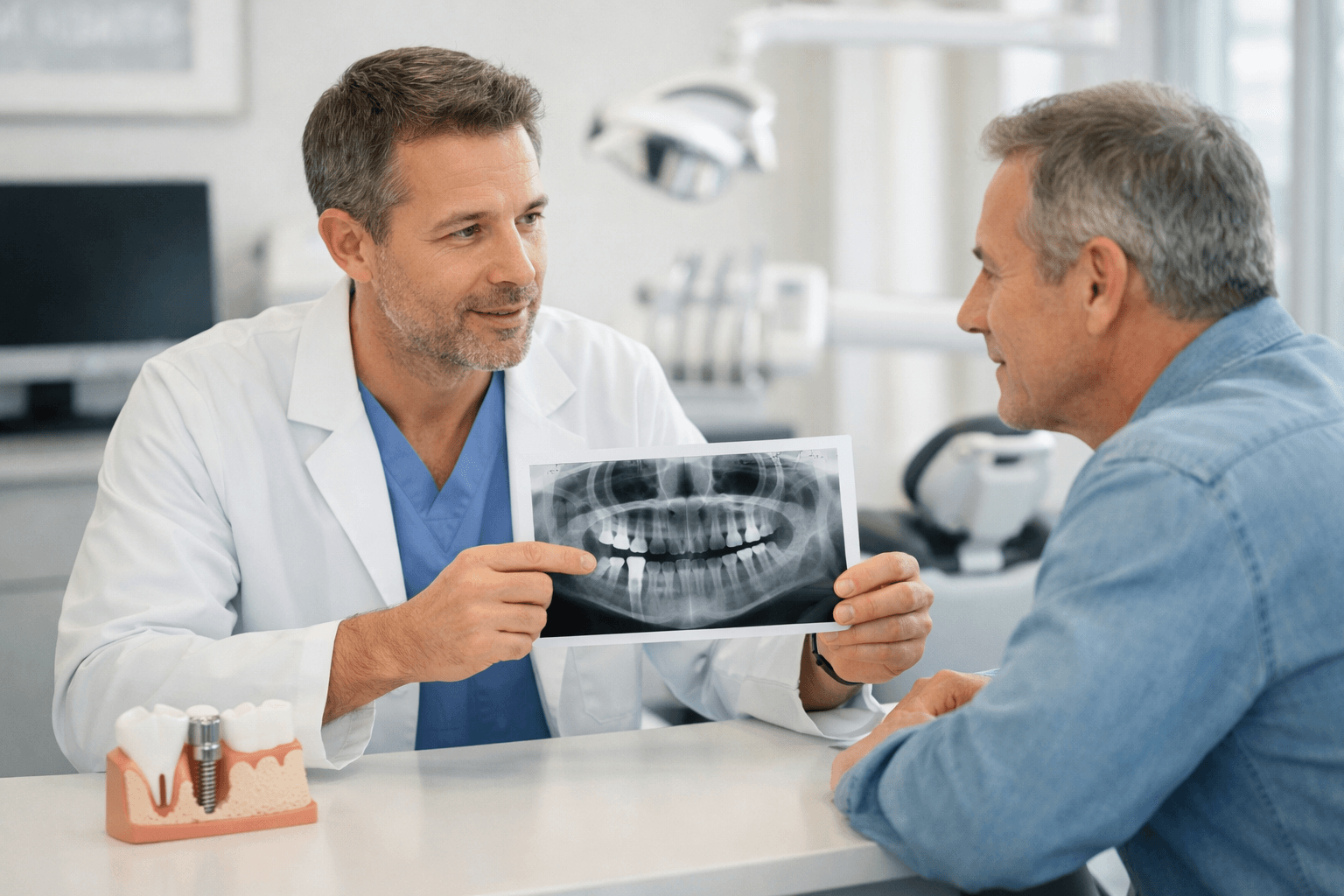
- Take dental radiographs to evaluate supporting bone and compare current findings with baseline or earlier images.
- Check whether the restoration or implant has a mechanical problem that could be contributing to discomfort or difficulty cleaning.
Baseline probing measurements and radiographs can be especially useful because they allow future changes to be identified more accurately. A diagnosis should not be based on symptoms alone, and a radiograph should be interpreted together with the clinical examination.
Who May Need Assessment?
Anyone with a dental implant can benefit from professional evaluation if they notice bleeding, swelling, discharge, recession, increasing discomfort or changes around the restoration. Assessment is also appropriate when cleaning becomes difficult or when a routine examination identifies bleeding or deeper probing measurements.
Patients with previous periodontitis, smoking exposure, diabetes or poor plaque control may need particularly careful supportive care. If you are travelling internationally for dental treatment, provide the clinic with your relevant dental records, implant details, previous radiographs and information about medical conditions or medications when available. A dentist in Turkey should still examine you directly before recommending treatment.
How Is Peri-Implantitis Treated?
Treatment is individualized according to the severity of inflammation, the amount and shape of bone loss, the position of the implant, the design of the restoration and the patient’s ability to maintain the area.
Assessment and control of contributing factors
Initial care may involve identifying and addressing factors that make inflammation more likely. This can include improving oral hygiene, treating active periodontal disease, reviewing smoking or blood glucose-related risks, and assessing whether the restoration permits effective cleaning. Excess cement, an overcontoured restoration or another local issue may need to be corrected where clinically appropriate.
Professional nonsurgical care
Professional debridement may be used to remove plaque and deposits from around the implant. Your dental team may also demonstrate customized brushing and interdental cleaning techniques. Nonsurgical care is generally part of the initial management approach, but established peri-implantitis may not resolve with home care alone.
The instruments and methods used should be selected by the treating professional according to the implant surface, restoration and clinical findings. No single nonsurgical method has been established as universally superior for every patient.
Surgical treatment for established disease
When disease is established or advanced, surgical treatment may be considered. Depending on the situation, options can include an access-flap procedure to improve visibility and debridement, resective treatment to reshape or reduce problem areas, reconstructive or regenerative procedures for selected bone defects, and soft-tissue procedures when tissue quality or coverage is a concern.
Not every implant or bone defect is suitable for every procedure. The clinician must consider whether the implant can be cleaned and maintained, how much supporting bone has been lost, the appearance of the area and the patient’s overall risk profile. Evidence quality varies between treatment approaches, and no single procedure is appropriate for all cases.
When might implant removal be considered?
Implant removal may be considered in selected cases, such as when an implant cannot be predictably maintained, has not responded to appropriate treatment or has another serious problem. This is a significant decision that requires clinical and radiographic assessment. Implant removal should not be assumed to be necessary simply because bleeding or mild inflammation is present.
What to Expect During Recovery and Aftercare
Recovery depends on the treatment performed and the condition of the tissues. Your dental team will provide instructions for cleaning, eating, medication and follow-up according to your individual procedure. If surgery is performed, temporary swelling, tenderness or changes in cleaning instructions may occur, but your clinician should explain what to expect and when to report concerns.
After treatment, supportive peri-implant care is essential. This usually involves periodic professional reviews, monitoring of bleeding and probing findings, reinforcement of home-care techniques and radiographic reassessment when clinically indicated. The ideal recall interval and exact maintenance protocol are not definitively established for every patient, so follow-up should be personalized according to risk and clinical response.
Contact your clinic promptly if you develop increasing swelling, persistent pain, discharge, significant bleeding, a change in the stability or fit of the restoration, or any concern after treatment.
How Can Peri-Implantitis Be Prevented?
Prevention begins before implant placement and continues throughout the life of the restoration. Important steps include:
- Manage gum disease first: Active periodontitis should be evaluated and treated before implant treatment where appropriate.
- Plan for cleanability: Implant position and restoration design should allow the patient and dental professional to access the area effectively.
- Follow personalized home-care instructions: Brush carefully and use suitable interdental cleaning aids as recommended by your dental team.
- Attend supportive maintenance: Regular examinations can identify bleeding, pocket changes or bone loss before problems become more advanced.
- Address smoking and systemic factors: Discuss smoking cessation and diabetes or blood glucose management with appropriate healthcare professionals.
- Keep baseline records: Initial probing measurements and radiographs help the dental team monitor changes over time.
- Report changes early: Bleeding, swelling, discharge, recession or altered comfort should be assessed rather than ignored.
Good home care reduces risk but cannot replace professional monitoring. The most suitable maintenance plan depends on your dental history, implant restoration, general health and ability to clean the area.
Frequently Asked Questions
Can peri-implantitis be painful?
It can cause tenderness or discomfort, but pain may be absent. A lack of pain does not rule out inflammation or supporting-bone loss.
Is bleeding around an implant always peri-implantitis?
No. Bleeding may indicate inflammation, but it does not by itself establish peri-implantitis. The diagnosis also considers probing findings, changes from baseline and radiographic evidence of bone loss.
Can peri-implantitis be treated without removing the implant?
In some cases, treatment may focus on local correction, improved cleaning, professional debridement and, when indicated, surgery. Implant removal is considered only in selected situations after individual assessment.
Can I travel to Turkey for peri-implantitis treatment?
International treatment requires careful planning. Before travelling, ask the clinic about the proposed examination, required records, treatment stages, follow-up arrangements and what happens if additional care is needed after you return home. A qualified dentist must confirm your diagnosis and suitability in person.
When Should You Contact Estexper Clinic?
Arrange an assessment if you notice bleeding, swelling, pus, gum recession, increasing discomfort, difficulty cleaning or a change in how your implant restoration feels. Estexper Clinic can review your concerns and help determine whether you need clinical examination, probing, radiographic assessment or referral for further periodontal care.
Because peri-implantitis can be subtle, prompt professional evaluation is more reliable than waiting for symptoms to become severe. Your final diagnosis and treatment plan should be determined by a qualified dental professional after a complete assessment.
Medical References
- Peri-implant diseases and conditions: Consensus report of workgroup 4 of the 2017 World Workshop on the Classification of Periodontal and Peri-Implant Diseases and Conditions. American Academy of Periodontology and 2017 World Workshop; Journal of Periodontology.
- Prevention and treatment of peri-implant diseases—The EFP S3 level clinical practice guideline. European Federation of Periodontology; Journal of Clinical Periodontology.
- AO/AAP consensus on prevention and management of peri-implant diseases and conditions: Summary report. Academy of Osseointegration and American Academy of Periodontology; Journal of Periodontology.
- Prevalence and risk indicators for peri-implant diseases: An AO/AAP systematic review and meta-analysis. Academy of Osseointegration and American Academy of Periodontology; Journal of Periodontology.
- Supportive care for the prevention of disease recurrence/progression following peri-implantitis treatment: A systematic review. Journal of Clinical Periodontology.