Written by: Estexper Medical Editorial Team
Medically reviewed by: Dt. Sait Gezer
Yes, many people can receive dental implants after wearing dentures for many years. Long-term denture use is not, by itself, an absolute contraindication, but tooth loss and long-term denture use may be associated with gradual jawbone changes that affect which implant treatment is suitable.
In Short
Dental implants may still be possible after many years of dentures. Suitability depends on the available jawbone, oral and general health, smoking status, hygiene ability, and detailed clinical assessment with appropriate imaging. Treatment may involve an implant-retained overdenture, a fixed implant-supported prosthesis, or additional procedures when bone volume is limited.
Why can dentures affect future implant treatment?
After natural teeth are lost, the residual alveolar ridge can gradually resorb, or reduce in volume, over time. This process is common after tooth loss and may continue during long-term denture treatment.
The amount and pattern of bone reduction differs between individuals. It may leave less width or height for standard implant placement, particularly in areas where the bone is already limited. Denture fit can also change as the ridge remodels, sometimes causing reduced stability or discomfort.
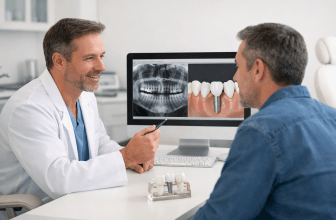
This does not mean that implants are impossible. It means that treatment planning may be more complex. Imaging is important because a clinical examination alone cannot show the complete three-dimensional bone anatomy or the relationship with nearby structures.
What implant options may be available?
Implant treatment after dentures is usually planned around the amount of remaining bone, the condition of the soft tissues, your general health, and whether you want a removable or fixed replacement.
Implant-retained overdentures
An implant-retained overdenture is a removable denture that attaches to dental implants. Depending on its design, the implants improve retention and stability, helping the denture move less during speaking and eating. The denture is still removed for cleaning, but it is more securely connected than a conventional denture.
For people without teeth, implant-retained overdentures have strong evidence for improving denture stability, oral function, satisfaction, and oral-health-related quality of life. In the lower jaw, a two-implant overdenture is a commonly studied approach and has been shown to provide better patient-reported outcomes than a one-implant overdenture. The exact number and position of implants must be determined for each patient.
Fixed implant-supported prostheses
A fixed implant-supported prosthesis is attached to implants and is not normally removed by the patient. It can provide a stable, non-removable replacement for people who are suitable candidates and who prefer not to wear a removable denture.
Fixed treatment may require different surgical and prosthetic planning from a removable overdenture. It also requires careful hygiene techniques around and beneath the prosthesis. The most appropriate option depends on anatomy, cleaning ability, expectations, and the dentist’s assessment.
Alternative implant strategies for limited bone
When standard implants cannot be placed safely in the ideal position because of reduced bone volume, the treatment plan may include bone augmentation, sinus-related procedures, or selected short, narrow, tilted, or other implant approaches. These options are not suitable for every patient and have specific planning and mechanical considerations.
A narrow or short implant is not automatically a simpler or better solution. The choice depends on the available bone, the forces placed on the restoration, the design of the prosthesis, and long-term maintenance requirements.
Who may be a candidate for implants after dentures?
Candidacy is based on more than the number of years you have worn dentures. A dental professional will usually consider:
- Remaining jawbone: The height, width, density, and shape of the ridge must be evaluated.
- Soft-tissue health: The tissues supporting the future restoration should be assessed.
- General health: Medical conditions, medications, healing capacity, and previous surgeries may affect planning.
- Smoking: Smoking can reduce the prognosis of implant treatment and should be discussed openly with the treating team.
- Diabetes: Uncontrolled diabetes may make healing and infection control more difficult.
- Periodontal history: A history of gum disease can increase the importance of infection control and ongoing monitoring.
- Oral hygiene: You must be able to clean the implants and prosthesis effectively.
- Expectations: Your preferred appearance, function, removability, treatment duration, and willingness to attend follow-up appointments all matter.
Only a qualified dental implant clinician who examines you can determine whether treatment is appropriate. If you are travelling internationally, a remote consultation may help with initial planning, but it does not replace an in-person examination and appropriate imaging.
What happens during the assessment?
The first stage is a detailed consultation. You may be asked how long you have worn dentures, whether they are comfortable, whether they move during eating or speaking, and what you hope to improve. Your medical history, medications, smoking status, previous gum problems, and past dental treatment should also be reviewed.
The clinician will examine the soft tissues, the denture-bearing areas, the bite, and the way your current dentures function. Imaging is then used to evaluate the available bone and relevant anatomy. The precise imaging protocol varies according to the case.
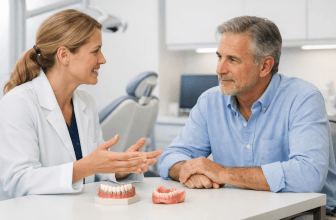
Based on these findings, the treatment team should explain the available options, expected stages, potential need for additional procedures, likely healing periods, maintenance requirements, and possible complications. A clear plan should also state whether the final prosthesis will be removable or fixed.
How is the transition from dentures to implants planned?
The transition is individualized. Some patients may continue wearing a conventional denture while implant sites heal or while a prosthesis is being prepared. Others may require modifications to their existing denture or a temporary arrangement. The exact sequence depends on the surgical plan and the condition of the current denture.
If bone augmentation or another preparatory procedure is necessary, it may add stages to treatment. Implant placement is followed by a healing period before the implants are used to support the final restoration. The overall process may therefore take several months, although the timeline varies considerably.
Patients travelling to Turkey or another country for treatment should plan for more than the surgical appointment. Ask in advance how many visits are expected, how follow-up will be organized, who will manage emergencies, and what records you should receive before returning home. Keeping implant details, radiographs, prosthetic information, and aftercare instructions can help your local dentist provide future maintenance.
What can recovery and aftercare involve?
Recovery depends on the number of implants, the type of restoration, and whether additional procedures are performed. Your treating clinician will provide instructions about oral hygiene, diet, denture use, medication, and follow-up appointments.
After the final restoration is fitted, professional maintenance remains important. Implant-supported teeth and overdentures require regular cleaning and monitoring, even when they feel comfortable. The prosthesis may need adjustment, repair, relining, or replacement over time. Attachments and other components can also wear or loosen.
Daily hygiene should follow the instructions provided for your particular design. This may include cleaning around the implants, beneath a fixed prosthesis, and on the removable denture. Patients who find cleaning difficult should discuss this before treatment because maintenance is part of implant success.
What are the possible risks and limitations?
Dental implants can provide important functional and quality-of-life benefits, but they are not risk-free and cannot guarantee a permanent result. Possible complications include implant failure, inflammation of the tissues around an implant, peri-implantitis, prosthetic wear or fracture, loosening of components, and the need for further surgery.
Risk can be influenced by smoking, uncontrolled diabetes, previous periodontitis, poor plaque control, unfavorable anatomy, prosthesis design, and inadequate long-term maintenance. A patient may also need additional treatment if the available bone is insufficient for the original plan.
Evidence about whether implant overdentures always prevent or reduce jawbone loss is not completely uniform. Outcomes vary according to the jaw, the number and design of implants, the prosthesis, follow-up duration, and study quality. Implant treatment should therefore be considered a way to improve retention and function, not a guaranteed method of stopping all bone changes.
Are implant dentures better than conventional dentures?
For many edentulous patients, implant-retained prostheses improve stability, chewing function, satisfaction, and oral-health-related quality of life compared with conventional dentures. This can be especially relevant when a conventional lower denture repeatedly moves during speaking or eating.
However, “better” depends on the patient’s priorities and circumstances. Conventional dentures do not require implant surgery and may be appropriate when surgery is unsuitable, when bone limitations cannot be addressed acceptably, or when a patient prefers a non-surgical option. Implant treatment involves surgery, healing, expense, hygiene responsibilities, and continuing professional care.
A consultation should compare the benefits and limitations of a conventional denture, an implant-retained overdenture, and a fixed implant-supported prosthesis rather than assuming that one option is right for everyone.
Frequently asked questions
Does wearing dentures for 10 or 20 years prevent implants?
No. The number of years you have worn dentures does not automatically prevent implant treatment. The main question is whether there is sufficient bone and whether your oral and general health support the planned procedure. Long-term tooth loss may make bone assessment and treatment planning more important.
Will I need bone grafting?
Not necessarily. Some patients have enough bone for standard implants, while others may require bone augmentation or a different implant strategy. This can only be determined after examination and imaging.
Can I keep wearing my dentures during treatment?
Many treatment plans include a temporary or modified denture arrangement, but this depends on the surgery and the prosthesis being planned. Your clinician will explain when and how your existing denture can be used.
Are implant-retained overdentures removable?
Yes. An overdenture is generally removed by the patient for cleaning, although it attaches to implants for improved retention. A fixed implant-supported prosthesis is designed to remain in place and requires specific cleaning methods.
How long will the treatment take?
The timeline varies according to bone quality, the number of implants, the type of restoration, and whether preparatory procedures are needed. Healing and treatment may extend over several months. Your provider should give you an individualized schedule.
Conclusion
Many people who have worn dentures for years can still benefit from dental implants. The possible solutions include implant-retained overdentures and fixed implant-supported prostheses, with additional procedures or alternative implant designs considered when bone volume is limited.
The safest next step is a comprehensive assessment with a qualified dental implant professional. Bring information about your medical history, medications, smoking status, previous gum disease, and current denture problems. If you are considering treatment in Turkey, make sure the plan includes appropriate imaging, clear communication about all stages, documented aftercare, and a reliable arrangement for long-term maintenance.
Medical References
- Dental Implants: What You Should Know — U.S. Food and Drug Administration (FDA).
- Group 4 ITI Consensus Report: Patient benefits following implant treatment in partially and fully edentulous patients — International Team for Implantology (ITI) Consensus Conference; Clinical Oral Implants Research.
- Average rate of ridge resorption in denture treatment: A Systematic Review — Peer-reviewed systematic review indexed in PubMed.
- Use of Narrow-Diameter Implants in Completely Edentulous Patients as a Prosthetic Option: A Systematic Review of the Literature — Peer-reviewed systematic review available through PubMed Central.
- Transitioning From Conventional Dentures to Implant-Retained Overdentures in the Edentulous Maxilla: A Systematic Review on Patient-Reported and Clinician-Reported Outcomes — Clinical Oral Implants Research; University of California, San Francisco and University of Michigan authors.