Written by: Estexper Medical Editorial Team
Medically reviewed by: Dt. Sait Gezer
Patients seeking dental treatment in Turkey sometimes receive different recommendations from different clinics: one plan may suggest several crowns, while another proposes extracting more teeth and placing implants. In full-arch cases, one clinic may recommend four implants and another five or more. These differences can be confusing, particularly when treatment plans are based on photographs or scans reviewed remotely.
In Short
Different crown and implant recommendations may reflect different diagnoses, tooth prognoses, bone anatomy and final prosthetic designs. More crowns or implants are not automatically better: each proposed extraction, crown and implant should have a clear clinical reason. Before accepting a plan, request the diagnosis and prognosis for each tooth, the final prosthesis design, relevant imaging and reasonable alternatives.
A different number of crowns or implants does not automatically mean that one clinic is correct and the other is wrong. Dental treatment planning depends on the condition and prognosis of each tooth, the proposed final prosthesis, bone and soft-tissue anatomy, bite forces, gum health, medical history and the clinician’s assessment of biological and technical risks.
At Estexper Clinic, international patients should be encouraged to compare the reasoning behind each proposal rather than comparing numbers alone. The purpose of this guide is to explain why plans can differ and how to ask informed questions before making an irreversible decision.
Why can dental clinics recommend different numbers?
There is rarely a single treatment plan that can be selected from the number of teeth visible in a photograph. Two clinicians may interpret the same case differently because they may place different value on tooth preservation, prosthetic simplicity, long-term maintenance or the risks associated with a particular tooth or implant position.
Different assessments of tooth restorability
A natural tooth may be heavily filled, fractured, discoloured or weakened but still considered restorable by one clinician. Another clinician may judge that its remaining structure, root condition or surrounding support gives it an unfavourable prognosis. If a tooth can be predictably restored, a crown may be proposed. If it is considered non-restorable or unlikely to provide reliable support, extraction and implant replacement may be discussed.
Extraction is irreversible. The American Association of Endodontists describes endodontic treatment and implant therapy as complementary options rather than automatic substitutes. The decision should consider restorability, periodontal and systemic factors, bone, aesthetics, cost, treatment duration, patient preferences and possible adverse outcomes.
Different prosthetic designs
The number of crowns shown in a plan may not equal the number of implants supporting the restoration. A crown can be placed on a natural tooth, an individual implant or a bridge framework. Several visible teeth may be connected in one bridge, while a full-arch implant prosthesis may replace many teeth but be supported by a smaller number of strategically distributed implants.
For example, a plan could use crowns on selected natural teeth as bridge abutments. Another plan could remove some of those teeth and use implants to support a different fixed prosthesis. Both plans may replace a similar number of visible teeth while using different foundations.
Different views of prognosis and risk
Prognosis means the expected outlook for a tooth, implant or restoration. It is not a guarantee. A clinician may recommend preserving a tooth if it appears maintainable with appropriate treatment and long-term care. Another may prefer implant replacement if the tooth is judged to have a high risk of fracture, recurrent disease or loss of support.
Similarly, adding implants is not automatically better. More implants may be selected because of bone distribution, the intended prosthesis, occlusion, cantilever control or the need to spread forces. In other cases, a well-designed full-arch prosthesis may be supported by fewer implants. The appropriate number depends on the individual anatomy and prosthetic plan.
Why the number of implants may differ in a full-arch plan
For complete-arch fixed prostheses, evidence does not show that more implants are universally superior. A systematic review and meta-analysis comparing fewer than five with five or more supporting implants did not find a statistically significant difference in primary survival outcomes across follow-up periods ranging from one to 15 years. However, this does not mean that implant numbers are interchangeable for every patient.
The number and position of implants should be selected in relation to:
- The proposed final prosthesis and the space it requires
- The distribution and quality of available bone
- The position of important anatomical structures
- The direction and intensity of bite forces
- The length of any cantilevered part of the prosthesis
- The patient’s gum and periodontal condition
- The need for bone or soft-tissue development
- The expected hygiene and maintenance requirements
International consensus recommendations from the International Team for Implantology emphasise that the final prosthetic design should be considered before the surgical plan. In other words, a clinic should not simply select a fixed number of implants and then design a prosthesis around them. The restoration, anatomy and biomechanical requirements should guide implant placement.
Crowns on natural teeth versus implant-supported restorations
When a tooth is damaged, the meaningful comparison is not “crowns versus implants” in isolation. The comparison should be between complete treatment strategies. One option might involve preserving a natural tooth and restoring it with endodontic treatment when appropriate, a post or core where indicated, and a crown. Another might involve extraction, healing or site development, implant placement and an implant-supported crown or bridge.
Both natural-tooth retention and implant-supported replacement can have favourable outcomes, but they are not the same treatment. A 2025 systematic review found high survival and generally favourable patient-reported outcomes for both root-canal-treated teeth and implant-supported restorations. However, the studies were heterogeneous and did not establish one universal preference for all severely damaged teeth.
When comparing the options, ask the clinician to explain:
- Whether the tooth is restorable and why
- The individual prognosis of the tooth and supporting tissues
- Whether periodontal or endodontic problems are present
- What treatment would be required to retain the tooth
- Why extraction is or is not being recommended
- How long each option may take
- What maintenance each option requires
- What could happen if the tooth or implant develops a complication
A natural tooth is not guaranteed to last for life, and neither is an implant or its prosthesis. The decision should be based on the specific diagnosis, the patient’s priorities and a balanced discussion of possible benefits, limitations and complications.
How imaging can change a treatment plan
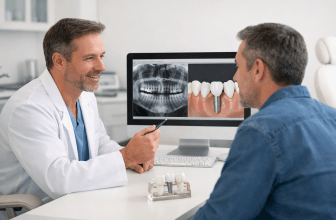
Different clinics may use different imaging protocols or may interpret the available images differently. A panoramic radiograph and intraoral photographs can provide useful information, but they do not answer every diagnostic question. Three-dimensional imaging may be considered when the clinician needs to assess bone volume, anatomical structures, implant positioning or the potential need for augmentation.
Imaging should be selected according to the diagnostic question and radiation principles. A qualified dental professional should determine whether additional imaging is justified. For international patients, it is useful to ask whether a proposed plan was based on recent, diagnostic-quality radiographs and whether a clinical examination is still required before treatment begins.
Remote reviews can help with preliminary planning, but they may not fully assess tooth mobility, gum bleeding, bite relationships, oral hygiene, soft tissues or other findings that require an in-person examination. A final plan may reasonably change after an examination in Turkey.
What to request when comparing conflicting plans
Ask each clinic for a written treatment plan that explains the diagnosis and the purpose of every proposed procedure. Avoid comparing only the total number of crowns or implants or the overall price.
1. An individual tooth and implant assessment
Request the prognosis for every existing tooth involved in the plan. The report should identify which teeth are considered maintainable, questionable or non-restorable and explain why. If implants are proposed, ask about the intended position, available bone and any site-development procedure that may be required.
2. The proposed final prosthesis
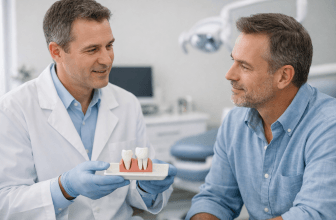
Ask whether the plan involves individual crowns, connected crowns, bridges, implant-supported crowns or a complete-arch fixed prosthesis. Request clarification about which structures support the restoration. A diagram can help you understand how the visible teeth relate to the underlying teeth or implants.
3. The reasons for each extraction and implant
Every extraction should have a clinical reason. Ask whether the tooth is considered non-restorable, has an unfavourable periodontal prognosis or is being removed mainly to accommodate a particular prosthetic design. For each implant, ask why its position is needed and how it contributes to support, distribution or stability.
4. Alternatives and consequences
A responsible consultation should discuss reasonable alternatives, including preservation of suitable natural teeth where appropriate. Ask what would happen if you chose a different option, including the possible need for future repair, retreatment, replacement or additional surgery.
5. Long-term maintenance
Ask how the proposed teeth or prosthesis should be cleaned, how often reviews are recommended and what professional maintenance may be needed. Also ask how complications would be managed if you return to your home country. International patients should request written records, radiographs and details of the materials and prosthesis supplied.
Questions for international patients travelling to Turkey
Before travelling, ask whether the treatment plan is provisional or final and whether an in-person examination could alter it. Confirm how many visits are expected, what happens if additional findings are identified and how communication will be managed after you return home.
It is also important to understand the difference between the surgical stage and the restorative stage. The person planning implant placement and the person designing the final prosthesis should work from the same plan. Ask who is responsible for each stage and whether the clinic will provide a coordinated written treatment sequence.
Do not feel pressured to approve extractions or implant placement immediately because a plan is presented as faster or more comprehensive. A second opinion from a qualified dentist, prosthodontist, periodontist or endodontist may be appropriate when the plans differ substantially or when multiple extractions are proposed.
Risks of choosing by numbers alone
Choosing the plan with the most implants may expose a patient to unnecessary procedures if additional implants do not provide a clear prosthetic or anatomical benefit. Choosing the plan with the fewest implants may also be inappropriate if the distribution, bone anatomy or prosthesis design does not provide suitable support.
Likewise, choosing the plan with the most crowns may overlook the prognosis of the natural teeth underneath. The number of crowns does not show whether the teeth are healthy, adequately supported or being used as bridge abutments. A lower price or shorter proposed schedule should not be treated as proof that a plan is safer or more suitable.
Good decision-making compares outcomes that matter: tooth or implant survival, prosthesis survival, biological and technical complications, treatment time, maintenance, cost and personal preferences. These outcomes should be discussed in the context of your own examination rather than generalized from another patient’s case.
A practical checklist before accepting a plan
- Obtain copies of your current radiographs and relevant three-dimensional images.
- Ask for the diagnosis and prognosis of every tooth involved.
- Identify which teeth will be preserved, crowned, connected, extracted or replaced.
- Ask for the exact final prosthesis design and the number and position of its supports.
- Request the clinical reasons for every extraction, implant and crown.
- Discuss reasonable alternatives, including their risks, treatment time and maintenance.
- Ask what may change after the in-person examination.
- Confirm the follow-up process and what happens if a complication develops after returning home.
- Take time to decide and seek an independent opinion if the plans remain unclear.
Conclusion
Different Turkish dental clinics may recommend different numbers of crowns or implants because they are not always proposing the same diagnosis, prognosis or prosthetic design. The key issue is not whether a plan contains more or fewer units. It is whether the treatment is supported by a clear diagnosis, an appropriate examination and imaging, a logical final prosthesis and a realistic maintenance plan.
Natural teeth and implants can both be suitable in carefully selected situations, but extraction is irreversible and no treatment offers a lifetime guarantee. Your individual suitability must be assessed by a qualified dental professional. Before travelling, ask Estexper Clinic or any provider you are considering to explain every part of the plan in writing so that you can compare clinical reasoning—not just numbers.
Explore our Cosmetic Dentistry services in Turkey for an overview of treatment options and individual assessment.
TREATMENT OPTIONS
Explore Your Treatment Options
Find out more about our services and discuss which options may suit your individual needs.
YOUR NEXT STEP
Discuss Your Questions With Our Team
Request an individual assessment or ask our team about treatment planning and follow-up arrangements.
Medical References
- AAE Position Statement — Implants — American Association of Endodontists.
- Comparative outcomes of endodontically treated teeth versus dental implant-supported prostheses: a systematic review — Acta Odontologica Scandinavica; indexed in PubMed.
- Number of implants placed for complete-arch fixed prostheses: A systematic review and meta-analysis — Clinical Oral Implants Research; indexed in PubMed.
- Number of Implants Placed for Complete-Arch Fixed Prostheses — Consensus Statements — International Team for Implantology.
- Quality Standards for Periodontology and Implant Dentistry — European Federation of Periodontology.
- Clinical utility of dental cone-beam computed tomography: current perspectives — American Academy of Oral and Maxillofacial Radiology consensus guidance.