Written by: Estexper Medical Editorial Team
Medically reviewed by: Dt. Sibel Gokceer
When several teeth are missing, choosing between dental implants and a removable partial denture is not simply a matter of selecting the most advanced option. The more practical treatment depends on your oral and general health, the condition of your remaining teeth, bone availability, treatment goals, maintenance expectations, healing capacity, and budget.
In Short
Neither dental implants nor partial dentures are universally more practical for several missing teeth. Partial dentures avoid implant surgery and may be quicker or more affordable, while implant-supported restorations may offer greater stability for suitable patients who can undergo surgery and maintain long-term care. The right option depends on an individual clinical assessment, including bone, gum health, general health, remaining teeth, treatment goals, and access to follow-up.
Dental implants can provide fixed support for crowns, bridges, or dentures, while a conventional partial denture is removed for cleaning and may replace several teeth without implant surgery. Both approaches can restore important aspects of oral function, but they involve different procedures, recovery periods, risks, and long-term responsibilities.
This guide explains the main differences between dental implants and partial dentures for several missing teeth. It also distinguishes fixed implant-supported teeth from implant-assisted removable partial dentures, because these options are not identical. A qualified dentist or implant clinician must assess your individual situation before recommending treatment.
What Is a Partial Denture?
A removable partial denture replaces one or more missing teeth and is designed to be taken out for cleaning. It is commonly supported or retained by the remaining natural teeth and the surrounding oral tissues. Follow your dental team’s instructions about cleaning and when to remove the denture.
The stability and comfort of a partial denture depend on several factors, including the number and position of missing teeth, the shape of your gums and jaw, and the health and strength of the remaining teeth. A well-designed denture may help restore chewing and appearance, but it can feel different from natural teeth and may move to some degree during use.
Partial dentures generally avoid implant surgery. They may therefore be practical for people who want a non-surgical option, need teeth replaced relatively quickly, or have medical, anatomical, or financial factors that make implant treatment less suitable.
What Are Dental Implants?
Dental implants are surgically placed in the jawbone. After healing, they can support individual crowns, bridges, or a removable denture. When several teeth are missing, a dentist may use implants to support a fixed bridge rather than replacing every missing tooth with a separate implant.
Implant treatment requires assessment of the jawbone, gums, remaining teeth, oral hygiene, and general health. It also involves a surgical procedure and a healing period before the final restoration is fitted. The overall treatment may take several months, depending on the treatment plan and how healing progresses.
Unlike a conventional partial denture, a fixed implant-supported crown or bridge is not normally removed by the patient. This can provide a more stable feeling during chewing, although implants still require careful cleaning and regular professional monitoring.
Fixed Implants and Implant-Assisted Partial Dentures Are Different
The phrase dental implants can refer to more than one treatment design. Understanding the difference is important when comparing treatment plans.
Fixed implant-supported crowns or bridges
Implants may support crowns or a bridge that remain fixed in the mouth. This option can offer stable support and may be attractive to patients who do not want a removable appliance. However, it requires surgery, healing, careful cleaning around the implants, and a suitable foundation of bone and healthy tissues.
Implant-assisted removable partial dentures
In some cases, implants are used to improve the retention and stability of a removable partial denture. The denture is still taken out for cleaning, but the implants can provide additional support, particularly when a conventional denture would otherwise move or feel unstable.
Systematic reviews suggest that implant-assisted removable partial dentures may improve retention, satisfaction, and quality of life compared with conventional distal-extension partial dentures. However, the available studies vary in design, follow-up, and patient selection. This approach still involves implant surgery and maintenance, while preserving the removable nature of the denture.
Dental Implants vs Partial Dentures: Main Differences
Surgery and healing
A conventional partial denture does not require implant surgery. Impressions, examinations, and dental laboratory work are used to design and produce the appliance. Adjustments may be needed after delivery as your mouth adapts.
Dental implants require surgery to place the implants in the jawbone. Healing is necessary before the final crowns, bridge, or denture support can usually be completed. The treatment schedule depends on your anatomy, oral health, the number and position of implants, and the clinical plan.
Stability and chewing
A removable partial denture can restore chewing ability, but its stability depends on the support available from the remaining teeth and tissues. Some patients adapt well, while others notice movement, pressure, or difficulty with particular foods.
Fixed implant-supported restorations are attached to implants and may provide greater stability than a conventional removable partial denture. Implant-assisted removable dentures may also be more secure than conventional distal-extension dentures. Nevertheless, stability does not remove the need for daily cleaning, professional reviews, or careful treatment planning.
Comfort and appearance
Comfort is influenced by the design of the restoration, the health of the gums, the location of the missing teeth, and personal adaptation. Some people prefer the fixed feeling of implant-supported teeth, while others prefer to avoid surgery and accept a removable appliance.
Modern partial dentures can be designed to look natural, but the visible components and denture base may be noticeable in some situations. Implant-supported restorations may provide a different appearance because they can replace teeth without the same type of removable base. Your dentist should explain the expected result for your specific tooth positions and smile.
Maintenance
Partial dentures should be removed and cleaned as instructed. The appliance and the remaining teeth require regular care, and the supporting tissues should be monitored. The denture may need adjustment or replacement over time.
Implant-supported teeth cannot be treated as maintenance-free. Plaque and food debris can collect around implants, crowns, and bridges, making careful brushing and interdental cleaning important. Regular dental examinations help monitor the implants, the restoration, and the surrounding tissues.
Cost and access
Conventional partial dentures are generally less complex than implant treatment and may be more accessible when budget, travel, or healing time is a major concern. Implant treatment involves surgery, restorative components, laboratory work, follow-up, and possible additional procedures, so the total cost can be higher.
However, the most practical financial comparison should consider the complete treatment plan and future maintenance rather than only the initial price. Evidence directly comparing the long-term cost-effectiveness of fixed implants and conventional partial dentures for several missing teeth remains limited and depends on the country, design, materials, and patient needs.
Who May Be a Candidate for Partial Dentures?
A partial denture may be considered when several teeth are missing and the remaining teeth can provide suitable support. It may also be appropriate when a patient prefers a removable option, wants to avoid surgery, needs a relatively straightforward treatment pathway, or has limited bone volume or medical factors that make implants less suitable.
Suitability still requires an examination. Active dental or periodontal problems, poorly fitting existing restorations, or unhealthy supporting teeth may need attention before a partial denture is made. Patients with a history of periodontitis may need particularly careful long-term monitoring of the remaining teeth and supporting tissues.
Who May Be a Candidate for Dental Implants?
Implant suitability is assessed individually. Important considerations include the amount and quality of available bone, periodontal health, oral hygiene, smoking, diabetes control, general health, and the ability to attend follow-up appointments and maintain the restoration.
Active periodontal disease, poor oral hygiene, smoking, uncontrolled diabetes, inadequate bone, and limited ability to maintain follow-up may adversely affect implant treatment. These factors do not automatically determine the outcome for every patient, but they should be discussed honestly during the consultation.
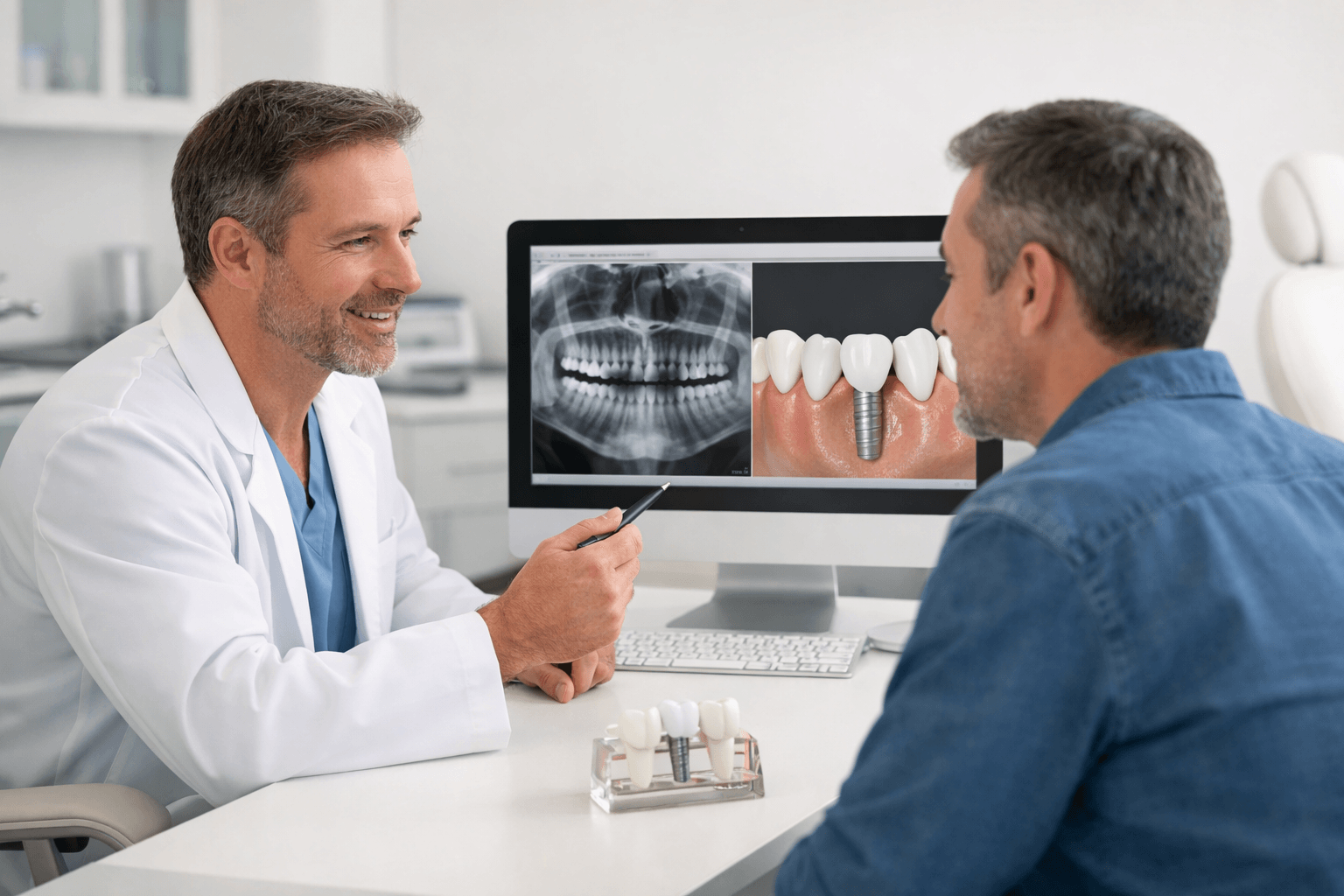
An implant consultation may include a review of your medical and dental history, examination of the gums and remaining teeth, and imaging to evaluate the proposed treatment area. A qualified dentist or implant clinician can then explain whether fixed implants, implant-assisted dentures, conventional partial dentures, or another suitable plan is appropriate.
Quality of Life: What Does the Evidence Show?
Systematic-review evidence indicates that both removable partial denture treatment and implant-supported fixed prostheses can improve oral-health-related quality of life for people with partial tooth loss. In direct comparisons, implant-supported fixed dental prostheses generally produced greater short-term improvements than removable partial dentures.
These findings should be interpreted carefully. The included studies were generally of low or moderate quality, and results can be influenced by prosthesis design, follow-up duration, patient expectations, and clinical selection. A stronger quality-of-life result in one group does not mean that implants are the right choice for every patient.
Research on implant-assisted removable partial dentures also reports improvements in satisfaction and quality of life compared with conventional distal-extension partial dentures. However, the studies are heterogeneous and do not establish that implant treatment is universally preferable.
Risks and Practical Responsibilities
Implant treatment involves surgical and biological risks. These may include infection, implant failure or loosening, difficulty cleaning around the implant, damage to surrounding structures, and the possible need for additional surgery. The restoration may also require repair, adjustment, or replacement.
Partial dentures avoid implant surgery, but they are not free of responsibilities or possible problems. They require cleaning, regular fitting checks, and monitoring of the remaining teeth and supporting tissues. If the denture is poorly maintained or the remaining teeth are not cared for, oral health may be affected.
Neither option should be selected solely because it appears more convenient at the beginning. The treatment that is most practical is the one that fits your health, anatomy, expectations, ability to maintain it, access to follow-up, and financial circumstances.
Preparing for Treatment in Turkey
International patients considering dental treatment in Turkey should request a detailed, individualized treatment plan before travelling. Ask which teeth are to be replaced, whether the proposed implants will support fixed crowns, a bridge, or a removable denture, and how many visits may be required.
It is also useful to clarify what is included in the treatment plan, the expected healing and review schedule, the type of restoration, and what happens if an adjustment or complication occurs after returning home. Your medical history, medication list, smoking status, diabetes control, and previous periodontal problems should be disclosed accurately.
Do not choose a treatment based only on a package price or a promise of rapid completion. A proper consultation and appropriate examination are essential, particularly when implant surgery is being considered. You should also understand how follow-up will be arranged after you return to your home country.
Which Option Is More Practical for You?
A conventional partial denture may be more practical if you want to avoid surgery, need a removable solution, have health or bone-related limitations, or need to control the initial treatment cost. It can be a reasonable way to replace several teeth when the design is suitable and the remaining teeth can be maintained.
Fixed dental implants may be more practical if you strongly prefer a non-removable restoration, have suitable bone and healthy supporting tissues, can manage surgery and healing, and are prepared for meticulous long-term maintenance. Implant-assisted removable dentures may be considered when improved retention is desired but a fully fixed restoration is not appropriate or preferred.
The final decision should be based on a clinical assessment rather than a general comparison. Ask your dentist to explain the expected benefits, limitations, risks, maintenance, total treatment stages, and alternatives for your mouth.
Frequently Asked Questions
Are partial dentures or implants better for several missing teeth?
Neither is universally better. Implants may provide more stable fixed support, while partial dentures avoid surgery and may be quicker or more affordable. Suitability depends on your oral health, bone, general health, goals, maintenance ability, and budget.
Can a partial denture be supported by implants?
Yes. Implant-assisted removable partial dentures use implants to improve support or retention, but the denture is still removable. This is different from a fixed implant-supported bridge or crowns.
How long does implant treatment take?
Implant treatment commonly requires a healing period and may take several months overall. The exact schedule depends on the clinical plan, healing, oral health, and the type of restoration. Your dentist should provide a personalized timeline.
Can smokers have dental implants?
Smoking can adversely affect implant treatment and should be discussed during the consultation. The dentist will consider your smoking habits alongside oral hygiene, periodontal health, bone, and general medical factors.
What is the most important factor after treatment?
Long-term maintenance is essential for both options. Clean the restoration as instructed, protect the remaining teeth, attend recommended reviews, and contact your dental team if you notice pain, looseness, swelling, or difficulty cleaning.
Explore our Cosmetic Dentistry services in Turkey for an overview of treatment options and individual assessment.
TREATMENT OPTIONS
Explore Your Treatment Options
Find out more about our services and discuss which options may suit your individual needs.
YOUR NEXT STEP
Discuss Your Questions With Our Team
Request an individual assessment or ask our team about treatment planning and follow-up arrangements.
Medical References
- Dental Implants: What You Should Know — U.S. Food and Drug Administration.
- Dentures — NHS.
- Dental treatments — NHS.
- Oral health-related quality of life after prosthodontic treatment for patients with partial edentulism: A systematic review and meta-analysis — Journal of Prosthetic Dentistry, indexed in PubMed.
- Are implant-supported removable partial dentures a suitable treatment for partially edentulous patients? A systematic review and meta-analysis — Journal of Prosthetic Dentistry, indexed in PubMed.
- Efficacy and risks of removable partial prosthesis in periodontitis patients: A systematic review — Journal of Clinical Periodontology, indexed in PubMed.
This article is for general education and does not replace an in-person examination or individualized advice from a qualified dental professional.