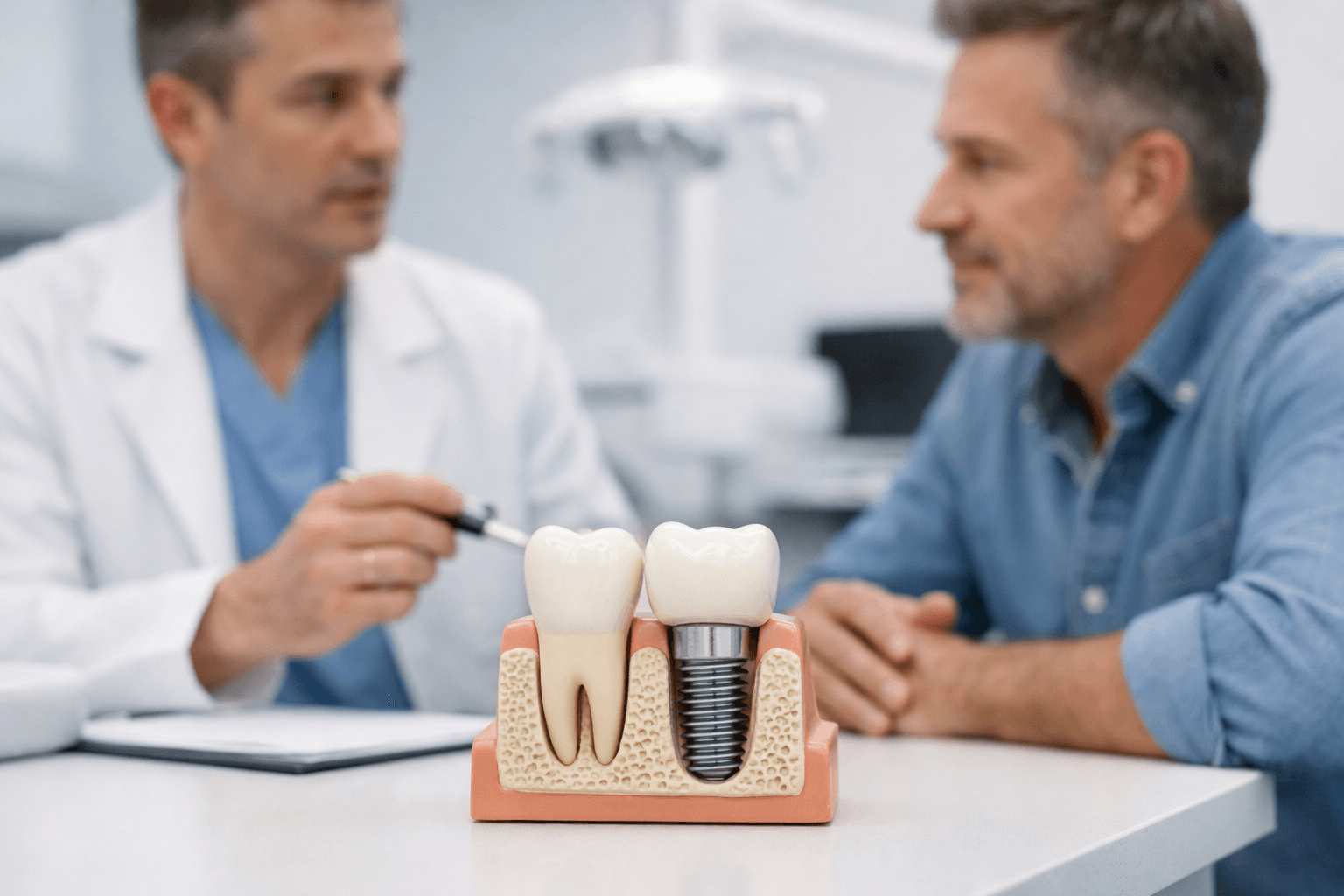
Written by: Estexper Medical Editorial Team
Medically reviewed by: Dt. Sait Gezer
When a dental implant replaces a missing tooth, the visible crown must be attached to the implant restoration. The two main options are screw-retained and cement-retained crowns. Both are widely used and can provide high long-term survival when appropriately planned and maintained.
In Short
Neither screw-retained nor cement-retained implant crowns are universally better. Screw-retained crowns are generally easier to remove for maintenance and avoid residual-cement concerns, while cement-retained crowns may be useful when implant angulation makes a screw-access opening esthetically or functionally unfavorable. The appropriate option depends on the implant position, bite, soft tissues, esthetic goals and the clinician’s ability to control cement and provide future maintenance.
What Is a Screw-Retained Implant Crown?
A screw-retained crown is secured to the implant restoration with a prosthetic screw. The screw passes through an access opening in the crown, usually on the biting surface or on the inner side of a front-tooth restoration. After the crown is tightened, the access channel is sealed with a restorative material.
A main characteristic of this design is retrievability. If the crown needs inspection, repair, cleaning or replacement, the dentist can usually access and remove it without cutting through the restoration. This can be useful during long-term maintenance or if a technical complication develops.
Screw-retained crowns also avoid the use of dental cement around the implant crown margin. This removes the specific concern of residual subgingival cement, which has been identified as a possible risk indicator for peri-implant inflammation. However, screw retention is not free from complications. Screw loosening, screw-access concerns and ceramic chipping may occur, depending on the restoration design, materials, occlusion and other clinical factors.
What Is a Cement-Retained Implant Crown?
A cement-retained crown is attached to an implant abutment using dental cement. The abutment is connected to the implant, and the crown is then cemented over it in a similar way to some conventional fixed dental restorations.
Because there is no screw-access opening through the visible crown, cement retention can offer an intact occlusal or facial surface. This may be particularly helpful when the implant is angled in a way that would place a screw-access opening in an unfavorable esthetic or functional location.
However, the crown margin must be planned carefully, and excess cement should be removed as thoroughly as possible. Cement located below the gumline can be difficult to detect and clean. Residual cement has been associated in the literature with inflammation around implants, especially when the margin is inaccessible or cement removal is incomplete.
Screw-Retained vs Cement-Retained Crowns: Main Differences
1. Retrievability and maintenance
Screw-retained crowns generally have an advantage when future removal is important. A clinician may be able to remove the restoration for examination, tightening, repair or replacement while preserving the crown itself.
Cement-retained crowns can sometimes be removed, but retrieval may be more difficult and may risk damaging the crown or abutment. The degree of retrievability depends on the cement used, crown design and clinical situation.
2. Risk of residual cement
Screw-retained crowns do not require cement around the crown margin, so they avoid complications specifically related to retained cement. This can be important when the crown margin would be positioned deep beneath the gum or access around the implant is limited.
With cement-retained crowns, cement selection, margin design and removal are important. Not every cement-retained crown will cause peri-implant disease; rather, residual cement is a recognized potential contributor to peri-implant inflammation.
3. Esthetics and function
Cement-retained crowns provide a continuous external surface without a screw-access channel. This may support a favorable appearance, particularly in visible areas or when the implant is not positioned along an ideal path for screw access. An uninterrupted occlusal surface may also be useful when a screw-access opening would interfere with the planned bite or weaken the restorative design.
Screw-retained crowns can also achieve excellent esthetic results when the implant is correctly positioned and the access opening can be placed discreetly. In some cases, however, the opening may be visible or affect crown shape and function. The implant angle, crown anatomy, available space and opposing teeth should be assessed individually.
4. Technical complications
Neither retention method eliminates technical complications. Screw-retained restorations may experience screw loosening, damage involving the screw or access channel, and ceramic chipping. Cement-retained restorations may experience loss of retention, crown or ceramic complications, and difficulties associated with cement removal or future retrieval.
An ITI consensus review concluded that both types of implant-supported fixed restorations can achieve high survival, but neither option removes all biologic and technical risks.
What Does the Research Say?
Research comparing the two retention methods has produced a nuanced picture. Some earlier evidence found fewer retention failures with cement-retained restorations. However, the authors emphasized the need for higher-quality, multicenter and long-term randomized trials. Fewer reported retention failures do not, by themselves, establish cement retention as clinically superior overall.
More recent evidence has focused on peri-implant health. A systematic review and meta-analysis of randomized clinical trials found no statistically significant difference between cement-retained and screw-retained prostheses in the risk of peri-implant mucositis or peri-implantitis. The evidence was assessed as moderate certainty.
This does not mean that excess cement is harmless or that cement removal is unimportant. It means that, across the included studies, one retention method did not demonstrate a clear overall advantage for those measured outcomes.
Evidence involving zirconia single crowns has also suggested broadly similar biologic and mechanical outcomes, without identifying a consistent overall clinical winner. Overall, current research supports a patient-specific decision rather than a rule that all crowns should be screw-retained or cement-retained.
When Might a Screw-Retained Crown Be Considered?
A screw-retained crown may be considered when:
- Easy removal for maintenance or repair is an important priority.
- The implant is positioned so the screw-access opening can be placed acceptably.
- The clinician wants to avoid cement-related risks around the implant.
- The crown margin or surrounding tissue makes cement removal difficult.
- The restoration design can provide appropriate strength, esthetics and occlusal function.
These factors do not automatically make screw retention the best choice. The access channel should still be evaluated for visibility, strength, occlusal contacts and overall appearance.
When Might a Cement-Retained Crown Be Considered?
A cement-retained crown may be considered when:
- Implant angulation would place a screw-access opening in a visible or functionally unfavorable position.
- An intact occlusal surface is desirable for the planned bite.
- The crown and abutment design allow the cement margin to remain accessible for inspection and cleaning.
- The clinician can control the cement process and remove excess material thoroughly.
- The restorative requirements favor a cement-retained design after considering esthetics and function.
Cement retention should be planned with attention to the crown margin, soft-tissue anatomy and access for maintenance. If excess cement cannot be predictably controlled or removed, another restoration design may be more appropriate.
How Is the Decision Made?
Before choosing a retention method, the dental team evaluates the implant’s three-dimensional position, angulation, available restorative space, soft-tissue anatomy, neighboring teeth and the patient’s bite. Esthetic expectations and the location of the missing tooth are also important.
The clinician may discuss whether future retrievability is a priority, how easily the area can be cleaned, and whether a screw-access opening would be visible or affect function. The planned crown material and laboratory design are considered as part of the same decision.
For international patients considering implant treatment in Turkey, it is reasonable to ask which retention method is being recommended and why. Patients can also request an explanation of the proposed restoration, maintenance plan, potential risks of screw loosening or cement-related inflammation, and how future repairs would be managed.
Aftercare and When to Contact the Dental Team
After the crown is fitted, oral hygiene and professional follow-up remain important regardless of the retention method. Patients should clean around the implant crown as instructed and attend recommended reviews so the implant, surrounding tissues, crown contacts and occlusion can be assessed.
Contact the dental team if the crown feels loose, the bite changes, chewing becomes uncomfortable, or the gum around the implant becomes swollen, tender or prone to bleeding. A screw-retained crown may be removable for assessment, while a cement-retained crown may require a different approach. Early professional evaluation can help identify the problem before further damage occurs.
Potential Risks and Limitations
Both screw-retained and cement-retained crowns can have biologic and technical complications. These may include inflammation around the implant, changes in surrounding tissues, loosening or loss of retention, ceramic chipping and other restoration-related problems.
The actual risk for an individual patient depends on the restoration design, implant placement, oral hygiene, bite, maintenance and other clinical factors. No online article can determine which design is suitable for a particular implant. A qualified implant dentist or prosthodontist should examine the patient and review the available clinical information before recommending a treatment plan.
Frequently Asked Questions
Are screw-retained crowns better than cement-retained crowns?
Not universally. Both methods can perform well, and current evidence does not establish one as superior in every situation. The decision should be based on implant position, esthetics, occlusion, maintenance needs, tissue anatomy and cement-control considerations.
Which type is easier to repair?
Screw-retained crowns are generally easier to remove for inspection, maintenance or repair. Cement-retained crowns may be more difficult to retrieve without damaging the restoration, although the exact situation depends on the design and materials used.
Are cement-retained crowns unsafe?
No. Cement-retained crowns are an established treatment option. However, residual cement can be difficult to remove and has been identified as a possible risk factor for inflammation around implants. Careful planning and thorough cement removal are important.
Can screw-retained crowns look natural?
Yes. They can provide a natural appearance when implant position and restoration design allow the access opening to be placed and sealed discreetly. The result depends on implant location, crown material and the overall treatment plan.
What should I choose for treatment in Turkey?
There is no single answer for every international patient. Ask the treating dental professional to explain how implant position, esthetic goals, bite, maintenance and future retrievability affect the recommendation. The final decision should follow an individual clinical assessment.
Medical References
- Clinical Performance of Screw- versus Cement-Retained Implant-Supported Fixed Reconstructions: Consensus Statements. International Team for Implantology (ITI).
- Incidence of Peri-implant Disease Associated with Cement- and Screw-retained Implant-supported Prostheses: A Systematic Review and Meta-analysis. The Journal of Prosthetic Dentistry / PubMed.
- Excess Cement and the Risk of Peri-implant Disease: A Systematic Review. Clinical Oral Implants Research / PubMed.
- Retention Failures in Cement- and Screw-retained Fixed Restorations on Dental Implants in Partially Edentulous Arches: A Systematic Review with Meta-analysis. Journal of Advanced Prosthodontics / PubMed Central.
- Clinical Efficacy of Cemented Versus Screw-retained Zirconia Single Crowns: A Systematic Review and Meta-analysis. Peer-reviewed dental literature / PubMed Central.